

Switzerland, Singapore, Luxembourg, the United States and the United Kingdom are seen as the 20 least corrupt nations on earth, according to an annual ranking of impressions about the integrity of nations released in Washington today.
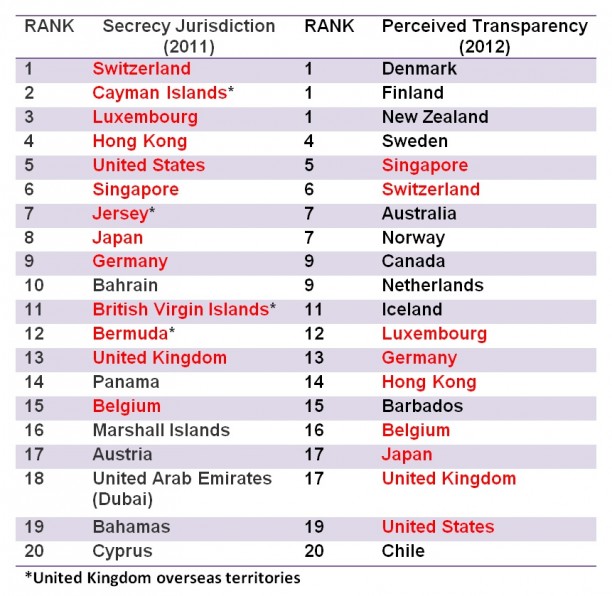
But those same nations also top a separate and less savory ranking–of countries whose corporate and bank secrecy laws make them havens for tax evasion and money laundering by criminals, corporations and kleptocrats alike.
The conflicting snapshots highlight the involvement of wealthy nations in laundering and sheltering the fruits of graft from less developed parts of the world, where corruption consigns millions to poverty.
Monday’s report, by the Berlin-based nonprofit group Transparency International, showed little movement in the relative positions of nations in the ranking, with Afghanistan, Somalia and North Korea appearing as the most corrupt countries on earth.
Greece, whose economic crisis has laid bare a culture of widespread tax evasion, fell to the lowest ranking of European Union nations.
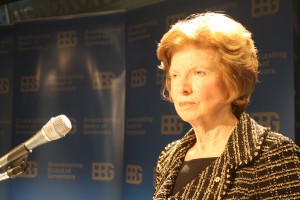
The report shows that corruption persists around the world despite political changes and rising anti-corruption movements, said Huguette Labelle, former chancellor of the University of Ottawa who chairs Transparency International’s board. “What the story tells us this year is that, unfortunately, there has not been great improvement,” she said.
Eurozone countries saw an overall increase in the perception of corruption, and Arab nations of the Middle East remained low in rankings despite widespread political changes since early 2011.
James S. Henry, a former chief economist at McKinsey & Co., criticized the index, saying it portrays corruption as a characteristic of a given country, when in reality graft is made up of borderless networks and systems. “This perception index is a kind of whitewash of that whole story.”
Henry points to New Zealand as a prime example of graft-enabling countries that get good grades according to this scale. “New Zealand is the place of choice for offshore trusts.”
He said the money-laundering industry has poured funds into New Zealand over the last five years, specifically because of its clean reputation.
When countries on the Corruption Perception Index are compared to the Financial Secrecy Index, a ranking from the Tax Justice Network that rates countries’ financial laws, regulations and international treaties, an odd thing happens.
Many of the countries that appear “cleanest” on the Corruption Perception Index — Singapore, Hong Kong, Japan, Switzerland, Luxembourg, Germany, Austria the United Kingdom, the United States, and the Bahamas — also appear conspicuously high on a list of nations whose financial secrecy laws shelter kleptocrats and facilitate thievery.
Alan P. Larson, the chairman of Transparency International’s U.S. chapter, said that the index doesn’t address the health of a country’s anti-corruption laws, but it provides critical insight.
“In a space that otherwise could seem like it’s all about conjecture and rumor and hearsay, it’s been an effort to provide a signal,” that people can use to make decisions, he said. Transparency International does not claim that the index reflects a whole or absolute picture of the world’s corruption networks.
This year’s index ranks 176 countries and territories on a scale of 1 to 100. The higher the number, the cleaner the score. That approach differs from the ordered rankings given in previous years, and seven countries were dropped from the list this year due to a lack of data.
Because of that, officials at Transparency International cautioned against comparing scores this year to those in earlier years.
Despite the disclaimers, the index sparked misleading headlines and overstretched comparisons worldwide. Global headlines following the report’s release focused on year-to-year comparisons that Transparency International warned were not valid.
E.J. Fagan, advocacy coordinator for the nonprofit Global Financial Integrity, said the index can be used as a tool for positive change.
“I understand where [critics] are coming from, but I think they’re wrong,” he said. “I think if they actually look they wouldn’t find any evidence of harm” being caused by the Corruption Perception Index.
He points to Afghanistan’s poor ranking as an example of how the index could increase pressure for reform.
“I think it’s important to remember that you’re talking about cause and effect. There’s causes of corruption, and then there’s the effect. [Transparency International] is measuring the effect.”
About The Author



[…] explanation of FATCA by TJN Senior Adviser David Spencer here.Clean countries do dirty business 100 reportersDec 6 – “Many of the countries that appear “cleanest†on the [Transparency […]