

Nursing Home Crisis: Trump’s "One Big Beautiful Bill" Slashes Medicaid, Delays Staffing Rules, and Threatens Care for Millions of Seniors
By Rebecca Raghunath
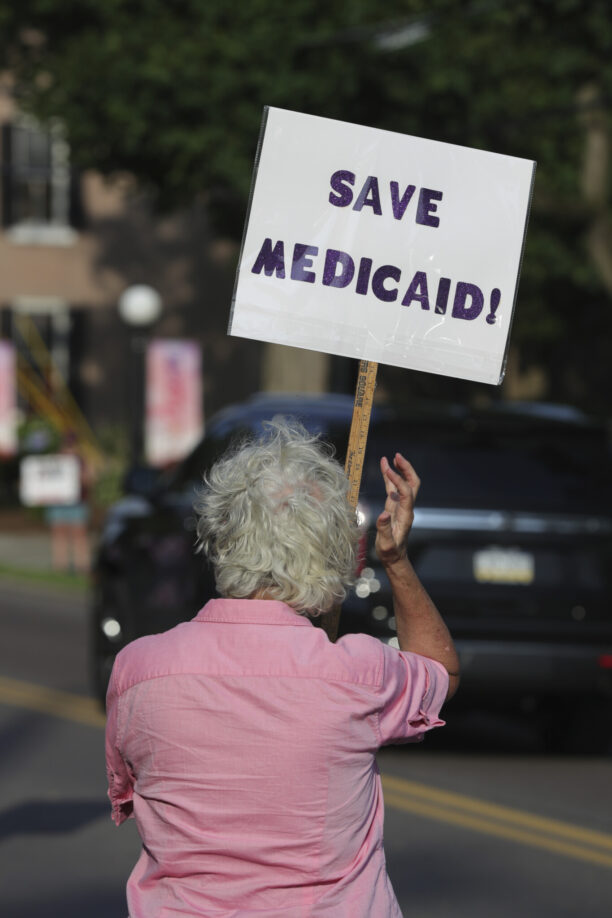
A woman holds a placard during the “Good Trouble Lives On: Dying for Healthcare,” rally at Memorial Park in Danville, Pa. in July 2025. (Photo by Paul Weaver/Sipa USA via AP Images.)
President Donald Trump’s One Big Beautiful Bill is throwing the future of care for more than 1 million nursing home patients into uncertainty, according to experts in eldercare in the U.S.
In addition to slashing Medicaid, which covers the cost of long-term care for indigent seniors, the bill delays minimum staffing requirements at nursing homes, opening the way for a potentially steep drop in patient care across the board.
About 1.3 million senior citizens currently live in nursing homes, with over 62% of them relying on Medicaid to cover the cost of their care.
The new bill puts off enforcement of a minimum staffing mandate for nursing homes until 2034. Experts are predicting that steep cuts to Medicaid will worsen nursing home residents’ quality of life and overall patient care outcomes by heightening staff turnover, with a ripple effect on current nurses, family caregivers, and hospitals.
In New York, for example, a projected $1.6 billion gap between the cost of nursing home care and Medicaid reimbursement is expected to force nursing homes to cut corners on supplies and amenities. Advocates warn that it will become increasingly difficult for nursing homes to provide quality care to seniors, and that many nursing homes will likely close, with upstate rural areas likely to be the hardest hit.
Why Staffing Requirements Matter: Protecting Residents and Staff
“The 3.48 hours is the absolute bare minimum needed to prevent falls and deaths and injuries in hospitalizations,” says Senior Attorney Gelila Selassie at Justice in Aging, a national organization that focuses on affordable healthcare advocacy for seniors.
“The idea is that nursing homes should and may need to go above that floor because residents have different needs, but this is a very low base level. So it’s really concerning that even the base level is being thrown out with this bill effectively with this moratorium.”
A recent study projects that minimum staffing requirements at nursing homes would save 13,000 lives a year. The new law puts minimum staffing off by a decade.

A recent study done by the University of Pennsylvania has shown that the minimum staffing requirements would save up to 13,000 lives a year in nursing homes. In addition, they would reduce the caseload of patients for each nurse in poorly staffed homes by 30 percent. Right now, nearly half of direct care workers leave their jobs each year, often because of “low wages and benefits, overburdening of caseloads, lack of career advancement, and other issues.” The study suggests strengthening staffing standards would ease their workload, and give them incentives to stay with their jobs.
“People are dying from lack of support, and there is a lot of massive turnover in these facilities because people are paid so poorly,” says Selassie.“They have such massive caseloads and workloads that it’s hard to retain staff.”
On top of budget pressures, 135 out of 600 nursing homes in New York currently face chronic staffing and safety issues, according to a report by Crain’s New York. Some 39 percent of certified nursing assistants working in nursing homes rely on public assistance to get by, according to PHI, a health policy nonprofit.
“We see too often in New York State care that is well below what is acceptable with residents, certainly suffering and experiencing bad health outcomes as largely due to inadequate staffing which is a problem across the country,” said Brooks.

Medicaid Savings, Family Burdens, and Community Losses
The House Committee on Energy and Commerce estimates that the measure would result in $880 billion in federal savings, with the total of Medicaid savings projected at $172 billion over a decade, through tighter eligibility checks and by imposing new work requirements on adults.
Researchers and advocacy groups warn that such deep cuts to Medicaid would jeopardize care in nursing homes and overburden families financially, whether for continued care or for transitioning their loved ones to home-based care.
In recent years, “[w]e’ve seen a huge increase in the amount of people who are allowed to receive care at home rather they’re going into an institution,” said Sam Brooks, director of national policy of the National Consumer Voice for Quality Long-Term Care, “but those services are optional.
“[T]hat’s likely what will be cut first from the Medicaid budget.”
Brooks said he anticipates that services that provide high quality home-based care would are among the most vulnerable to cuts, and would have devastating consequences.
“People are dying from lack of support, and there is a lot of massive turnover in these facilities because people are paid so poorly. They have such massive caseloads and workloads that it's hard to retain staff.”
Gelila Selassi, Justice in Aging
Data from CMS reveals that nursing homes with higher averages of nursing care per day have higher overall quality and fewer instances of abuse.
National Consumer Voice for Long-Term Quality Care
The burden for families grows, as government pulls back support for senior care.
Grabowski agreed, “Families are the main providers of long term care in this country, and without them, we’d be lost. They’re going to have to take on a greater burden if nursing homes are unable to meet this demand.”
He worries that the shortage of staff in nursing homes will force more family members who may lack the skills, knowledge, or time to take on caregiving roles—especially for patients with dementia who require around the clock care. He also is particularly concerned about seniors without any family to care for them.
Natalie Kean, director of federal health advocacy at Justice in Aging agreed.
“[B]udget pressures are going to lead to a cut in access to home-based care for older adults,” she said.
Following the Great Recession, all states reduced spending on Home and Community-Based Services in 2011 and 2012. Some cut allowance levels while others slashed the number of beneficiaries receiving home and community services. New York, for example, reduced per participant spending on home health by 27 percent and cut the number of people enrolled in their personal care services benefit by 8 percent.
In New York, state policymakers are preparing for the rocky road ahead to mitigate the harms of Medicaid cuts to long-term care in the bill.
“We don’t want to see anyone lose their coverage, but it’s going to be a really hard environment,” Kean said.
About The Author

Rebecca Raghunath
Rebecca Raghunath is a journalism student at the Craig Newmark Graduate School of Journalism at the City University of New York. She is currently a reporting intern at 100Reporters, focusing on age-related issues.
Subscribe



© 100Reporters 2026. All rights reserved.