



Immigrants are the backbone of America’s long-term care workforce. When an ICE surge swept through Minnesota, the people who feed, bathe, and comfort the elderly grew afraid to leave their homes — and the communities they serve fought back.
Immigrants are the backbone of America’s long-term care workforce. When an ICE surge swept through Minnesota, the people who feed, bathe, and comfort the elderly grew afraid to leave their homes — and the communities they serve fought back.

The noise outside was impossible for the residents of Abiitan Mill City to ignore. It was early January, and hundreds of people had gathered in front of the upscale retirement community in Minneapolis, after reports that U.S. Immigration and Customs Enforcement (ICE) officers were staying at a hotel across the street. Enraged that an ICE officer had shot and killed a 37-year-old mother named Renee Good, the demonstrators blew whistles and horns, banged drums and flashed spotlights in an attempt to disrupt the officers’ sleep.
The residents of Abiitan lean liberal. This past March, many of them teamed up for an improvised “No Kings” rally. Unable to travel to the State Capitol in St. Paul, they took to a nearby corner with their wheelchairs, scooters, and walkers. Most, if not all, opposed Operation Metro Surge, a stance sharpened by the fact that a number of Abiitan employees are immigrants. Still more could be targeted because of the color of their skin.
“[My wife] and I talked to our housekeeper. She is from Ecuador and was scared to death,” said Gary McLean, a retired professor who moved to Abiitan in 2018, after his first wife died of cancer.
McLean is blind and a self-described workaholic, drawn to Abiitan for its robust community life. “I was worried if I stayed in my apartment, all I would do is stay in my den and work. And I knew that was not good.” At Abiitan, he can choose from lectures to volunteer opportunities to Spanish classes. All of it appealed to him.
The sense of connection McLean found at Abiitan includes his relationships with the staff on whom residents rely for anything from meals to help with daily medications to hospice care. The building’s name means “to live in” in Ojibwe, and it serves as a reminder that it stands on what was originally native land.

McLean’s initial conversation with his housekeeper about the ICE surge left him concerned about her safety. When he asked her about buying groceries, she described the terror of imagining ICE officers dragging her from her car in the parking lot. How would her family manage if she were to suddenly disappear?
Indeed, the presence of so many ICE officers on Abiitan’s block proved deeply unsettling for residents and caregivers alike. Abiitan checks employment eligibility against the federal database, E-Verify, to ensure all its employees are working legally. But the direct threat to immigrant workers at Abiitan, regardless of their status, appeared to envelop the entire community. The caregiving team felt an “always on” sense of stress, according to a manager. One employee had been detained and then jailed, an experience so terrifying that they quit their job to move out of the city and live closer to family.
Among the many realities laid bare by ICE activity in cities across the country is the importance of foreign-born workers for the over 9.5 million people in long-term care, the majority of them over 60. Millions more adults may be in need of long-term care but are not currently receiving it — either because they can’t afford it or there aren’t enough workers, according to Emily Wright, the director of research at the National Domestic Workers Alliance (NDWA). Still others rely on unpaid help from family members.
Immigrants have always played a foundational role in the caregiving sector. They are critical to the fabric of our economy, our labor market and our communities.
Haeyoung Yoon, VP of Policy & Advocacy, NDWA
A third of home care workers were born in another country. These workers come from over 163 countries, most prominently from Mexico and the Philippines, according to LeadingAge, a lobbying organization that represents non-profit aging services providers across the U.S. According to PHI, a research and advocacy organization for the direct care workforce, immigrants account for one in four direct care workers — personal care aides, certified nursing assistants and personal attendants. In Minnesota, some 4,000 of the state’s 25,000 nursing home workers were born in Liberia alone, according to Jamie Gulley, the president of Service Employees International Union for Minnesota and Iowa. Gulley estimated that at least 400 union members were unconstitutionally detained during the ICE presence in Minnesota.
As the American population grows grayer — by 2030, people over 65 will outnumber the under-18 population for the first time in U.S. history — the need for quality care will only increase. “People want to age and thrive and live with dignity in their homes rather than being institutionalized,” said Yoon. “So the need for home and community-based care is that much more important.” The direct care workforce added nearly 1.8 million new jobs over the past decade, growing from nearly 3.5 million workers in 2014 to nearly 5.4 million in 2024, according to a recent report from PHI. The field will grow by more than 772,000 new jobs from 2024 to 2034 — an increase of 13 percent — which the report notes is more new jobs than any other single occupation in the country. If the Trump administration holds to its commitment to deporting 4 million people, the direct care industry could lose 274,000 immigrant direct caregivers.
This increased need is happening to a part of the economy that has struggled for decades, even before the Trump administration initiated policy changes to decrease the number of foreign-born workers in the U.S. “COVID exposed the broken and fragmented care system we have in this country,” said Yoon. “This is a sector that was experiencing chronic worker shortages and high turnover, because a segment of workers who provide these critical long-term care and support services were earning poverty wages and had no access to good benefits.”
The result, according to Yoon, is a workforce that simultaneously takes great pride in skills covering everything from CPR to certified nursing assistant training, and yet feels undervalued by a society that is dependent on them.
During COVID, people were dying and we still went to work.
Kpana Farwenel, Nursing Assistant
So said Kpana Farwenel, a U.S. citizen who was born in Liberia and works as a nursing assistant in an Alzheimer’s unit in a Minneapolis suburb. She wishes the government showed more empathy for people who do the kind of work she does.
“I like the work because of the patients, because where they are right now, it’s no one’s [first] choice,” she said. “They didn’t choose to be there.
“So whenever I’m working with them, I picture I’m the one laying in the bed,” Farwenel said. “I’m helping them. I love the patient.”
After a coworker was arrested during the ICE surge, Farwenel grew so fearful that she took her ID with her everywhere, even when she stepped outside for a quick work break. “I still don’t know if she was deported,” she said of her coworker. Even though her children were born in the United States, Farwenel worries constantly about the safety of her son, who goes to college two hours north in Duluth, and her daughter, who is in high school. Her workplace had a designated “safe” room for employees, a private area that ICE could not legally enter without a search warrant. She still felt terrified.
Likewise, Yvonne Gbieor’s dedication to her work was tested in ways she couldn’t have imagined even a year ago. Gbieor arrived in Minnesota as a refugee in 2002, having fled Liberia during that country’s first civil war. Since then, she has worked as a certified nursing assistant in many sectors of the healthcare industry — from a cancer ward to a nursing home to a group home for vulnerable adults to her current job caring for patients in the memory care unit in a long-term care facility in Minneapolis. She finds the work rewarding, albeit challenging. “It’s taught me resilience, strength, endurance, love, passion,” she said.
A permanent resident who is on the path to citizenship, Gbieor was terrified to leave her home, a situation that grew more dire when her family decided to take her granddaughter out of school. (She attended school in the same district where 5-year-old Liam Conejo Ramos — also known as the boy in the blue bunny hat — was detained with his father on his way home from school.)
It kind of broke me. Being a Black person, being an immigrant with an accent….
Yvonne Gbieor, Certified Nursing Assistant
It’s a feeling that Gbieor said hasn’t entirely receded, even though the number of ICE officers in Minnesota has declined significantly. “Every day before I leave my house, I still pray to God that he will take care of everything.”
During the height of Operation Metro Surge, Gbieor’s employer told their staff that they wouldn’t be written up if they felt unsafe coming to work. And there were days when Gbieor didn’t leave her home. But those absences were unpaid. “I have a family to feed,” she said. “Even though I was so uncomfortable, when I was leaving my house in the morning, I had to look left and look right, look around my surroundings to see who was watching me, see who was following me and all those kind of things. It had a serious impact on me, but I kept pushing.”
Suleiman Ahmed has spent his career helping older Somalis navigate American healthcare. Then his clients stopped leaving home.
Beyond the clinical jobs, foreign-born workers make up more than 30 percent of housekeeping and maintenance staff in nursing homes, according to LeadingAge. “Marie,” who asked to use her middle name in order to speak freely, is an executive who oversees the nutritional department of a Minnesota company that owns assisted living facilities. The overwhelming majority of her employees are immigrants, mostly from Latin America and countries in East and West Africa. “Even though they are here legally, their skin says, ‘Stop me,’” she said.
Their work is integral to the direct-care economy. “We see these people three times a day,” she said of her staff. “We know when they’re sick because they’re not eating; we notice those things. If you really want to know what’s going on with the patient, you ask somebody in housekeeping or you ask somebody in the kitchen.”
As the ICE surge in Minnesota ramped up, worker shortages meant the facilities Marie oversees needed to get creative and implement emergency menus that could be prepared by a skeleton staff — frozen lasagna you could heat and serve, canned fruit instead of freshly cut, picnic-themed meals to distract patients from the fact that they were using paper plates. She told employees to call her directly if they didn’t feel safe coming to work, mostly because she’d built up enough relationships with her staffers that they knew she wouldn’t retaliate against them or make them feel like their job was in jeopardy. “I’ve been in the healthcare industry for 30-plus years,” she said. “We’re a very resilient bunch, but that bunch is getting tired.”
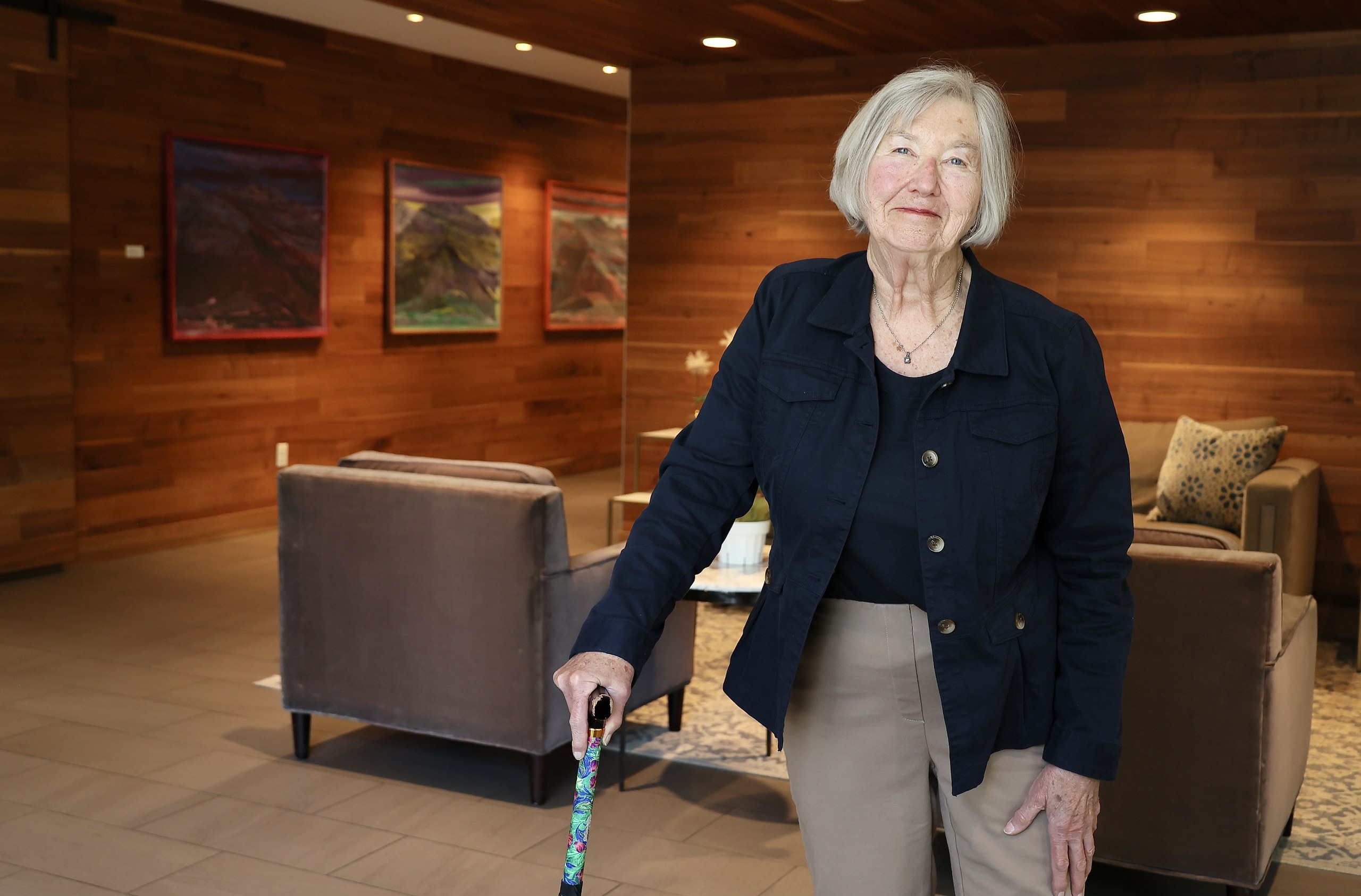
The strain on their foreign-born staff was not lost on the residents of Abiitan. “They were afraid to drive,” said Karen Mitchell, a retired nurse practitioner who has lived at Abiitan since 2022. “They were afraid to go to the grocery store and they were running out of food.” Concerned, Mitchell talked with a manager. They organized an on-site food bank so that the workers didn’t need to go to shops. Mitchell took the role of communicating with the staff about what they needed. Residents were careful to put the food in the staff break room so that employees could take what they needed in private. Abiitan’s men’s group joined the effort, teaming up with a local food shelf to provide even more items. The management team facilitated rideshare options for staff and also adjusted their own schedules — including working overnight shifts — so that they could offer employees escorts to their cars.
“Being able to do something felt so good for all of us,” said Mitchell. “You felt like you were at least helping a little bit.”
Several Abiitan employees put Post-it notes on the door to the food shelf thanking the residents for their thoughtfulness. “I frequently encountered employees getting food and they all were — I mean, tears in their eyes — expressing their gratitude” to the residents and to the building’s management, said McLean.
Gbieor said that the concern and care she received from residents at her facility buoyed her, as did the reaction of the city itself. “I was really amazed to see the way people stood up for us during the ICE season,” she said. “And I didn’t regret living here. I tell people all the time that Minnesota is cold, but Minnesota is a very good state to raise your family.”

Elizabeth Foy Larsen is an award-winning freelance writer and editor whose stories have appeared in publications including The New York Times, Los Angeles Times, Mother Jones, The Daily Beast, Slate, Travel + Leisure, Parents, Family Circle, and StarTribune. Her reporting on the sex abuse scandal at the Children’s Theatre Company was the initial inspiration for MAGIC & MONSTERS.
© 100Reporters 2026. All rights reserved.