The following story was originally published June 17, 2013 and is being republished due to renewed interest following a related article in the current edition of the New Yorker.
To protect profits threatened by a lawsuit over its controversial herbicide atrazine, Syngenta Crop Protection launched an aggressive multi-million dollar campaign that included hiring a detective agency to investigate scientists on a federal advisory panel, looking into the personal life of a judge and commissioning a psychological profile of a leading scientist critical of atrazine.
The Switzerland-based pesticide manufacturer also routinely paid “third-party allies” to appear to be independent supporters, and kept a list of 130 people and groups it could recruit as experts without disclosing ties to the company.
Recently unsealed court documents reveal a corporate strategy to discredit critics and to strip plaintiffs from the class-action case. The company specifically targeted one of atrazine’s fiercest and most outspoken critics, Tyrone Hayes of the University of California, Berkeley, whose research suggests that atrazine feminizes male frogs.
The campaign is spelled out in hundreds of pages of memos, invoices and other documents from Illinois’ Madison County Circuit Court, that were initially sealed as part of a 2004 lawsuit filed by Holiday Shores Sanitary District. The new documents, along with an earlier tranche released in late 2011, open a window on the company’s strategy to defeat a lawsuit that, it maintained, could have effectively ended sales of atrazine in the United States.
University of California at Berkeley.” credit=”University Photo
The attorney who won a $105 million settlement from Syngenta, maker of the highly profitable weed killer atrazine, will represent a leading scientist and critic of atrazine who is accusing the University of California, Berkeley of overcharging him on laboratory fees.
The scientist, Tyrone Hayes, has been embroiled in a bitter public clash with Syngenta over his research, which shows that male frogs exposed to atrazine develop as females, able to lay eggs.
On Thursday, Stephen J. Tillery, who represented water districts in an eight-year class action suit against Syngenta, said he would represent the scientist in his current dispute with the University of California. Hayes maintains that his lab fees have gone up by 295 percent since 2004, while fees for his colleagues have risen by only 15 percent.
Tyrone Hayes says his lab UC-Berkeley may have to close in 30 days for lack of funds.” credit=”
In an interview, Hayes, a professor of integrative biology at University of California, Berkeley, said the university withdrew the last $20,000 from his lab’s account this week, leaving him with no funding for his research. University officials advised him that because of the shortfall, his lab will close within 30 days.
Hayes said word of his lab’s impending closure came five hours after he sent a detailed letter to the school’s vice chancellor protesting what he described as exorbitant lab fees and inequitable charges by the university over the past 10 years.
Hayes has publicly questioned whether UC-Berkeley is penalizing him for his outspoken criticism of atrazine because of a five-year $25 million research agreement awarded in 1998 between University of California-Berkeley and Novartis, a parent company of Syngenta. The office of the vice chancellor said that there is no current institutional agreement between the school and Syngenta.
Tillery’s class action suit against Syngenta uncovered documents, disclosed by 100Reporters in June, that the company had spent millions of dollars on a secret campaign to discredit atrazine’s critics. The documents also showed that Syngenta had tried to dissuade Duke University from hiring Dr. Hayes.
The company did not respond to a request for comment on the funding issue facing Hayes’ lab.
John Huelsenbeck, chairman of the department of integrative biology, said he is trying to work out a resolution.
“No one wants this to happen. It’s basically a funding issue,” Huelsenbeck said. “It’s disruptive to the research, and we don’t want to see frogs with scientific importance euthanized. ”
University spokesman Dan Mogulof said Hayes’ lab is not being closed and he was unaware of a 30-day deadline. He said money was taken from his account to cover routine university charges.
“At its heart, this is a business issue. There is nothing to suggest any action against Dr. Hayes,” Mogulof said.
Each year, nearly a dozen labs at the school face a similar situation, he said. “This is happening more often due to a decrease in federal funding.”
However, Mogulof said that at one time UC-Berkeley had sought to establish a $3 million endowment to support Hayes’ laboratory.
Since this dispute became public, Hayes said individuals and organizations have expressed interest in funding his lab. He said, however, that he first wants to resolve the fees charged to his lab by the university.
Controversy has roiled over Hayes’ work for more than a decade. Recently unsealed court documents from the Tillery class action lawsuit against Syngenta Crop Protection reveal an orchestrated campaign by the corporation to discredit Hayes by commissioning a psychological profile of him, tracking him at speaking engagements, videotaping him, baiting him through emails and contacting Duke University to insure it did not hire Hayes.
Mogulof said the charges to Hayes’ lab are not excessive, and the university posts a standardized list of fees. However, that list fails to reflect discounts and other modifications that some faculty members have negotiated, Hayes said. When asked about the fees each individual faculty member pays, Mogulof wrote in an email, “That sort of researcher-specific data is never posted on the web.”
Hayes has received international prominence for his work on the endocrine disrupting effects of the herbicide atrazine, manufactured by Syngenta Crop Protection. Atrazine is widely used on corn, timber and golf courses in the United States, though the European Union ended its use a decade ago.
His findings on sexual abnormalities and on risks from exposure to endocrine disrupting chemicals at low levels, even below regulatory guidelines, have altered understanding of how endocrine disrupting chemicals affect animals and humans.
Syngenta has criticized Hayes’ research, and maintains research the company funded to satisfy the concerns of federal regulators was unable to replicate his findings. Nevertheless, other scientists have taken issue with the quality of Syngenta’s research.
Hayes’ history of confrontations with the herbicide manufacturer dates back to 1997 when he received funding from Novartis Agribusiness. Hayes said that when he got research results Novartis did not expect or want, the corporation refused to allow him to publish them. He secured other funding, replicated his work and released his findings: exposure to atrazine creates hermaphroditic frogs. That started an epic feud between the scientist and the corporation.
Mogulof denied that feud has spilled onto the UC-Berkeley campus and said the university does not allow funders to interfere with academic freedom. In fact, he noted that the university publicly supported Hayes when Syngenta filed an official complaint against him with the university in 2010..
When asked about that support in 2010, Hayes said he would not characterize it as help or support. He said he had complained to the university on a number of occasions, reported harassment and threats from Syngenta, and asked for help from the school. He was told the school’s legal counsel represented the school, not individual faculty members and he was essentially on his own. In light of that response, Hayes maintained his emails, the basis of Syngenta’s ethics complaint against him, were his personal business and they had not been written on the university’s computer system. The school agreed and the complaint was dismissed.
Jay Feldman, executive director of Beyond Pesticides, a not-for-profit in Washington, D.C., said “Dr. Hayes’ work is landmark, and essential to our greater understanding of chemicals at levels missed by our regulatory agencies. We need more debate and national attention on these low-dose exposures to endocrine disrupting chemicals.
“He has shown the impact of exposure on amphibians, on their sexual development, demasculinization, hermaphrodism . . . serious impacts on the sustainability to our planet and life as we know it.”
Feldman said Hayes’ work was critical in showing why it is important to switch pest management away from chemicals in favor of techniques without chemicals.
“We need more funding in this area, not closing a leading lab,” Feldman said.
Hayes said his goal in writing his letter Aug. 12 was simply to ask for fair treatment from the university.
Currently, he is paying about $60,000 a year, including a materials fee, to the Office of Lab Animal Care at UC-Berkeley. The university, he said, is charging him up to 21.5 times more a day for his lab animals than some of his colleagues. He said that he and his students perform their own animal care and maintenance. Other labs that maintain their own animals are not charged this materials fee, he wrote.
In his letter to the vice chancellor, Hayes wrote that Berkeley has raised charges on his lab by 295 percent since 2004, but charges for his colleagues have risen only 15 percent during that period.
To see a tenured professor struggling to keep his lab afloat is unusual, said Emily Marquez, a staff scientist with Pesticide Action Network, an international not-for-profit. Marquez worked in Hayes’ lab when she was a student at University of California-Berkeley.
“If his animals are euthanized, the loss would be a setback not only for the scientific community but for the larger community,” she said. “He takes it upon himself to go out to the public and speak about his work. He doesn’t get any academic accolades for that.”
To protect profits threatened by a lawsuit over its controversial herbicide atrazine, Syngenta Crop Protection launched an aggressive multi-million dollar campaign that included hiring a detective agency to investigate scientists on a federal advisory panel, looking into the personal life of a judge and commissioning a psychological profile of a leading scientist critical of atrazine.
The Switzerland-based pesticide manufacturer also routinely paid “third-party allies” to appear to be independent supporters, and kept a list of 130 people and groups it could recruit as experts without disclosing ties to the company.
Recently unsealed court documents reveal a corporate strategy to discredit critics and to strip plaintiffs from the class-action case. The company specifically targeted one of atrazine’s fiercest and most outspoken critics, Tyrone Hayes of the University of California, Berkeley, whose research suggests that atrazine feminizes male frogs.
The campaign is spelled out in hundreds of pages of memos, invoices and other documents from Illinois’ Madison County Circuit Court, that were initially sealed as part of a 2004 lawsuit filed by Holiday Shores Sanitary District. The new documents, along with an earlier tranche released in late 2011, open a window on the company’s strategy to defeat a lawsuit that, it maintained, could have effectively ended sales of atrazine in the United States.
Campbell's Soup announced this year that it would discontinue the use of BPA in its cans. / REUTERS
In a recent decision to permit continued use of a chemical in food packaging that research has tied to cancer, diabetes, miscarriages and developmental delays in children, the U.S. Food and Drug Administration has favored two industry-funded studies over more than 1,000 independent analyses finding the chemical poses serious risks to human health.
The FDA’s decision on bisphenol A was not an isolated, or even unusual, call. For more than 30 years, U.S. regulatory agencies have relied on an arcane rule for approving chemicals used in everything from food packaging and drugs to pesticides and electronics, one that favors industry-funded reports over independent academic research.
That process exalts studies that follow design standards known as “Good Laboratory Practice,” and discounts research that may be confirmed through peer review, but do not follow the GLP protocols. Favoring GLP has given a green light to hundreds of chemicals and products from nicotine to atrazine linked to human disease and chronic health conditions.
Critics contend that the protocols, defended by the chemical industry, have become an arbitrary barrier, shutting out important independent research. In the case of BPA, a common chemical used in food packaging, adherence to the protocol largely overrode studies linking BPA to breast cancer, prostate abnormalities, low sperm count, developmental disorders, heart disease, obesity and diabetes.
Good Laboratory Practice standards are used almost exclusively in industry-funded studies, but are seldom followed by independent academic and government researchers. The guidelines establish standards for the conduct of research–covering issues like recordkeeping, sample sizes and the training of technicians–but not its underlying quality.
The risks of using Good Lab Practice standards as the defining mark of good science were underscored in the government evaluation of BPA, a review by 100Reporters has found.
One of the two industry-backed studies that government regulators relied on to clear BPA tested the chemical on rats that were resistant to its harmful effects. Nevertheless, the study followed the standards of Good Laboratory Practice, and so passed regulatory muster.
BPA is a plastic hardener widely used in the epoxy resin lining of food and drink cans, dental sealants, cash register receipts, electronics, compact discs and medical devices. The Centers for Disease Control and Prevention found BPA, a known endocrine disruptor, in more than 90 percent of urine samples representative of the U.S. population as a whole.
“It’s not the flaws of GLP per se but blind adherence to GLP,” said Dr. Jennifer Sass, senior scientist with Natural Resources Defense Council. “It’s scientific stupidity.”
The organization filed a petition in 2008 to prohibit use of BPA in human food and packaging. Sass said the FDA’s 15-page letter rejecting the petition found fault with individual studies but failed to look at the overwhelming body of evidence.
“There is no way you can say bisphenol A is safe,” said Sass. “Not one independent study says it’s safe.
“Really, this just kicks the can down the road.”
Gold Standard
Every person in Europe and the United States is affected by the regulatory embrace of Good Laboratory Practice. It is the standard for evaluating the safety of food, color additives, animal food additives, human and animal drugs, medical devices for human use, biological and even electronic products.
The federal regulation establishing GLP includes dozens of requirements from the size and design of the laboratory to clothing worn by lab workers, methods for archiving data, record keeping, equipment calibration and maintenance. What it fails to assess is rigor of the research design, integrity of the science and influence industry may exert over the outcome.
Even critics of GLP are not calling for its abandonment. Rather, they want all valid research to be considered equally in the regulatory process rather than giving greater consideration to GLP studies.
Dr. Frederick vom Saal, professor of biological sciences at University of Missouri, Columbia, said GLP creates an evaluation process so fundamentally flawed it puts the public at risk.
“The system is profoundly broken and corrupted by industry influence,” vom Saal said. “This is smoke and mirrors at the regulatory level to make it seem that industry science is good and academic science is unreliable.”
GLP studies are almost always private, industry-funded research. Academic and government research facilities rarely adhere to GLP because it is expensive and burdensome.
GLP is “FDA’s misguided gold standard,” vom Saal said, noting even the terminology “good laboratory practice” is used to imply good science comes from GLP labs and pseudo-science comes from non-GLP labs.
Born by Scandal
GLP was devised and implemented in the late 1970s following a scandal over poor quality research and altered data at a number of private research companies. A criminal investigation resulted in convictions for three executives of Industrial Bio-Test Laboratories charged with deliberately doctoring data. No academic labs were involved in the scandal, but the GLP standard that emerged is now used by regulators in the United States and Europe.
“I’d like to see the name changed. GLP does not guarantee good science. It’s just about good recordkeeping. Let’s call it GRKP . . . Good Recordkeeping Procedures,” vom Saal said. “People doing GLP research often have no knowledge of the science underlying their work. They are doing prescribed work using 20th century technology.”
That happens, he said, because the objective of corporately-funded research is to protect the profitability of the product.
In the case of BPA, that’s a $10-billion-a-year industry, said a colleague of vom Saal, Dr. Wade Welshons, associate professor of veterinary biomedical sciences at University of Missouri.
“Ten billion dollars a year is about $25 million a day or a million dollars an hour,” Welshons said. “For every hour the regulation of BPA is delayed, the industry is making a million dollars.”
Citing a jump in production from six billion pounds in 2004 to over eight billion pounds today, Welshons called the growth “extraordinary. The money involved runs over every human health concern,” he said.
In an emailed response to questions from 100Reporters, the FDA stated that it did not rely solely on GLP research in ruling on bisphenol A, though it acknowledged using industry-funded research in a crucial way: to set the level at which regulators would measure detectable damage from BPA exposure. Based on that calibration, the FDA concluded that said the levels at which BPA leached into food did not pose a serious risk to human health.
According to figures from the Center for Responsive Politics, the American Chemistry Council, the main industry representative for BPA, dramatically intensified its lobbying efforts in the final three months of 2011, just as government regulators turned to making health assessments of BPA and formaldehyde, a known carcinogen. The council spent $5.37 million lobbying Congress and government agencies in the last quarter of 2011, more than double their spending the year before.
The American Chemistry Council responded by email to written questions, indicating it supports giving “appropriate weight” to both GLP and non-GLP research. It said GLP studies should carry greater clout because they permit for more meaningful statistical analysis.
These studies typically submit all raw data, allowing government regulators to review and audit research studies. In contrast, the council said, non-GLP studies published in peer-reviewed academic journals are typically limited in the thoroughness of reporting, and the FDA is often unable to validate the studies.
Countering that notion, vom Saal said it’s routine for scientists to duplicate findings of research published in peer-reviewed journals. He said GLP studies often rely on outdated, insensitive measurements designed to find nothing . . . “like looking for a landing spot on the moon using binoculars.”
He noted that one of the two initial studies the FDA relied upon in approving BPA used over 8,000 rats and found no harmful results from exposure to BPA. But the study, published in the journal Toxicological Sciences 10 years ago, used a strain of resistant animals. The researcher, Dr. Rochelle Tyl of Research Triangle Institute, N.C., responded to criticism from other scientists by duplicating the research with non-resistant mice and said that once again there was negligible damage from BPA exposure, proving the chemical is safe.
Vom Saal said large sample sizes do not insure accuracy but demonstrate “no understanding or training in statistics.” Using resistant animals, he said, is another way to insure no harm is found from BPA exposure.
A group of 37 scientists criticized the two BPA studies in letters published in the scientific journal Environmental Health Perspectives. In response, Tyl defended GLP as the only international legal framework that establishes quality standards and independent government-mandated inspections of research facilities.
Another scientist who requested anonymity for fear of losing research funding if he spoke openly said, “Unfortunately, at the EPA, FDA and other regulatory agencies, the way it’s set up is that industry pays the bills, and thus they kind of set the standards and review practices.”
Although the European Food Safety Authority, like the FDA, favors GLP, cracks are eroding support of GLP in the European Union. The EU, Canada and 11 U.S. states have banned BPA in baby bottles. Now a new French initiative calls for elimination of BPA for all food packaging by 2014. Britain and a number of EU members are objecting to the French move. They claim it is based on bad science, and would breach trade rules.
Too Expensive for Academic Labs
Dr. Jason Rohr, an integrative biologist at the University of South Florida, is a leading researcher on atrazine, but his lab, like most academic labs, does not adhere to GLP protocol.
“I’ve never made an attempt to get it. It’s a lot of work, and I’ve never felt it improves the science at all,” he said. “It is record keeping, not science. You can design an experiment to intentionally not find results and still meet GLP.”
Rohr and other researchers contend that GLP gives a false sense of authority to often dubious research and tends to mask conflicts of interest and serious flaws.
Rather than GLP, academic scientists rely on control groups and peer review prior to publication of their research to assess the quality and integrity of the science.
“Peer-review offers the opportunity to evaluate the science. GLP does not,” Rohr said.
In a paper published in Conservation Letters in 2010, Rohr reviewed conflicts of interest with industry-funded GLP research conducted on BPA and atrazine, and found numerous instances of such conflicts. In one, for example, an industry-funded researcher did a comprehensive analysis of research on atrazine, citing 144 misleading statements or errors. Of these, 96.5 percent of the cited “mistakes” would have benefitted Syngenta Corp., the manufacturer of atrazine–which also happened to be the company financing the review.
“Fortunately, misconceptions and biases of the magnitude presented here are relatively rare in peer-reviewed literature,” Rohr wrote, adding that “although the peer review system is not infallible, there is no indication that it is widely corrupted either.”
When evaluating the safety of atrazine, EPA regulators did not consider Rohr’s research showing harmful effects on fish and amphibians.
“The science advisory panel at the EPA for the most part ignored most work from non-GLP labs,” he said, noting that adhering to the Good Lab Practice standard is burdensome, and comes at a cost.
“GLP is time consuming, and I’d rather answer additional (scientific) questions,” Rohr said. “I don’t have any problem with GLP, but it becomes problematic and increases the risk to society when agencies place greater weight on GLP studies over other studies.”
Sass, of the National Resources Defense Council, said the dispute over GLP is political, not scientific. She contrasts industry research versus academic research, explaining industry designs research to look for a specific risk assessment.
“Academic research is designed to look for the unknown, to move science forward, often using new methods to get to places scientifically we’ve never been to before,” she said.
Dr. Olga Naidenko, a senior scientist with the not-for-profit Environmental Working Group, views GLP as an evolution from the 1970s, when there was fraud in reporting research results, to today, when GLP provides transparency and oversight but sometimes flawed science. It is now widely recognized GLP is not enough. Government approval of the arthritis drug Vioxx, she noted, was based on GLP research, only to force the drug from the market after it was linked to heart attacks, strokes and deaths.
Naidenko said regulatory agencies overwhelmingly rely on GLP and don’t know how to incorporate academic research into their evaluations. As a result, she said, many chemicals previously considered safe under the GLP model of evaluation may not, in fact, be safe at all.
By relying on GLP, vom Saal said, government regulatory agencies are acting like trade organizations, protecting the marketplace. He likens regulatory approval of BPA to the government’s earlier handling of nicotine. In the early 1990s. virtually everyone in science and medicine knew nicotine was bad, but the government allowed industry-funded studies to cast doubt on the health risks of smoking cigarettes.
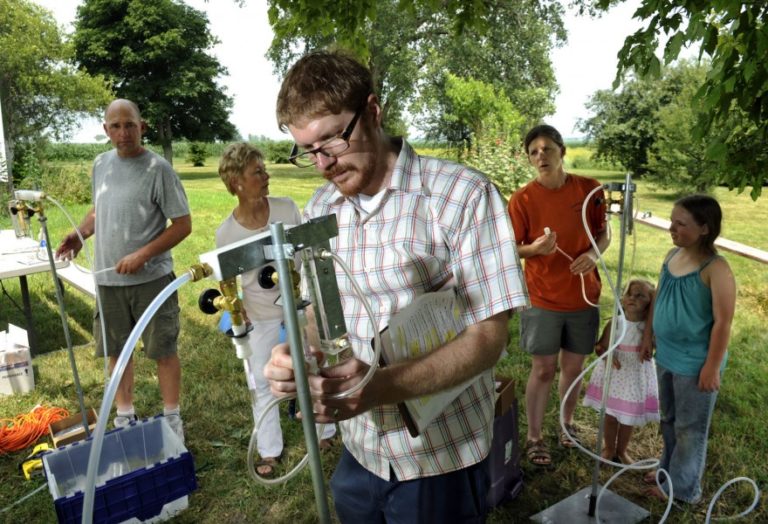
Brian Poeppel, left, his wife Anita, right, and farmer Jane Heim, second from left, listen as Karl Tupper gives instructions for a device to measure chemical drift. At far right, are the Peoppel’s children, Laura, 3, and Lucy, 9. /Photo by David Zalaznick
By Clare Howard
Brian and Anita Poeppel were brimming with excitement when they left their farm just outside Chicago and moved to 15 acres they planned to farm organically in Central Illinois. Trouble started before the first harvest. It was invisible, sometimes drifting into the big old farmhouse on a summer breeze, sometimes blanketing the children’s backyard swing set, always teasing with its anonymity and guile.
The Poeppels had known from the beginning theirs would be an organic farm surrounded by a sea of farms using chemical fertilizers and pesticides. To the young couple, it had at first seemed reasonable that organic farmers and chemical farmers could coexist. The Poeppels visited their new neighbors and talked about their hopes and dreams of a healthy life.
For six years, the couple struggled when pesticides sprayed on nearby farms drifted over their property. Their daughters stayed indoors gazing out at their swing set, wading pool and favorite climbing trees. Once, Brian Poeppel, 40, was arrested for trespass. He had tried to block a chemical applicator working on a nearby field, saying the pesticides were blowing directly onto the Poeppel’s property. He was convicted of disorderly conduct, fined $500 and put on probation for two years.
Then the Poeppels changed their strategy. They stopped pleading with neighbors, and started filing complaints with the Illinois Department of Agriculture. They organized a statewide network of farmers to investigate pesticide drift. The Poeppels signed up for the Drift Catcher program conducted by the Pesticide Action Network, a not-for-profit group. Organic farmers 2,000 miles west of them organized a movement they are calling the Pitchfork Rebellion, and turned to independent urinalysis testing.
Their independent analysis is producing a startling picture of the tendency of pesticides sprayed in one area to migrate on the air and in water supplies. Along with new research on the potential health effects of these chemicals, these analyses are prompting a new vision of chemical drift as a form of trespass, willful negligence and property damage.
“The system is phenomenally productive with huge yields, small amounts of work and little fossil fuel input,” said Dave Kennell, associate director of the Center for Renewable Energy at Illinois State University. “But now we know about the dead zones (in oceans), human health effects, death of the soil, erosion and resistant pathogens and weeds.
We can’t discount that when we look at the big picture,” Kennell said.
A French court issued a historic verdict finding biotech giant Monsanto guilty of pesticide poisoning of a 47-year-old French grain farmer who suffered neurological damage including memory loss, headaches and stammering after a 2004 incident when he inhaled the herbicide Lasso, a product banned in the European Union in 2007 but still registered and used in the United States.
In a statement, the company said it had complied with safety and marketing guidelines in force at the time, and that it plans to appeal.
Karl Tupper prepares a PowerPoint presentation for a group of Illinois organic farmers in a barn. / Photo by David Zalaznik
Gathering evidence
On a Sunday in July, already hot and humid by mid-morning, two other organic farm families joined the Poeppels for a training session to learn how to install and operate Drift Catcher monitoring equipment. Karl Tupper, then a scientist with PAN, flew from California to conduct the training. Organic farmers Greg and Janet Morse rumbled into the barnyard on their 1980 Honda motorcycle. Jane Heim drove down from her farm near Paw Paw, Ill.
Training started in the barn with a PowerPoint presentation projected onto a white sheet hung from the rafters. In other regions of the country, Tupper told the group, evidence gathered through Drift Catchers helped shape public policy. He explained that spray drift in the form of droplets or dust that moves off the targeted site is regulated, but that drift that has volatilized, or turned to vapor, is unregulated by the EPA and by state agencies. Drift Catcher monitoring equipment detects both types.
Laboratory analysis of results from each farm can cost more than $6,000.
“This country has built an agricultural economy around toxins,” Tupper said. “These pesticides are in our bodies. Drift is inevitable. But the chemical industry wants to say drift is okay as long as it is below some safe amount.
“How do you define that safe amount, especially when a profit is made fm these chemicals, but the cost of drift falls on the victim?” Tupper asked.
The Morses have farmed 365 acres without chemicals for 23 years in the Crow Creek valley near Putnam, Ill., and say they have fought all that time against chemical drift. In 1999, they said, spray drift damage covered their entire farm. But the source was not clear. The couple worries that after years of effort and expense to earn the U.S. Certified Organic designation for their farm, they could lose their status because of drift.
Greg Morse and his wife continue to file complaints even though little is done. They said they face regular retaliation, insisting that spray planes working on nearby farms often buzz their house. They took extra precautions when their children were growing up. They feared their son, a long-distance track runner who often ran through their timberland, would be deliberately sprayed as retaliation for his parents’ complaints.
“One time, I just went berserk when a plane buzzed our house and turned on the sprayer over our farm,” said Morse, 64. “I took a shotgun and play acted. There was no shell in the gun. A Putnam County sheriff came out to the farm and said he’d heard I was shooting at crop planes. But we’re in Bureau County, so within three hours a Bureau County Sheriff shows up.”
Anita and Brian Poeppel listen in the lower level of their central Illinois barn to a PowerPoint presentation by Pesticide Action Network scientist Karl Tupper. / Photo by David Zalaznik
Asked about the incident, Bureau County Sheriff John Thompson said his deputy responded to a complaint filed by the plane pilot, a transient crop duster.
But Sheriff Thompson added that pesticide drift is a common problem. He rides his motorcycle to work and has been sprayed by a crop duster.
“I have no idea what the chemicals were,” he said.
The Morses point to the irony of this. When they file drift complaints with the Illinois Department of Agriculture, it can be weeks before an inspector shows up to investigate and take samples for chemical residue. One time, Greg Morse was standing in his pasture with his organic cows and felt the chemical spray dousing him.
“I can’t afford to have a camera crew filming these guys. It shouldn’t be up to us to monitor all the time. Why should we have to regulate and defend?” he asked.
Tupper, of the Pesticide Action Network, is sympathetic but said, “The onus falls on the victim.”
“Not only are we the victims,” Brian Poeppel said, “but we’re the bad guys in the community just because we don’t want to be drifted on.”
Chemical manufacturers contend their products pose no hazards. In a statement late Tuesday, Syngenta, which manufactures the weed-killer atrazine, dismissed concerns about its safety. Some 76 million pounds of atrazine are applied over American soil each year, much of it aerially.
The company called atrazine “one of the most carefully examined herbicides in the world,” adding, “Its safety has been clearly established by more than 6,000 scientific studies conducted over the past 50 years.”
Under the U.S. Farm Bill, the government subsidizes farmers of chemically-treated commodity crops including corn, cotton, soybeans and wheat. There is no subsidy program for organic produce.
“It looks like the government is on the chemical industry’s side,” said Janet Morse, 62.
People get discouraged from filing complaints because the government does not enforce regulations, Anita Poeppel said.
“Campaign to get people to report drift,” Tupper said. “When complaints are not filed, agencies say there is no problem. Slowly but surely things are changing. Buffer zones and no-spray zones are being established.”
After lunch under the backyard maple trees, the group unpacked and assembled the monitoring equipment. Everyone had a hand at putting together the equipment and reviewing recording procedures. It was a long, humid day with little levity save that provided by Bella, the Poeppel’s Anatolian shepherd, who liked to be either in the thick of things or running through the children’s wading pool.
Everyone passed certification in the Drift Catcher program. By late afternoon, Janet Morse stood alone, staring at the assembled equipment.
“I’ve been waiting for this for 23 years,” she said quietly, almost to herself.
Anita Poeppel stands with her children, Susannah, left, Laura and Lucy by the children’s favorite maple tree. / Photo by David Zalaznik
The results
Results came back five months later, just days before Thanksgiving. The Poeppel and Morse farms were getting chlorpyrifos drift, an insecticide considered highly toxic to bees, wildlife and humans even at low levels. It is used widely on corn. The EPA banned all uses in homes and daycare centers because of its toxicity for children, but still allows its agricultural uses. Chlorpyrifos is linked to ADHD and autism, is considered hazardous to brain development and impacts neurobehavioral development in fetuses and children. In utero exposure at even minor levels is linked with pervasive developmental disorders.
The highest concentration of chlorpyrifos detected was at the Poeppel farm. The Drift Catcher log at the time of the sampling included a notation that pesticides were being applied by plane several miles to the northwest.
Dr. Susan Kegley, a scientist who founded the Pesticide Research Institute in 2006 to provide research and consulting on the chemistry of pesticides, considers this alarming for several reasons. The distance between the Poeppel farm and the aerial application was about two miles or more, yet drift was still detected. The level was about half the EPA recommended exposure limit for a 1-year-old child; however, because the reading was an average over a 20-hour period, there could have been dangerous spikes. She believes neurological harm can be occurring at levels lower than what the EPA considers safe.
“This is a pesticide that should be taken off the market. We can’t afford to have more children with ADHD and developmental problems,” she said. “The EPA has not included inhalation of chlorpyrifos in its risk assessment, believing it’s not significant. We found inhalation is a huge risk for people living near an application.”
For the Poeppels, the level of chlorpyrifos confirms their suspicions, but reopens the question of whether to stay or sell the farm and try to start somewhere else.
“We’re getting blasted. We’re right in the middle of this and we fear for our girls — raising them in this area,” Anita Poeppel said. “Whenever we ask someone about what is being aerially applied, they say, ‘Don’t worry, it’s just fungicide.'”
Now they are striking at the pocketbooks of neighbors who use aerial spraying, by filing claims to their insurance companies. Their first claim is being processed. An inspector came to the farm and confirmed what the Poeppels knew: the organic apple crop had been damaged by chemical drift.
Clare Howard is a freelance journalist and member of 100Reporters. This article was made possible with a George Polk Investigative Reporting grant funded by the Ford Foundation.
This website uses cookies to improve your experience. We'll assume you're ok with this, but you can opt-out if you wish.AcceptRead More
Privacy & Cookies Policy
Privacy Overview
This website uses cookies to improve your experience while you navigate through the website. Out of these, the cookies that are categorized as necessary are stored on your browser as they are essential for the working of basic functionalities of the website. We also use third-party cookies that help us analyze and understand how you use this website. These cookies will be stored in your browser only with your consent. You also have the option to opt-out of these cookies. But opting out of some of these cookies may affect your browsing experience.
Necessary cookies are absolutely essential for the website to function properly. This category only includes cookies that ensures basic functionalities and security features of the website. These cookies do not store any personal information.
Any cookies that may not be particularly necessary for the website to function and is used specifically to collect user personal data via analytics, ads, other embedded contents are termed as non-necessary cookies. It is mandatory to procure user consent prior to running these cookies on your website.