Cursed

Cameroon: Gas Project Brings Royalties for Shareholders, but Few Benefits for Locals, or National Coffers

Tainted Water and Brutality Instead of Jobs, Locals Say

By Christian Locka
 

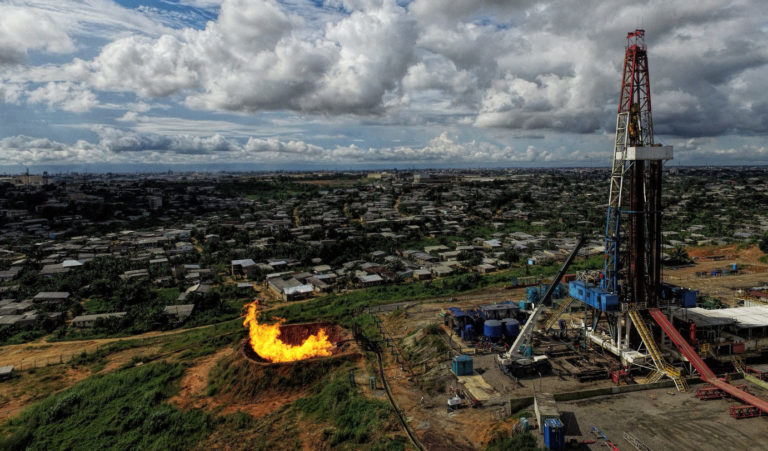
As the first rays of daylight pierced a thick haze blanketing the Ndogpassi neighborhood, several dozen angry men appeared, seemingly from nowhere. They formed a human barrier across the main entrance to a natural gas power plant in the east of Douala, Cameroon’s economic capital.

Some of the men laid across the roadway, forcing employees of the plant to abandon their cars and enter the facility on foot. As daylight emerged and a crowd of onlookers grew, the men began to sing Cameroon’s national anthem.

That episode, in the summer of 2016, signaled the start of a long protest in against Gaz du Cameroun (GDC), fueled by accusations of corruption, payoffs to public officials, and lying to the community about the start up and operation of this important power plant, which is actually owned by the British Victoria Oil and Gas, plc based in London.

The principal complaint: the promise of a substantial number of permanent jobs for local residents has gone unmet.

“GDC says that local residents aren’t qualified. Yet, at the same time, the company is training people from outside, hiring them and refusing to do the same for us,” said a protestor in the crowd. He wouldn’t give his name to a stranger, citing fear of reprisals from the security forces. “Only two people from the neighborhood, out of forty, have been hired by GDC for the new drilling operations.”

To cut the tension, authorities brokered a meeting between the disgruntled residents and company officials.

A month later another group of residents took to the streets, protesting that the company brought on local youth only as temporary hires, and groundskeepers. Today the community is overwhelmed by youth unemployment and plagued by a foul odor from the drinking water, damage to the local environment and brutal police retaliation when they speak out.

Local complaints and accusations of broken promises to the community have not prevented gas-industry analysts from heaping praise on VOG’s Cameroonian affiliate. The Petroleum Economist, the prestigious London-based trade publication, lauded VOG’s management of Cameroon’s natural gas production facility as exemplary. Upon receiving the “Energy Company – Small cap of the Year” award for 2015, Kevin Foo, founder and executive director of VOG, said the prize was testimony to the dedication and hard work of the teams in Douala and in London.

And indeed, when Cameroonian President Paul Biya first launched the project in 2013, residents of Ndogpassi welcomed the gas plant as a ticket out of poverty.

A two-year investigation by 100Reporters has found that the project, though managed by President Biya, has failed to pay royalties, training fees and taxes to the Cameroonian treasury, even as it made payments to investors totaling millions of dollars.

Now, after years of silence, the Cameroonian government admits the plant’s owners have missed tax payments to the Cameroon treasury, and has identified possible violations of resource, Social Security and environmental rules. In March, it threatened to terminate the contract with the VOG subsidiary that runs the plant. Executives for the company and its various international subsidiaries declined to comment about the government’s accusations.

Cameroonian President Paul Biya inaugurates the Logbaba Gas Project in Douala.

Gas to the Rescue

Before the construction of this power plant, which covers some 20 square miles, industrial and business users in Douala burned heavy and expensive fuel oil. And these users had to deal with regular supply interruptions that hurt production. Natural gas was seen as the solution: clean, reliable and less expensive, especially for businesses with their own generators.

Two exploratory wells in Ndogpassi yielded enough proven reserves to satisfy consumption needs in the region through 2043.

“Energy is at the heart of any development process,” Biya said in November 2013. “Without it, there can be no industry, no transformation of raw materials, and therefore no modern economy. There was a time when it was said that the infantry was the queen of battles. Today, one might say, paraphrasing the formula, that energy is the queen of the battle for development and progress. Together, this battle, we will win it.”

The Ndogpassi plant was a rare win on the energy front for Biya, whose earlier efforts to foster energy production in Cameroon had largely failed.

Yet even from its start, the Ndogpassi plant, designed to tap identified reserves of up to 11.3 billion cubic meters in the region, was met with questions: Could the government strike a deal that would truly benefit the national treasury? Or would accusations of corruption, opacity and favoritism mar this project, as they had so many others in the field?

On November 15th, 2013, President Biya, dressed in a dark suit, strode across the rocky red ground of Ndogpassi. Accompanied by his wife, Chantal, various government officials and VOG officials, Biya officially launched the drilling operations.

Biya lauded the $100 million project as emblematic of a presidential policy of “Great Ambitions.”

The project augured well for the neighborhood, many of whose 20,000 residents lacked reliable access to safe drinking water, decent healthcare, land ownership or the Internet.

Antoine Tebu woke up early that day to witness Biya’s opening ceremony, and joined in cheering for the president. Tebu is a neighborhood chief – a citizens’ representative – and owns a welding shop. He is also the community’s spokesman before the gas drilling company.

Tebu said the euphoria was short-lived. Soon, soldiers from the Rapid Intervention Battalion (BIR), an elite division of the Cameroonian army, arrived and were posted at the facility. Tebu said they erected a barrier of cement-filled barrels 10 meters from the entrance to the GDC facility, and went on to commit acts of violence against civilians. They barred local moto-taxis from the area, and struck civilians who ventured near.

“They beat the motorbike drivers worse than they beat prisoners, so badly that blood poured from their nostrils. They then forced them to walk on all fours before letting them go. They even beat the motorbike passengers,” Tebu said, adding that during this time some drivers, fearing reprisals, refused to transport residents to the plant.

[ctt template=”4″ link=”78wfQ” via=”no” ]“I told a sergeant from the BIR, ‘Most of the people you are beating are residents of the neighborhood,’” Tebu said.[/ctt]

Alain Tedom, 28, is the third of Tebu’s seven children. He remembered that he was celebrating his new degree in banking when he witnessed a horrific scene:

“A motorbike driver had crossed the blocked zone to drop off a passenger. On the way back, as he was crossing the barrier, a soldier stopped him, beat him and ordered him to hand over his motorbike. The driver refused,” Tedom said. “They continued beating him. Only when he was in very bad shape did he finally abandon his motorbike.”

Residents complained about this incident, but witnesses told 100Reporters that beatings continued nevertheless. And a letter to GDC from the local chief, obtained by 100Reporters, describes assaults by soldiers on local residents. — “to beat them, to make them drink dirty water. They enter bars and garages, pulling out their guns to threaten bar patrons and garage employees.”

On July 4, 2016, the report found, a BIR soldier kicked down the entrance to the garage owned by a Mr. Tato, which was located a few steps from the gas facility. After threatening the employees, the soldier “enters the office, takes out a large knife and attempts to stab the office agent in the stomach but misses, and when pulling back the knife, he cuts (sic) his own hand.”

As with other complaints by area residents, this incident was reported to authorities and GDC operators, but went unanswered.

Contacted by email, VOG initially said it would respond to questions from 100Reporters. Ultimately, however, the company declined to comment.

As supreme chief of the army, President Biya created the special military unit in the early 2000s. The force is under his direct command, and has a long record of complaints about alleged abuse of civilians.

In a telephone interview, Colonel Didier Badjeck, the Cameroonian army director of communications, said he was not familiar with the BIR units posted at the gas facility and therefore could not comment on the accounts of violence at their hands.

“But, they (the soldiers) are there on instruction from their hierarchy,” he noted.

Gas is Gold

In the mid-1950s, Ndogpassi was just a village when the French company Elf-Aquitaine discovered a large reserve of natural gas beneath the surrounding bush. At that time, this type of gas had little commercial value on the international market. Elf was looking for oil, so after digging several exploratory wells, the company abandoned the project.

Nevertheless, its exploration set the stage for a series of odd transactions that ultimately led to the new gas plant:

[mvc_timeline_father title=”Gas Rises”][mvc_timeline_son date=”2001″]Cameroonian government signs a 35-year contract with Denver, Colorado-based RSM Production Corporation.[/mvc_timeline_son][mvc_timeline_son date=”2005″]RSM signs an agreement with Rodeo Development Limited (RDL), a company based in the British Virgin Islands.[/mvc_timeline_son][mvc_timeline_son date=”2006″]RDL – whose principal shareholders were the CEO and founder of RSM, Jack J. Grynberg, and his family members – is sold to Bramlin Ltd., based in the British island of Guernsey.[/mvc_timeline_son][mvc_timeline_son date=”2008″]VOG acquires Bramlin, giving it control of RDL with its 60 percent interest in and operator of the natural gas project in Ndogpassi.[/mvc_timeline_son][/mvc_timeline_father]

The Cameroonian government then accelerated a wholesale relocation of the local population to allow RDL – now known as GDC – to begin gas-drilling operations.

Seated on a wooden chair in his office, Chief Tebu recounts that during construction, GDC trucks damaged the community’s water wells. In response, GDC dug a new community well, inaugurated in March 2012 by Jonathan Scott-Barrett, then general director of the company.

“Everyone who was there drank that water. From that time, the water has had a foul odor that worries the locals,” Tebu said.

GDC said it spent some $25,000 on the well. But  Tebu said that the company did not drill deep enough to reach clean water. In a 2014 financial report the company said it has spent more to maintain the well, but did not provide specific numbers.

Frank Tchinda stands by faucets for water from a well dug by Gaz du Cameroon after a company accident destroyed community wells that supplied drinking water. Residents complain that the water is tainted, and carries a foul odor. Photo by Christian Locka.

When local residents noticed the well water’s poor quality, some began to use it only for washing dishes and doing laundry. Others, like Frank Tchinda, stopped using the water altogether, turning instead to other neighborhood wells constructed by locals.

“You would have to be blind to not see that this water is bad. It stinks,” Tchinda, 23, shouted during an interview, pointing to the yellow stains on the white tile around the borehole.

The company and the government say the water has been thoroughly tested at the Pasteur Center laboratory in Cameroon. That may be, residents say, but they remain suspicious, saying that the GDC well is the only one in the area that produces foul-smelling water.

Tebu said he first noticed the odor when his job was delivering fresh water to the plant. He said GDC officials ordered him not to use water from the community well it had dug. Today the plant has its own water well.

Frank Tchinda and Alain Tedom, who say that the Gaz du Cameroon project has failed to hire locals, as promised. Photo by Christian Locka.

Jobs and Revenue

“In 2015 the plant was operating at only 20% capacity, and GDC registered $21.4 million in revenues – up more than 112 percent from the previous year. Gas went through pipelines buried across Doualato reach local food processing companies, breweries, electricity providers and foundries”.

As production increased, GDC began hiring local workers. Tedom, Tchinda and other residents were paid to clear brush around the facility. “Soon after, they got rid of us,” Tedom said. Just two months in, locals turned up for work one morning, only to find the entrance blocked. A GDC official said that London had ordered a halt to hiring of temporary local workers.

Nevertheless, the company’s financial report for the year said that it had “hired” 90 local residents.

Since then, GDC has brought on local workers for temporary stints via text messages. One message on April 20th, 2016 was typical: “Good morning. Please be at the guard station … at 8 a.m. for a one week job. Bring your helmets and shoes.” Recently, the company has contracted with another traditional chief in the neighborhood to recruit local temporary workers.

Locals complain that they had been promised permanent jobs. In January 2016 the “unemployed youth of Logmayangui,” with Tedom and Tchinda at the top of the list of signees, sent a letter to the General Director of GDC. They complained that the company only hired outside contract workers for grounds and warehouse work. Encouraged by local chiefs like Tebu, local youth demanded stable, permanent jobs. They also denounced what they saw as nepotism at the plant, claiming new hires, coming from distant regions of Cameroon, were all family or friends of GDC employees.

GDC told Tedom it would consider the complaints when it came to work on new wells at the plant, Tedom said. But today, locals say the company continues to sign permanent contracts with English-speaking workers from Cameroon’s two Anglophone regions, leaving the locals with the temporary work.

“I would like a permanent job at the plant to help me pay for my studies,” said Tchinda, who is close to earning a woodworking certificate.

161102 rsz_spud_day_4

Follow the Money

Jobs are not the only issue for critics of the gas facility.

During a meeting between company officials and local residents, Tebu said he realized that the Cameroonian government is also missing tax revenue from the Ndogpassi gas project.

Tebu said that local contractors pay taxes normally, but when GDC hires, it pays fewer taxes. Tax authorities can easily control local contractors but it is difficult to extract taxes from GDC, which is registered in the British Virgin Islands.

Government documents obtained by 100Reporters suggest that the operators of the gas plant have failed to meet its fiscal obligations.

According to the concession contract, RSM must pay the government a fee each year during the exploration phase and then a larger annual fee during the production phase of the project. One such fee is earmarked for training Cameroonian nationals to work in the petroleum industry. The total owed is roughly $170,000, which has never been paid.

GDC is jointly owned, with VOG or its subsidiary owning a 55 percent stake, RSM Production Corp. holding 40 percent, and the Cameroonian government owning 5 percent.

Reached by telephone, Jack Grynberg said, “I have paid nothing. It is the responsibility of the operator, VOG, to pay that money.” Later, in an email to 100Reporters, Grynberg said all questions concerning the Ndogpassi gas project should be addressed to VOG, as operator of the concession for GDC.

According to a report of the Cameroon Extractive Industries Transparency Initiative, GDC is responsible for “making (liquidating) all payments due in place of (instead of)” RSM, and for integrating all monies paid on behalf of RSM into its fiscal declarations. But neither GDC’s financial reports nor its reporting to the government make any mention of training fees paid to the government of Cameroon. These fees for training programs alone would now amount to $170,000 – three years of exploration and five years of production.

Government reports, based on statements submitted by oil and gas corporations, also indicate that between 2009 and 2011, GDC did not pay land-use fees, or voluntary contributions associated with its workforce. In its 2014 statement to Extractive Industries Transparency Initiative, GDC declared it had paid more than 8,400,000 Cameroonian francs, or $15,300 in voluntary social donations, but made no mention by name or by region of the beneficiaries of its largesse.

129047_3ac8ef36586a4886a3d4

Twisted Tale of Subsidiaries

GDC, the company extracting Cameroon’s natural gas, is listed in the British Virgin Islands, a territory that doesn’t require companies to declare revenues or beneficial owners. VOG registered its subsidiaries in six territories with weak or non-existent taxation: There are two in the British Virgin Islands, two in Guernsey, three in Kazakhstan, three in England and Wales, and one each in Russia and Cyprus. The Cameroonian subsidiary generates all the revenues for the entire group, according to an interim financial report filed by VOG financial report for 2017.

The company disputes the terms of the government concession, and has not paid fees and taxes in Cameroon. Meanwhile, the company has made millions of dollars in royalty payments and given no-interest loans to its subsidiaries.

Cameroon should receive royalty payments in the amount of 8 percent of GDC’s monthly revenues, according to the concession contract. Despite annual revenue of more than $27 million in 2015, GDC indicated in its annual report that it would pay royalties to the state once it had recovered all “petroleum costs,” which include exploration costs, development costs, production costs, construction costs and all the other general operating expenses of the project.

GDC confirms that it has not yet paid the Cameroonian government, because it has yet to recoup all its costs. This condition, which is not included in the contract, angers Cameroonian authorities. Rather, the concession agreement says the operator “shall pay to the State a proportional royalty at the rate of eight (8%) for all levels of gas production.”

In its annual report, GDC reports that, “the interpretation by the group of what constitutes ‘petroleum costs’ has not been formally agreed upon by the Cameroonian government.”

In other forums, however, VOG, the operator of the Cameroon plant, paints a different picture.

The company’s 2016 Interim Financial Report states that as of June 2016, it had recovered its “petroleum costs” and returned 40 percent of project shares to RSM.

While VOG conditions its royalty payments to Cameroon on first recuperating its costs, the British multinational has consistently distributed royalties from the Cameroonian gas operation to its offshore subsidiaries. Cameroon Holdings Limited (CHL), one of the subsidiaries based in Guernsey, lists its only source of revenue as “GDC royalties.” According to VOG’s annual financial reports it pays royalties of up to 15 percent of GDC revenue during the lifetime of the Ndogpassi gas project to CHL.

Bramlin Limited, based in Guernsey for the duration of the gas project, is another subsidiary of VOG, and it receives royalty payments in the amount of 4.5 percent of GDC revenue.

According to a confidential document acquired by 100Reporters, Rodeo Resources Incorporated — another company related to Bramlin and VOG — also receives 1.2 percent of GDC revenues for the life of the project. Additionally, Rodeo receives a $500,000 production bonus for each million cubic meters of gas and natural gas condensate produced at Ndogpassi, up to a total of $10 million.

Company officials at VOG declined to comment for this report.

A road near the Gaz du Cameroon plant. Photo by Christian Locka.

Holding an Empty Bag

In May 2017, the government charged that Cameroon lost more than $7 billion in illicit financial flows, including fraud and corporate tax evasion between 2003 and 2012. Lacking the necessary expertise to verify information, the government says it must rely on statements of companies like VOG about the production of gas and natural gas condensate extracted at Ndogpassi, the amount of earned revenue, the identities of the offshore entities, and revenue sharing.

In 2015, Cameroon joined 126 nations in an international agreement on transparency in tax matters. That was followed by a promise from the government to crack down on tax cheats.

“The coming days will permit us to collect the information we need to stop fraudulent operators, even the most sophisticated,” declared Roland Atanga, head of legislation and international fiscal relations at Cameroon’s tax authority. The senior tax inspector notes in the journal, Tax News, that working collectively with other countries to fight fraud and tax evasion, Cameroon hopes to reinforce investor confidence and improve its international visibility.

Despite the difficulties Cameroon has prying financial information from offshore oil and mining operations, the state continues to uphold Article 105 of the petroleum code, which keeps all oil, gas and mining contracts confidential. International groups have tried, without success, to convince Cameroonian authorities that these contracts must be transparent–published and made available to the public–in order to guarantee accountability.

The state-owned oil company, the Societé Nationale des Hydrocarbures (SNH), which represents the state in all oil and gas contracts, including the Ndogpassi concession, is itself an illustration of government opacity. The public corporation, whose board chairman is also secretary general for President Biya, does not publish statistics in open data format, according to international governance auditors. They’ve also complained that statistics submitted by SNH are not accompanied by narrative reports on the activities and regulation of the industry.

In addition to reports coming from the state oil and gas Company, Biya’s own legal advisor, Jean FoumanAkame, is on the Ndogpassi management committee. During an official visit to the gas facility in April 2015, Akame stated that he was satisfied with the project’s management.

The public treasury does not share this satisfaction.

On March 10, 2017, Adolphe Moudiki, Director General of SNH, sent a notice of termination of the concession contract to GDC.

In the notice, Moudiki says GDC has failed to share monthly income proportional to production, or pay concession and exploration fees or training costs totaling nearly $800,000.

In addition, the Director General of the SNH reproached GDC for not signing the agreement of participation of the State, not holding meetings with the government prescribed by the contract, and violating government rules on oil and gas exploitation. The government claims the company has changed the concession contract without notice, has sold natural gas to customers without permission or without government agreement on prices. All this has denied the government a due share of the plant’s revenue, he wrote.

Antoine Tebu, a council leader, who says that the plant has shortchanged locals, as well as the Cameroonian treasury. Photo by Christian Locka.

A New Deal?

The accusations come just as GDC applied for a license to operate a new gas block, and announced a planned, major expansion of operations in Cameroon. The government said the company first needs to settle accounts on the Ndogpassi project, and submit to an audit, as spelled out in its concession contract.

Several government inspection missions to the gas facility have turned up other possible violations, the government said, such as not having a doctor for workers, an evacuation plan, or plans to deal with accidents.

As for the youths who took to the streets to demand work at the gas facility, they were detained by police for a few days. Now out, they vow to continue their protests until GDC offers them permanent jobs.

Chief Tebu, watching the sun sink below the horizon beyond the plant, despaired. “What are we going to do” about this plant?” he murmured.

If you like hard-nosed original reporting, please support our work. Show you care.

[mvc_button btn_icon=”fa fa-heart” btn_text=”Donate Now” btn_size=”18px” btn_url=”https://www.paypal.com/cgi-bin/webscr?cmd=_donations&business=diana@100r.org&item_name=100Reporters&item_number=One-time+Donation&currency_code=USD” btn_next=”_blank” btn_border=”#82022d” btn_clr=”#000000″ btn_bg=”#63d611″ border_width=”2px”]

RELATED ARTICLES

Washed Clean: In Cameroon, Kimberley Officials Launder Conflict Diamonds onto World Markets

Market day in the riverside town of Gbitti in eastern Cameroon is a colorful affair. Farmers sit on the bare red earth, their wares spread out before them. Across the narrow stretch of the Kadei River that separates Cameroon from the Central African Republic, merchants and shoppers haul wooden canoes by pulling on a steel rope stretched between the two banks. Children squeal and splash in the muddy waters where women beat their washing on nearby stones.

On the sandy river bank in February stood a man dressed in jeans, a jacket and grey knit cap, with a practiced air of nonchalance. But his eyes gave him away, darting right and left, scanning for danger as he negotiated – perhaps for the following Monday – the delivery of rough diamonds.

Suddenly the deal was cut short. A teenager brandishing a spear shouted from across the river, “Stop talking to our brother!” Armed young men, members of the Christian militia rebel group known as the Anti-Balaka, which emerged during the Central African Republic’s brutal civil war, were watching from the opposite banks and had spotted this reporter’s camera.   

“We have lost our families in the war. We do not want to be filmed,” one young man in a bright red bandana shouted.

“The diamond in two weeks,” the merchant muttered, and he moved swiftly away to quell the ruckus from his comrades across the river.

Money for Rebels

The illegal trade in rough diamonds through border towns of Gbitti, Kentzou and Garoua-Boulai in eastern Cameroon provides a steady source of income for rebel groups on both sides of the Central African Republic’s bloody conflict. According to the United Nations, the war has claimed more than 5,000 lives and displaced roughly one million since Muslim Seleka rebels seized power three years ago. Christian and animist groups known as the Anti-balaka turned upon Muslims, pushing them south in reprisals that led to a de facto partition of the country.

Although elections brought a new government to power in February, the conflict has wreaked havoc on the economy, starvation has followed and hundreds of thousands of refugees have fled, many into UN camps in Cameroon. The government is too weak to assert full control over the mineral-rich country, and a low intensity conflict has persisted.  

The violence has robbed the Central African Republic’s government of an important source of income from the diamond trade, which had accounted for as much as 20 percent of its budget. But when war broke out, the small nation at the heart of Africa was suspended from the Kimberley Process (KP), a 2003 accord signed by 81 countries to certify the origin of diamonds and prevent them from funding rebel groups. Without KP certification, the Central African Republic was completely locked out of the international gemstone market. (It won a partial reprieve last June.)

As the doors to legal trade swung shut, neighboring Cameroon became an outlet for laundering CAR diamonds into the global marketplace. Cameroon had only joined the Kimberley Process in 2012, and the government launched campaigns in the border towns to educate KP officials about spotting conflict diamonds.

But a year-long investigation by 100Reporters has found serious cracks in Cameroon’s system: Rough diamonds from the Central African Republic are easy to purchase here; enforcement of the certification rules is lax; and dealers speak openly of Kimberley Process officials, who will certify – for the right price – that gems from across the border are conflict free–whatever their origin. This reporter, posing as a buyer, found one KP official willing to falsify certificates for rough diamonds and assist in evading export taxes. 

Cameroon’s Minister of Mines, Industry and Technological Development Ernest Ngwaboubou, who is responsible for overseeing the rough diamond industry and enforcing KP standards, declined requests to comment.


Guns and Diamonds

In Gbitti, diamond traders from the Central African Republic use the money to buy light weapons that they ferry back across the river, selling arms to rebels on both sides of the conflict. Security forces in Cameroon are hard pressed to control the arms smuggling because buyers stagger their purchases, buying the weapons days apart to avoid suspicion.

“It is difficult to determine, even in times of conflict, whether a machete or spear is intended for lawful use,” said a major in the infantry battalion stationed in a field office in Eastern Cameroon, about 250 kilometers from the regional capital of Bertoua. He refused to reveal his name because he is not authorized to speak for the military. 

Diamond and gold smuggling was rife in the region even before the CAR civil war. The Kimberley Process secretariat has estimated that as much as 20 percent of rough diamonds from CAR were illegally traded prior to 2013. The World Bank in 2010 put the estimate even higher, at 50 percent.    

The trade in rough diamonds between the two countries once was quite lucrative. François Nganke, an artisanal miner from Gbitti in his mid 30s, said he left a secure job with the humanitarian medical organization Doctors Without Borders for the lure of  gemstones, which he sold across the border in CAR. “The prices charged by Central African purchasing offices were interesting. We sold our stones to them,” he said.

But the CAR trade collapsed when that country was suspended from the Kimberley Process in 2013, and its prices for rough diamonds plunged. Nganke now regrets his change of career.  Mining is back-breaking work. In Gbitti men, women and children each day hack at the dry earth with old pickaxes, hoes and shovels sifting through the alluvial deposits for buried treasure. “It is painful. We need a pump” to wash the gems free from the soil, said one mother who has worked as a miner for five years.

Around her lay giant clods of earth and gaping holes, a testament to the sheer physical effort required to earn a living. “Sometimes we provide all this effort for nothing,” she said.

Today these small-scale miners in Cameroon face mounting competition from smugglers. “The majority of diamonds sold in Gbitti come from Central African Republic,” said Issa Bouba, a registered diamond dealer for the Cameroonian Ministry of Mines. He buys from the miners and sells the stones on international markets.

``This is Business``

The scale of the illegal trade and its impact on a country struggling to recover from war is difficult to measure. According to a United Nations’ panel of experts report, since the Central African Republic’s KP suspension, smuggling of 140,000 carats of rough diamonds cost its government $24 million in lost revenues, representing 2.3 percent of its annual budget.  When the conflict broke out in 2013, the country was exporting $62.1 million a year in rough diamonds, its leading export.

The Central African Republic the world’s 12th largest producer of rough diamonds measured by value. The stones are round and 12-sided with a greenish-brown tint. Despite these distinctive qualities, tracing their origin is particularly difficult. The vast majority of production is done by artisanal miners sifting the deposits by hand for gems, sold to intermediary merchants called collectors. Moreover, 80 percent of the Central African Republic’s output comes from the southwestern region of the country bordering Cameroon, and the gems produced from the two countries are very similar in color and quality. Kimberley Process officials in Cameroon who certify the origin of the diamonds find them difficult to tell apart. They rely upon the collectors to maintain a production book, recording where the miners say they extracted the stones.

“With 20,000 artisanal miners in Cameroon and limited ability to monitor those miners, it is impossible to be sure where each diamond recorded in that book has come from,” said Amnesty International in its report “Chains of Abuse: The Global Diamond Supply Chain and the Case of the Central African Republic.”  

Human rights groups say the illegal trade in diamonds is closely interlinked with a vicious cycle of violence on both sides of the border. It has helped keep a low-intensity conflict alive in the Central African Republic, spawning horrific attacks that have driven people from their homes. Starving families have waded across the narrow Kadei River to find refuge in Cameroon, the United Nations has reported. More than 200,000 Central African refugees have fled to Eastern Cameroon, and some have brought the illegal trade in diamonds with them.

Adam Abba, 45, a Central African Republic merchant now living in Kentzou, sat legs crossed on a mat in his two-room house, provided by the refugee agency of the United Nations High Commissioner for Refugees, and brightly painted in its signature blue. Here in Kentzou, hundreds of Muslims like him collect and sell Central African diamonds from areas controlled by the Muslim militia Seleka.

A jovial man, Abba shared a breakfast of red tea and white rice as he explained how he laundered blood diamonds from the Central African Republic and the Democratic Republic of Congo through Cameroon.

“In the Kimberley Process office, even when the diamond comes from the Central African Republic, it is not complicated. The officials will say it comes from Cameroon. For this, you’re going to pay (a bribe). This is business, right?” Abba chortled.

“We are Africans. We understand each other,” he added.

Five hours drive to the north in Garoua-Boulaï, Aladji Samassa, another Central African Republic merchant tapped away on his new Samsung Galaxy tablet, scrolling through samples of diamonds that he had recently sold in Dubai.

“You see the stone with a red background? It is the most expensive. Arab customers like that,” Samassa said, displaying a photo of the glittering gem. Some of the most expensive diamonds evade the export tax in Cameroon, thanks to “someone” in the Kimberley Process secretariat whom Samassa said “makes things easier.”

100Reporters wanted to find out more about this “someone” and how the smuggling worked. This journalist telephoned officials at the regional secretariat of the Kimberley Process in Bertoua, the provincial capital. I introduced myself as a diamond collector seeking certification for Central African Republic diamonds.

I spoke with Dubois Ndamba, the senior Cameroonian official in the eastern region responsible for enforcing the Kimberley Process and certifying the origin of the diamonds. When asked about warnings issued by his superiors to watch out for blood diamonds from the Central African Republic, Ndamba brushed concerns aside. He said he knew what he was doing, adding that what he was doing “should not be vulgarized.”  Ndamba offered to lower the tax and to provide fake certificates.

Here is an excerpt from the recorded telephone conversation between this reporter and the Ndamba, the Kimberley Process official:

Christian Locka: Mr. Dubois, hello.

Dubois Ndamba: Yes, hello?

CL: Dieudonne referred me, I do not know if he told you about my case? I’m in the diamond business, and I have Central African diamonds for export. We discussed this yesterday, and he gave me Saffana’s number, but it does not work. That’s why he gave me your number.

DN: Yes, explain yourself well so I understand.

CL: I have a partner who wants to export. I want to know how you can help.

DN: Help to do what?

CL: For export.

DN: You already have the diamonds in hand?

CL: They are in Garoua-Boulaï.

DN: What status do you have, you are collecting? You have the collector papers?

CL: I work with Mr Ndoko.

DN: This is how many carats?

CL: They are around 500.

DN: 500 carats?

CL: Yes.

DN: OK. I am in Yaoundé (Cameroon’s capital) right now. You are where, in Bertoua?

CL: I’m almost at Bertoua, I’m entering Bertoua.

DN: I am also going down to Bertoua, I would like you to call me. I expect to be in Bertoua in the evening or tomorrow morning.

CL: Okay, like that for the certificate?

DN: Yes.

CL: What must I do?

DN: For the certificate, this is where it starts. We will do the paperwork at the base so that the certificate will be given in Yaoundé, do you understand?

CL: Yes.

DN: You do the paperwork in Bertoua where we make appointments. We sign what we have to sign – just like that for the certificate. You go back to Yaoundé to the central Kimberley office. We will assess the value of the diamonds, what you are going to pay. You are given a valuation certificate and you pay the tax on this. Then, you are issued a certificate that allows you to get away with the diamond.

CL: The fact that they come from Central African Republic, I thought it would be concerning?

DN: It should disturb, but we will arrange the paperwork so that it no longer is from over there. We will act as if it originated from us (Cameroon) – you understand a little? – so that it is no more from over there (Central African Republic).

CL: I understand you.

DN: I know what it means, do not worry. We will arrange everything. Then we will see if there are some (diamonds) that are big. They can be put aside and carried beside you when you fly (to the diamond markets to sell them) so that they do not weigh down your luggage.

CL: OK.

DN: For calculating the tax, we take the light ones, which may be cheaper. We will do everything to do with the certificate.  

CL: So, the bigger ones, we will set them aside?

DN:  We will sort them, don’t worry. The most valuable diamonds, which can be expensive in taxes, you can put them aside. When you have the certificate of origin for the small value ones, I will add the others ones and you can export them all.

CL: OK. You are in Yaoundé; you say you’ll be in Bertoua when?

DN: I will be in Bertoua tonight. I am currently at the mines department.

CL: I call you tomorrow . . . 

The next day, this reporter called Ndamba, and informed him that as a Kimberly Process official, he had offered to break the law. Ndamba denied it.

“I had no need to talk of CAR diamonds. You only have talked to me of CAR diamonds. I know that if you are in Cameroon and have diamonds in your hands, it is not foreign territory. So I would help in this direction by giving the diamonds a place of origin. I do not approve of someone fetching the diamonds and bringing them here so I can certify them,” Ndamba said.

Few Kimberley Controls

Beginning in 2014, the KP national secretariat in Cameroon launched a publicity campaign to raise awareness among artisanal miners, diamond purchasing officers and collectors, as well as among Kimberley Process officials about the dangers of commercializing blood diamonds.

The efforts have done little to curb profiteering.

Cameroon was admitted as a member of the Kimberley Process in 2012 and reported the next year annual production of 2,721 carats in rough diamonds, and about 3,400 carats in 2014. And yet the number of falsified rough diamond certificates seized far outpaces its annual production, according to International Peace Information Service (IPIS), an Antwerp based research institute that specializes in natural resources.

“Forged Cameroonian Kimberley Process certificates presented abroad indicate the volume of illegal exports is significant. In 2013, the Kimberley Process Secretariat in Cameroon confirmed that a total of 6,722 carats worth of would-be Cameroonian KP certificates presented abroad were counterfeit. With a potential Cameroonian diamond production of only 5,000 carats, these almost certainly include Central African diamonds,” IPIS said in its report, Diamonds in the Central African Republic.

Most of the fake certificates and untaxed diamonds pass through the Douala International Airport, Cameroon’s economic hub. Three years after Cameroon signed the accord pledging to export diamonds that were conflict free, its airport lacked a Kimberley Process control office, despite promises from the Cameroon government and a track record of the airport’s use as a smuggling center.  In one extreme example of fraudulent export, a parcel of 281,869 carats with a certificate of origin from Cameroon as well as a fake KP certificate left through Douala Airport at the end of 2009, according to the IPIS report.

Diamond operators interviewed for this investigation said Central African blood diamonds transported through Cameroon land in India, Belgium and the United Arab Emirates – global hubs for the international diamond trade.

Diamonds are small, have high value and it is difficult to tell where they originate. Add to this the impulse toward corruption, laissez-faire governance and the ease with which the Kimberley Process can be and circumvented – and the result is a constant stream of blood diamonds entering the international market. Aware that certification was at risk of becoming little more than a salve for the Western buyer’s conscience, the human rights NGO Global Witness in 2011 withdrew its support from the Kimberly Process, calling it an “outdated mechanism”

“The sad truth is that most consumers still cannot be certain of the origin of their diamonds, nor whether they are financing armed violence or repressive regimes,” said Charmian Gooch, founding director of Global Witness.


This story was co-funded and produced by 100Reporters and the African Network of Centers for Investigative Reporting, with assistance from the Open Society West Africa.

Photo Credits: 

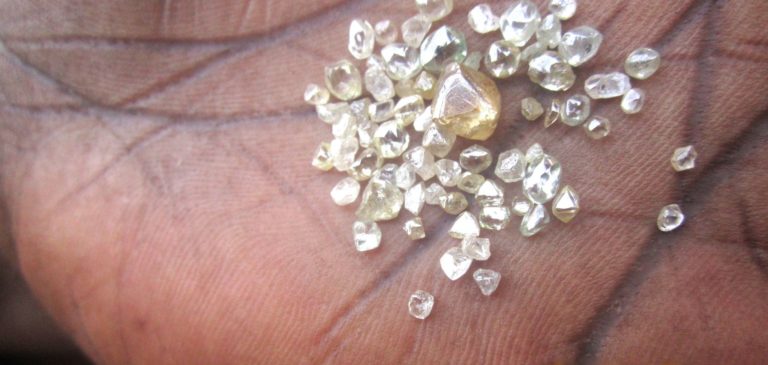
Lead Photo: Issa Bouba, an official government collector who certifies the origin of gemstones and promised to handle diamonds from the Central African Republic, holds raw diamonds in the palm of his hand, Gbitti, Cameroon. Photo by Christian Locka.

Former Seleka soldier drives to a village in the Central African Republic, about 16 miles from Bambari, where residents say anti balaka Christian militia attacked a mosque. May 10, 2014. Photo by Siegfried Modola/Reuters.

Prospector pans for gold and diamonds near the town of Gaga in the Central African Republic. April 6, 2014. Photo by Goran Tomasevic/Reuters.

Video: Adam Abba, a diamond collector in Kentzou, Cameroon, handles gemstones mined from western regions of the Central African Republic, which are barred from international trade under the Kimberley Process. Video by Christian Locka, editing by Aishvarya Kavi.

Prospector pans for gold and diamonds near the town of Gaga in the Central African Republic. April 6, 2014. Photo by Goran Tomasevic/Reuters.

Young woman pans for diamonds in a pit dug in Gbitti, Cameroon. Photo by Christian Locka.