Trouble In

MORE FROM THIS SERIES

By Kait Bolongaro and Maurice Oniang’o

A two-hour drive west from the bustling capital of Nairobi, the city of Naivasha, with its population of about 200,000, lies perched on the shore of its namesake lake.

This is home to most of Kenya’s flower farms. It is also home for Lydia Wanjiku Matimu, who worked as a flower harvester at Wildfire Kenya Ltd, a Fairtrade certified farm, for the last six years. Matimu had high hopes that the promise of a more ethical agricultural workplace would improve her life.

Instead, she has suffered two miscarriages. She blames chemicals used on the farm.

“What caused the miscarriages is the chemical they sprayed,” Matimu said in an interview. Just before her first miscarriage, she said, “they sprayed sulfur and we were told to go pick the flowers before the recommended time.”

This was not how Fair Trade was supposed to work. Fair Trade promises consumers that by buying Fair Trade certified products, they are fighting exploitation and improving the world–one purchase at a time. Worker wages are supposed to “fulfill basic household needs,” while Fair Trade prohibits use of “the most harmful chemicals” on crops, according to the organization’s website.  The organization also promises that workers are treated equally, however the health care coverage provided the laborer in the plantation–who is most directly exposed to danger–offers but a fraction of the benefits that protect more senior workers.

Lydia Wanjiku Matimu, a mother of three resigned from a Fair Trade certified flower farm. She resigned after she had a second miscarriage. Her salary was 6200 shillings ($62) and after deductions her take home was about 5000 shillings.

Lydia Wanjiku Matimu.

Lydia Wanjiku with her children from left Elizabeth Wambui (15 years), Freshia Wanjiru (11 years) and Lukas Wairia (12 years) at home in Naivasha.

Despite repeated invitations, Wildfire Kenya Ltd, declined to comment about Matimu’s story. The company’s web page lists educational and sports activities the farm sponsors for employees. The list does not detail steps the farm takes to protect worker health.

In a written statement, Fairtrade International said Matimu’s story, and additional accounts of negligence and poor conditions and pay outlined in this series, have triggered an internal investigation under the organization’s Protection Policy and Procedures for Children and Vulnerable Adults.

“Fairtrade standards have strict minimum labour requirements, including for safety measures and pesticide handling, in addition to prohibitions against child labour, forced labour, freedom of association, and discrimination,” said Fairtrade spokesman Eric Fichtl, in an emailed reply to questions from 100Reporters and Journalists For Transparency (link added). “These apply to all workers, whether permanent or temporary, migrant or local, subcontracted or directly employed.”

Matimu said she was well into her second trimester when she had her first miscarriage. She then lost her second fetus after three months of pregnancy.

“That day, they sprayed sulfur at around 8 and it is supposed to be left for 8-12 hours. But before that time elapsed, they got an order for flowers,“ Matimu said. Expectant mothers are usually given light duties on the farm, but Matimu said that that day, she was ordered to the greenhouse to harvest the flowers.

She collapsed shortly after leaving the greenhouse and woke up in the flower farm clinic, Matimu said. She didn’t learn of her miscarriage until she sought medical treatment at a hospital in neighboring North Kinangop.

“What caused the miscarriages is the chemical they sprayed. They sprayed sulfur and we were told to go pick the flowers before the recommended time.”

MATIMU

Matimu said she complained to her employers at Wildfire, but they did not accept responsibility for the miscarriages, and refused to investigate her claim. Devasted by the losses of her pregnancies, Matimu quit her job, putting her family into financial hardship. She remains unemployed.

Fairtrade’s Fichtl said the organization maintains procedures that member cooperatives and farms are supposed to follow when laborers have complaints about health and safety conditions. “Under our protection procedures, Fairtrade International will be conducting an assessment of the allegation and following up on it,” the company said.

Flowers became the first non-food item certified by Fairtrade in 2001. Globally, there are now 55 producer organizations growing Fairtrade certified flowers, a majority of them in Kenya.

Growing demand from European consumers has led to a boom in Fairtrade flower sales. Around 640 million stems were sold between 2013 and 2014, a 5 percent increase from the same time a year earlier. According to Fairtrade International, the cut flower industry has blossomed into Kenya’s second most important export commodity, following tea, for a total value of about $424 million.  The European Union is the principal export market.

Temperate climate means that Kenya’s floriculture industry can produce all year, and thus the country ranks as the world’s fifth-largest exporter of cut flowers. Of exports to Europe, 44% originate from Fairtrade certified farms. Despite growing demand for their product, poor pay remains a problem for Kenyan flower farm workers. According to a 2014 report sponsored by Fairtrade International, the expected living wage for flower farms in Naivasha is $172 a month.  Over the past decade, real wages (adjusted for inflation) have decreased.

Low Pay For Premium Flowers

Matimu said she knows of other laborers who have reported illnesses they believe are related to their work. And complaints go beyond health, to salaries that do little to lift them out of poverty.

Inside one small house of farm worker, a sole bed sheet separates the living area and the bedroom. A television sits in one corner, a make-shift kitchen in the other. The worker, who asked that his name not be used for fear of reprisals, welcomed visitors into the house he shares with his wife and two sons.

The farm worker is employed by Oserian, a Fairtrade-certified farm known for its roses. The man earns net pay of $140 a month, and he doesn’t see how the Fairtrade label has helped his family’s standard of living.

Peter Ombunde works with a local organization that champions for the rights of flower farm workers in Naivasha. He has questioned Fair Trade on their modus operandi on several occasions but he never gets positive results.

“I have been struggling for a while. I have worked at Oserian for 10 years but I am not benefitting. I just have debts“

A FARM WORKER

Judy Atieno A mother of two, resigned from one of the flower farms in Naivasha after having three miscarriages.

Oserian contributes to his sons’ education. The company provides grants ranging from $150 to $300, according to a child’s academic performance. He receives $300 for both boys--well short of the $1,100 he must spend for tuition.

Oserian representatives declined repeated requests for interviews to discuss the conditions described by this laborer and others. On its website Oserian says only that it is “a Fairtrade farm, which means we make sure our employees have good working conditions and opportunities. Further afield, we’ve funded a number of social projects – like the drilling of boreholes away from Lake Naivasha, so nearby communities can access water more easily.”

The laborer said the farm used to supply useful items such as t-shirts and shoes.

They could also access advances of cash and gas, which were repaid in installments. He says such benefits have been scrapped.

Unfair Trade was produced in collaboration with Journalists for Transparency, with support from Transparency International, the global anti-corruption organization.

MORE FROM THIS SERIES

Consumer Voices

MORE FROM THIS SERIES

Strolling through the streets of Cologne, Germany, the city’s cathedral dominates the skyline.

By Kait Bolongaro and Brandy Miller

Likewise, in Europe, Germany dominates the marketplace for environmentally sensitive, ethically sourced food products that have come to be known as fair trade farming.

Cologne is headquarters of Fairtrade International, one of the most important bodies in that marketplace – and the body responsible for certifying that many fair trade products are sourced from farms that adhere to labor and environmental standards considered at least a step better than conventional producers. And few consumers are as supportive of those ethical standards than Germans. According to the European Parliament, Germans spent $625 million on fair trade products in 2012.

“I think there’s no right in the world that forever half of the world has to live and to work under conditions we would not accept in our countries,” said Dieter Overath, founder of TransFair, or Fairtrade Germany. For 25 years he’s been the organization’s CEO, and the most ardent defender of its model.

Fairtrade’s biggest success in Germany has been a deal with discount supermarkets such as Lidl and Aldi which account for 50 percent of groceries purchased in the country. (Photo by Kait Bolongaro)

“I think there’s no right in the world that forever half of the world has to live and to work under conditions we would not accept in our countries,”
- Dieter Overath

Fairtrade’s biggest success in Germany has been a deal with discount supermarkets such as Lidl and Aldi which account for 50 percent of groceries purchased in the country. (Photo by Kait Bolongaro)

Overath wants Fairtrade’s push for ethical standards in farming to become a global battle cry for more equitable production chain. His plan? Get the logo known, one community at a time.

In Germany that means Fairtrade Towns, which began in 2009 and now include 500 towns. The crux of the campaign calls on Germans to pledge to “think globally, act locally” and commit to support fair-trade standards.

But even in activist Germany it has been difficult to make the fair trade concept ubiquitous, despite the public’s keen awareness of the issues surrounding social and environmentally friendly production and trade.

Part of the problem, according to academic researchers, is that fair trade proponents have yet to deliver on promises of substantial change for low-income producers on small farms in Africa.

four-year study by leading development economists at the University of London’s School of Oriental and African Studies found that Fairtrade certification did not significantly improve the lives of workers on fair trade farms.

“This research was unable to find any evidence that Fairtrade has made a positive difference to the wages and working conditions of those employed in the production of the commodities produced for Fairtrade-certified export in the areas where the research has been conducted,” said the report, which was funded by the British government’s Department for International Development. The report examined the economic impact of fair trade production in African countries with large populations of low-income workers.

“In some cases, indeed, the data suggest that those employed in areas where there are Fairtrade producer organisations are significantly worse paid, and treated, than those employed for wages in the production of the same commodities in areas without any Fairtrade certified institutions … ” the report concluded.

“At the very least, this research suggests that Fairtrade organisations need to pay far more attention to the conditions of those extremely poor rural people – especially women and girls – employed in the production of commodities labeled and sold to ‘ethical consumers,’ who expect their purchases to improve the lives of the poor,” the report said.

Fairtrade initially said that it had “welcomed” the research, but went on to criticize the report’s methodology, and to accuse the authors of bias. Fairtrade went so far as to issue  “a vague threat of legal action,” according to a statement by the report’s authors, who defended their research methods and cited surveys of earlier research on Fairtrade that similarly showed no significant impact on working conditions.

In Germany the promise of fair trade has translated into rising sales for Fairtrade certified goods. Overath said that partnerships with discount supermarkets are highly successful, and spread awareness of Fairtrade values. As discount stores account for nearly 50 percent of food sales nationwide, with 92 percent of all people living in Germany going to a discount store once a week, these partnerships have proven themselves as vital to Fairtrade’s expansion into the German market.

Fairtrade Germany relies on a wholly-owned subsidiary, FLOCERT, to protect farmers abroad. The body, which Fairtrade describes as independently governed, is tasked with making sure producers receive a fair share of money paid to the cooperative as long as they meet Fairtrade’s standards. Most of FLOCERT’s staff – traders, importers, cooperatives and licensees — lives in producer countries.

Overath explained that cooperatives are supposed to decide collectively how to spend the Fairtrade premium.

“Our control is only to make sure there is a common decision and that the projects decided upon are actually put into action,” said Overath. “We don’t interfere. They can even decide to have a football field.”

But that promise is also the challenge: While they’re aware of the Fairtrade promise of ethical practices, German consumers have also heard stories that disturb them.

At a market in Cologne, a shopper named Anna said it’s important to support small farmers in developing countries and protect them from land-grabbers. And that’s why she was less confident in Fairtrade’s ability to deliver on its promises.

“I have heard inspections are often announced beforehand. It’s often but not always, so everything is quickly cleaned and the kids who potentially work in the fields are sent home. Everything is checked, it’s deemed good, and the Fairtrade logo stays,” she said.

"In some cases, indeed, the data suggest that those employed in areas where there are Fairtrade producer organisations are significantly worse paid, and treated, than those employed for wages in the production of the same commodities in areas without any Fairtrade certified institutions ... "

The French Connection

Germans aren’t the only Europeans consumers who are enthusiastic supporters of Fairtrade products. From coffee to bananas, the French can’t get enough of fair trade. The country’s consumers spent $405 million on Fairtrade products in 2012.

In France, Fairtrade International is known as Max Havelaar. For Emilie Sarrazin-Biteye, the non-profit group’s president, the movement became popular in France because of a large push from civil society and the media.

“The average French person knows it’s a label and they know it’s good. The most work we have to do [from a campaign perspective] is to explain the motivation behind it, which is that producers are better paid,” she said.

Fairtrade arrived in France in 1992, when three other non-profit groups decided that French consumers needed ethical and sustainable alternatives for products grown abroad.

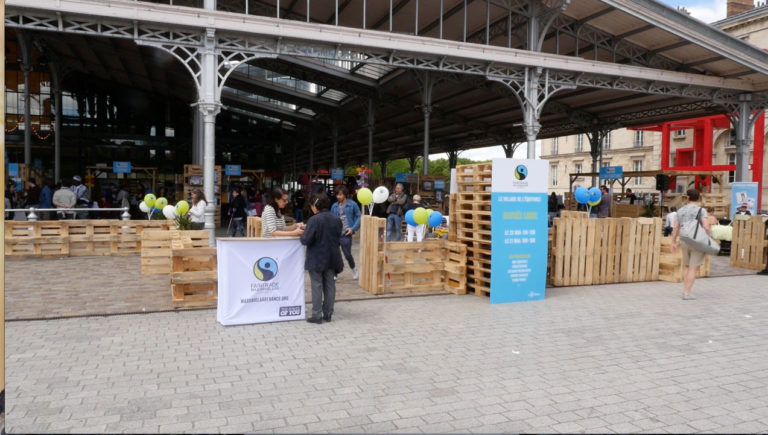
The movement is celebrated each year in the popular 15 Days for Fairtrade, which showcases products labeled ethical and sustainable. Max Havelaar France organizes workshops, festivals, pop-up villages and cafés, community dinners, concerts and movie screenings across the country to raise awareness about the movement.

Sarrazin-Biteye says she has seen its benefits in action.

The French spent $405 million on Fairtrade products in 2012 making it the second largest market for the label in Europe. (Photo by Kait Bolongaro)

“The average French person knows it's a label and they know it's good. The most work we have to do [from a campaign perspective] is to explain the motivation behind it, which is that producers are better paid"
- Emilie Sarrazin-Biteye

“Fairtrade is essential for consumers because they know who produced their products"
- Emilie Sarrazin-Biteye

“Fairtrade is essential for consumers because they know who produced their products,” she explained. “It is also beneficial for producers. It gives them a real space to sell their products and the objective is that they can have the means to live the life they want and guide the trading process.”

French enthusiasm for the Fairtrade brand was on display at the event in Paris. Passersby tried coffee and chocolate sourced from producers around the world and participated in activities designed to educate the public about the organization’s mission.

Elsa Bonnet said purchasing fair-trade products is a good way for Europeans to remember who makes their favorite items.

“I feel like I’m making a responsible gesture that will do something good for this world. I feel like a responsible citizen and I think of the people who are behind this label and I am happy to buy something that will help them,” she said.

Flavia Hofstetter, a working mother in her mid thirties, agrees with Bonnet, except for the pinch of the price tag.

“I feel better but poorer sometimes because it’s not always easy to buy [fair trade] because the products are a lot more expensive and it can be complicated sometimes,” she said.

The country’s most popular Fairtrade event is an annual fifteen day event that promotes the label such as at this Fairtrade village in Paris. (Photo by Kait Bolongaro)

Parting Of The Ways In The USA

Across the Atlantic, American consumers are also becoming more ethically minded when grocery shopping, according to recent data released by Fairtrade USA and the Natural Marketing Institute.

Consumer awareness is rising, with a reported sixty-seven percent of consumers recognizing the Fair Trade Certified seal, up from 59 percent in 2015. From 2015 to 2016, there was a 75 percent increase in newly released consumer packaged goods with the Fair Trade label.

Two of Fair Trade USA’s most popular retailers, Starbucks and Whole Foods Market, have openly shared their commitment to product origin and sustainable sourcing. Starbucks itself has pledged to buying 100 percent ethically sourced Fair Trade coffee.

Since 2012, Fair Trade USA has existed as its own independent label, following a break from the global organization Fairtrade International. Fair Trade USA declined to comment on problems emanating from some Fairtrade International farms in Africa. The US organization has said it split away to pursue more consistent applications of fair trade principals, to a greater farm population beyond selected cooperatives.

“Beginning in coffee, we are adapting Fair Trade standards for both workers on large farms and independent small holders.” The organization said in a statement published on its website. “Through this more inclusive model, Fair Trade USA can reach over 4 million farm workers who are currently excluded from the system.”

“Beginning in coffee, we are adapting Fair Trade standards for both workers on large farms and independent small holders.”
- Fair Trade USA

As a third-party certifier for more than 1,000 U.S companies, Fair Trade USA and its partnering certification bodies audit and certify supply chains, ensuring product compliance with Fairtrade International standards covering fair prices, wages and working conditions, along with sustainable farming practices to limit chemicals and protect the environment.

Fair Trade USA has historically focused on improving pay and working conditions in developing countries with the fewest legal protections, but has recently expanded programs to the Global North. Wholesome Harvest, a tomato farm in Amando, Arizona, is one such project paving this expansion. Because Fair Trade USA broadened certification eligibility to more estates, plantations and small-scale farms that are not organized into a co-op, their overall outreach differs from Fairtrade International, which restricts eligibility and focuses on particular crops and sectors.

This series was produced in collaboration with Journalists for Transparency, with support from Transparency International, the global anti-corruption organization.

MORE FROM THIS SERIES