Secular Turkey Strikes Back, One School at a Time

When the Turkish Ministry of National Education announced plans last summer to turn her daughter’s public school into a religious academy, Bercis Kaplama grew so upset that she dashed off a petition, and went door-to-door collecting signatures. She got 13,000.

Kaplama and other parents took the signatures to court and succeeded in stopping the conversion of this one school of 280 students. Her victory, however, appeared to do little to stem the tide of Islamic education flooding Turkey’s public schools.

[quote_box_right]Turkey’s President converts neighborhood public schools into training academies promoting Sunni Islam

Shift prompts widespread protest, felt at the ballot box on Sunday

Too soon to say what poll results will mean for classrooms[/quote_box_right]

Sunday’s elections may change that. Turkish voters dealt a severe reversal to President Recep Tayyip Erdogan, who had spearheaded the changeover of Turkey’s public schools to vocational schools dedicated to promoting Sunni Islam. The moves sparked large protests throughout the country.

Erdogan had sought a super majority that would have allowed him to rewrite the Constitution and create an unchecked executive presidency. Instead, his ruling Development and Justice Party (AKP) lost its parliamentary majority.

While it is clear that AKP’s increasingly Islamist policies drove secularists to rally at the polls, it’s too soon to know what Sunday’s election will mean for those schools that have already made the shift from public classroom to religious training ground.

Although Turkey’s population is 99 percent Muslim, the towering founder of modern Turkey, Mustafa Kemal Ataturk, planted the nation’s roots in secularism when he founded the Democratic Republic in 1923. Ataturk’s far reaching reforms, from writing a constitution modeled after European countries to banning the Ottoman alphabet in favor of Latin script, opened the country to the West and sparked a commitment to secularism that the judiciary and military would safeguard for decades to come.

On Erdogan’s watch, the government has shuttered public schools and reopened them as imam-hatips, religious schools with vocational training for clergy starting in the fifth grade. In these schools, segregated by sex, instruction focuses on Sunni Islam for up to 13 hours per week.

Kaplama is a Sunni Muslim, like the majority of Turks, but she calls herself a secularist. When asked about her religion, she pointed to the sky, and said: “That’s between me and my God.” To keep God out of her daughter’s school, Yesilbahar Middle, she filed suit against the Istanbul Education Directorate. Kaplama, who lives in the district of Kadikoy, a secular stronghold on the Asian side of Istanbul, convinced the court to reverse the order to convert her daughter’s school.

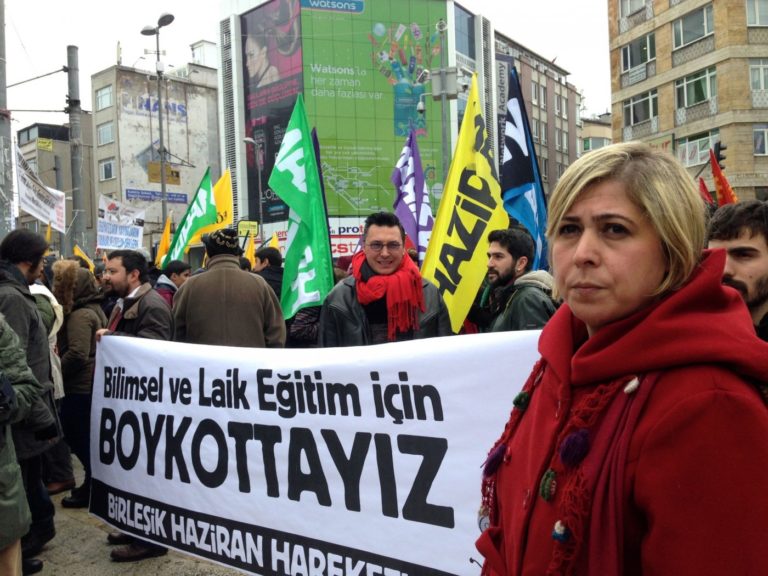
Sitting at a café in central Kadikoy, where a burgeoning anti-government protest was underway in the square below, Kaplama chain-smoked with her colleagues who oppose the religious schools. After several schools converted to imam-hatips this summer, she and other parents founded an advocacy group called Hands Off My School. Now she advises parents at eight different schools on how to resist reforms. She says she worries that, “The government wants a generation that doesn’t question anything, but is just loyal.”

Between 2011 and 2014, the Ministry of National Education increased the number of imam-hatips by 73 percent and closed almost 1,500 general high schools. Last fall, 40,000 students were placed in religious seminaries against their will, according to Turkish daily Hurriyet. Erdogan, a graduate of an imam-hatip, boasts that the number of students in these schools increased from 63,000 to almost 1 million since he took office in 2003. With no other public schools available in some neighborhoods, families are forced to enroll their students or pay for private school.

A Long Struggle

A few miles west of Kadikoy in Fatih, another district in Istanbul, women glide along cobblestone streets, their abayas pinned modestly above their mouths. Here, Mohamed Eslek, a smooth-faced 18-year old from southern Turkey, boards and studies at an imam-hatip. To Eslek, increasing enrollment is natural since the ruling Justice and Development Party (AKP) overturned what he considers discriminatory laws. Eslek explains, “Before there was a ban on imam-hatip schools. Now our government eliminated the restriction on schools and graduates.”The back and forth on education dates to 1997 when the Turkish military threw an Islamist prime minister out of office, shut down all imam-hatip middle schools and reclassified the schools so that graduates were often unable to attend mainstream universities. In the following years, enrollment in imam-hatips plummeted.In 2003 however, Erdogan became prime minister after the Islamic AKP won the majority in Parliament, with a pledge to expand rights for his base. Five years later, he attempted to lift Ataturk’s historic ban on headscarves but was sanctioned by the Constitutional Court for radical behavior intended to promote an Islamic state. In the following years, he gained power over the courts, clearing passage to lift the ban on headscarves for girls as young as nine. He passed an education bill in 2012 that restored imam-hatip middle schools and paved the way for construction and conversion of public schools.Eslek does not see anything wrong with imam-hatip construction. “It’s normal that people send their children to these schools. It’s a Muslim country and parents want these values for their children,” he said. Eslek said he hopes to work in religious affairs in the government administration, and his time in Istanbul and his degree will ease that path. Also, he said, “Preaching helps my communication skills.”Eslek was selected to participate in a government program for boys who want to preach professionally, and he now studies at one of the most prestigious imam-hatips in Istanbul. He says it’s like other schools, “except that we spend 60 percent of our curriculum on regular course and 40 percent on religion.”The trophy section in his school’s lobby, which brims with wrestling prizes, could be anywhere in America, but the standard photo of Ataturk, a requirement in all government buildings, is uniquely Turkish. TV monitors direct students to classrooms equipped with white boards. Framed Quranic verses and a monochrome photo of post-World War I-era imams, in turbans and kaftans, dress the stairwell.After he won first place in a preaching contest at his school, Eslek went recently to Fatih Mosque to compete in a district level competition. As he took the pulpit, he sister, Merre, sat far behind the men, a tight black headscarf flowing into her gray robe.Merre, who is an Islamic Studies major at her university, bristled when asked about her experience at an imam-hatip. “We are just like anyone else! What do people think, that we are just praying all day?” From the pulpit, Eslek uttered the Bismillah prayer in Arabic before launching into a sermon he had downloaded from the website of the Directorate of Religious Affairs, describing how the Prophet Mohammad cried tears of joy when a wandering friend returned to the faith.Huseyin Korkut, the director of Onder, an umbrella organization for alumni of imam-hatips, argues that government oversight ensures quality education and morality. His office is in the second story of a government-funded mosque, and from there he told 100Reporters, “Unlike some schools in Pakistan, imam-hatips aren’t uncontrolled. They are under the supervision of the ministry. It’s a formal education.”Korkut describes the 1990s as a time of struggle, and says that Onder fought against the military government for people’s rights. He says the military’s actions were based on a fear that, “We’d end up with an electoral majority shaped by imam-hatips that could form a significant political party.”Marc Gopin, director of the Center for World Religions, Diplomacy and Conflict Resolution, says history is an important factor in explaining events in Turkey today: “The severity of Ataturk’s reforms and repression created a backlash in the same way that the Shah of Iran created Khomeini.”Professor Ahmet Turan Arslam, an alum of the imam-hatip that Erdogan attended, harkens back to Ataturk’s days in his account of restricted religious freedom. In the school’s alumni magazine, Conquest,he writes, “The government didn’t promote religion and refused Arabic and Persian words so people were forced to forget their religion and language… In villages then they couldn’t even find imams for a funeral.”Now, Korkut says, “The new government removed the inequalities against imam-hatips and restored rights.” Still, he recognizes that imam-hatips, “don’t reflect Turkey’s diversity.” He proposes an effort to integrate other Muslims to the imam-hatip educational system, including Kurdish language speakers and Shi’a Muslims.

A Fight with the Koran in Hand

Alevis, who make up 15-25 percent of Turkey’s total population, alternatively identify as Shi’a or as a culture with its own unique characteristics. Since the AKP ramped up Sunni education in schools, Alevis have protested by the tens of thousands. “They are trying to convert Turkey to a Sunni country like Qatar or Saudi Arabia. They don’t have any respect for any other religion or sect,” said Dogan Bermek, chairman of Cem Vakfi, one the largest Alevi organizations in Turkey. “They keep openly educating people with more Wahabi influence.”Bermek urges the government to incorporate an unbiased portrayal of Alevism into religious education. “At the end of the day, we all have the Koran in hand,” he said. Instead, he added, “Imam-hatips push only one branch of Islam.”Korkut, of the alumni group, says he would work with the Ehli Beyt Foundation, an international Shi’a organization headquartered in Fatih to include more Alevi teachings in imam-hatip curricula based on “written sources” that emphasize similarities between Alevi and Sunni beliefs, and not what he calls, “false beliefs,” or the syncretic oral traditions that guide much of Alevism.But mainstream Alevis say the foundation misrepresents their beliefs. “That’s a highly fundamentalist Shi’a organization,” Bermek said. “They are not Alevis and cannot be accepted by Alevis. It’s an AKP puppet organization.”Imam-hatips now make up 10 percent of public schools in Turkey, but Bermek’s bigger fight is against Sunnification of mainstream education. In 2005, he opened a case with the European Court of Human Rights (ECHR) on behalf of almost two thousand Alevi families whose children were forced to attend compulsory religious classes.In September 2014, the European Court ruled that Turkey’s compulsory, confessional Sunni religion courses are a violation of children’s rights. The court rejected Turkey’s attempts to revise the content of the courses as insufficient. Erdogan brushed the decision aside, saying that without the classes, children will fall prey to bad influences, “sometimes a drug, sometimes violence, sometimes organized violence turned into terror.”Now, secular parents fear that the government is trying to turn all public schools into imam-hatips by changing the curriculum. Last year, an opposing party played an audiorecording at a press conference in which President Erdogan’s son, Bilal, allegedly talked to education officials about plans to increase imam-hatips, but also to increase the Islamic content in all public schools up to 11 hours so it would be “like having imam-hatips.” Critics of recent reforms, such as the secular teacher’s union Egitim Sen, argue that students already must take 10 hours of religion per week: two compulsory hours and eight “elective” hours that are de facto compulsory because national exams require related content knowledge.At a National Education Council meeting in Ankara in December, officials voted on a number of proposals to strengthen religion requirements, including the introduction of “values education” for pre-school children. The National Education Council also ruled that compulsory religion classes should start in first grade rather than fourth grade. In northern Turkey, according a Turkish daily newspaper, one religion teacherrecently told seventh grade female students that since they weren’t wearing headscarves, “raping you or doing evil to you is permissible.”

Blood Across the Border

On the other side of Turkey’s southern border, the Islamic State’s interpretation of Sunni Islam has served as its justification for the massacre of untold thousands of Shi’a and Yazidis, Christians and Sunnis.Critics warn that by proselytizing Sunni Islam alone among the young, Turkey’s leadership is polarizing society. Dengir Mir Mehmet Firat, who co-founded the AKP but left the party in 2011, told 100Reporters that the AKP’s emphasis on Sunni education could spur sectarian violence. Firat warned, “In the past we had such kinds of problems…There was fighting between the Sunni and the Alevi, and it could happen again.”Firat added that because the AKP “assumes that Alevi are not Muslims,” and demonstrates this bias in its education system, some Alevi react by identifying as “secular” and then join “left parties and make radical movements and protests and clash with police.” Citing the history of Alevi repression in Turkey and the strand of Alevi involvement in leftist groups, some Turkish media reports warn that a Sunni-Shia confrontation is a serious threat.Among Turks, public opinion surveys suggest that support for the use of violence in defense of Islam is growing. A January poll by the Ankara-based Metropoll Strategic and Social Research Center, done after the Charlie Hebdo attacks in Paris, found that 20 percent of Turks surveyed “approve of the use of violence in the name of Islam in some cases,” up from 13 percent in September 2014.Korkut, of Onder, dismissed the claim that Turkey’s strictly Sunni education encourages radicalism. Imam-hatips must teach “the middle way,” he said, asserting that, “Among the graduates almost no one joined al Qaeda or ISIS.”In nearby Jordan, the tenets of Sunni Islam pervade all aspects of the curriculum. According to the Jordan Times, the former education minister says the curriculum contains messages that “erase the other,” including Christians, and fails to mention the “truth of the past and present,” steps that can lead to extremism. Similar critiques are heard today in Turkey. Thousands of Jordanian youth are fighting with ISIS in Syria, and the monarchy battles pro-Islamic State sentiments and protests at home.

Education as Politics

e United June Movement recently organized a schools boycott and marches in cities across Turkey to protest the changes in education. The coalition of leftist parties is named after the month of the anti-government Gezi Park protests in 2013.At the boycott, hosted in a left-leaning community center, volunteers from the secular teachers’ union Egitim Sen staffed events. Parents signed up children and teens for seminars on subjects including Darwinism, gender relations and human rights.One of the delegates, Emre, a high school geography teacher who declined to give his last name because he is a government employee, noted that after the Gezi Park protests President Erdogan acknowledged that, “there’s a part of society that they can’t transform.” This is why, Emre said, “after 2013 they sped up education reforms. They say, ‘If we can’t transform adults, we will transform the youth.’”Emre helped organize a march from downtown Kadikoy to the Directorate of Education last month. Crowds gathered the same day in half a dozen cities in Turkey chanting, “Viva our united struggle” and “We will destroy the AKP.” Police circled schools and some administers locked schools to keep in students. Police, whodetained a teenage boy accused of insulting the president, fired water cannons on the crowds.That morning Biru Yildiz, a waiter at the community center, called his daughter’s private school to tell them she was out protesting. After her school was converted to an imam-hatip last year, he spends most of his income on her $3,000 annual tuition. Yildiz said, “As a socialist, I believe school should be free. I have difficulty paying tuition, but I will never send her to an imam-hatip.” To him, the changes in education, “create tension in society” that otherwise don’t exist between religious groups.Beza, a lanky teenager with a low-riding backpack, attended the boycott with other Kadikoy middle school students. She said, “We watch the news. They are converting many schools and there’s no need for more.” In addition to two compulsory hours of religion, electives at her school now include the Life of the Prophet, Koranic Studies, Ottoman Languages and Arabic. Her classmate, Sema, however, expressed interest in attending an imam-hatip, saying, “I heard that they are learning Arabic and Ottoman languages… I will want to use a headscarf when I turn 15, so that won’t bother me.”The Alevi community, having staged a protest in Istanbul the day before, was conspicuously missing at the February boycott. Bermek explained Alevi absence: “We shouldn’t use children for our political message,” he said. “We don’t support that. That would make us the same as the AKP.”Several weeks later, local leadership in Kadikoy hosted an education conference featuring the leader of the main political opposition in Turkey, Kemal Kilicdaroglu. He denouncedTurkish officials for pushing reforms developed by politicians, not educators. He pointed to declining learning outcomes, and said, “Why cannot we bring to life an education policy that frees the mind?” Turkey placed 44 out of 66 countries on an international assessment of students from nations belonging to the Organization for Economic Cooperation and Development (OECD) in 2012, and 36 percent of Turkishyouth are not in school or working, the highest recorded rate among OECD countries.Although the opposition checked the AKP at the ballot box, dismantling Islamic education will be tough, says Batuhan Aydagul, who ran for parliament on an education platform. According to Aydagul, the AKP stuffed the education system with party loyalists at all levels and now, “The AKP wouldn’t go back. They did what they wanted to do while they had the advantage. Why would they give it up now?” He describes the imposition of imam-hatips where children have no option for secular education as a “clear violation of human rights.”

Journey without End

ermek recently attended a groundbreaking ceremony for an Alevi clergy education center in Istanbul. It’s an illegal center, unrecognized by the government. As a secular state, the Turkish government limits or controls all places of worship and does notrecognize facilities to train Alevi, Armenian, Syriac, Catholic or Protestant clergy.Bermek took another case to the European Court of Human Rights, arguing that if the government funds clergy education for Sunnis, they should do the same for other religions in Turkey. The Grand Chamber will rule on the case this month, although Bermek holds out little hope that the government would comply with an adverse ruling.Despite his complaints against the Turkish government, Bermek says the Turkish people generally accept one another: “They don’t discriminate against Alevis. All this is new… We don’t want to see Turkey like this.“Most people voting for AKP don’t want a fundamentalist state,” Bermek said. While the Turkish people are accepting of other religions, AKP politicians are different. “They are always trying to do more,” Bermek said, “because fundamentalism has no end.” Photos from top: Bercis Kaplama at a rally in Kadikoy to protect secular education. Photo by Xanthe Ackerman; Mohamed Eslek preaching in the Fatih Mosque during a Koran reading contest. Photo by Ekin Caliser; Mohamed Eslek preparing to walk up the pulpit stairs and preach at a Quran reading contest in Fatih Mosque.Photo by Ekin Caliser; The personal effects of some of an estimated 1,700 Iraqi troops reportedly executed near Tikrit last year and buried in a mass grave by Islamic State fighters. Photo by John Moore/Getty Images; Girl drawing at the school boycott organized by The June Movement. Photo by Xanthe Ackerman;  Mohamed Eslek and other contestants in a Koran reading contest in Fatih Mosque. Photo by Ekin Caliser.

Syrian Refugees: Uprooted and Out of School

When Faud al-Shiekh Sanaa, a gaunt master teacher from Aleppo, made his way to Turkey with throngs of other refugees from Syria in July 2012, he immediately set about registering children for school. Classes back home would have started in September, and there was little time to waste.

As Sanaa’s list climbed to 1,200 names, he wrote to local authorities for help. There was need, but no space available in the Turkish schools in Kilis, the border city where the children had landed.

By November, with backing from international and Turkish charities, Kilis’s governor, Süleyman Tapsız, presided over the opening of the “Culture Center for Syrians.”

Now, Principal Sanaa’s center teaches 2,000 Syrian children. Students attend in three shifts, each no longer than three and a half hours.

The arrangement works—as long as the center is not called a school and its students are not called refugees.  Its survival hinges on the kindness of local officials, as Turkey grants the Syrians “temporary protection,” but not refugee status.

“Syrians are not legally allowed education here in Turkey,” Sanaa said. Although classes are teeming with up to 70 students, Sanaa counts himself lucky. The leadership in Kilis is unusually generous towards Syrians.  “The Turks turn a blind eye. They give us everything we ask for.”

But in distant Istanbul, where buildings and land are scarce, goodwill doesn’t stretch as far. Syrian-run centers there get little support. Principals resort to letter writing campaigns to pay the rent. Financial strains can lead to mismanagement, delays in teacher payroll, and tuition hikes.

Amal Shaban, an educator from Damascus, turned a rundown four-story building reminiscent of a New York tenement into a school for 250 students.  The Message of Light Center stands in the garment district of a busy downtown neighborhood. Just the same, Shaban had to turn away over a thousand students who couldn’t pay fees last year.

Teachers lack textbooks for some courses, and students often can’t afford the photocopies. During a visit there, Shaban offered a visitor a juice box, given by the municipality. Because Syrians don’t have the right to education in Turkey, she takes any small gesture from the government as a gift.

By most measures, Turkey has been generous to the 1.36 million Syrians who fled there from the civil war to the south. The country hosts over a quarter of all Syrian refugees. It does so with far less foreign aid than its neighbors, meaning Turkish taxpayers shoulder a disproportionate cost for responding to the crisis.

Yet Syrians in Turkey are labeled as guests of the state, not refugees. The lack of refugee status hinders outside oversight and assistance, and deprives the Syrians of rights guaranteed under international conventions. These agreements give refugee children the right to education, and their parents the right to work.

Some 325,000 Syrian youngsters are out of school in Turkey. The Syrian opposition government’s education minister says they represent a “lost generation” in danger of becoming a “mafia of terrorists, drug dealers, and thieves.”

With their status so precarious, Syrians in Turkey cannot easily advocate or organize.  Because most Syrians cannot work legally, poverty and exploitation are rampant.

“We don’t know the language of rights,” said Abdul, a Syrian father whose brother was killed in a demonstration in Homs. “There were no rights in Syria.”

Turkey’s Hospitality

As a backer of the Syrian opposition, Turkey was quick to support fleeing Syrians. The Ankara government opened its borders to Syrians when the revolution turned violent in April of 2011. Its magnanimity promoted Turkey’s image as a prominent and capable regional power.

Turkey created 22 state-of-the art camps to host 220,000 Syrians in border areas.  There, the newcomers receive health care and access to education. In camps, 93 percent of children are enrolled in school. UN Secretary General Ban Ki Moon and Goodwill Ambassador Angelina Jolie have visited and praised these camps.

Muhammad Maari, a 26-year-old English teacher in Akçakale Camp on the Syrian border says that Turkish officials “always try to help us.” Maari fled Syria in March 2013 when he was conscripted for Bashar al-Assad’s army. Now, he teaches in a row of tents that serves as an education center. Some 8,000 children cram into the tents each day, split into separate shifts for elementary, middle and high school classes. The government provides desks, white boards, and notebooks. Maari lacked some textbooks this year but he made do with photocopies of books smuggled from Syria.

Yet Syrians are routinely turned away from camps, given limited capacity. Anna Shea, legal advisor on refugee and migrant rights at Amnesty International, said she found over a hundred people waiting outside the camp at Akçakale, hoping to get in, when she visited. Some had been there 45 days without cover from the scorching sun. At night they slept with their children on cracked earth, she said.

Contain and Control

Alongside its generosity, however, Turkey’s government has kept tight control over its response to the refugees. Security concerns and an underlying mistrust of foreign actors have fueled Turkey’s hesitation to work with partners, and limited the access of outsiders to Syrian children.

It took almost two years for the Ankara government to grant UN agencies access to the camps. Only at the end of 2012 did UNICEF begin planning to support work on education in camps.

Because five out of six Syrians in Turkey live outside of camps, UNICEF also advocated for services outside camps. In 2014, the government finally approved the construction of 50 schools, but restricted them to ten southern provinces.

Now the UN and advocacy groups in Turkey are pushing for more services in northern cities. The government prefers to concentrate Syrians in the south, but advocates estimate that 300,000 Syrians live in Istanbul alone.

Sema Genel, executive director of Support to Life, a Turkish nongovernmental organization (NGO), says that authorities discourage her and other organizations from providing services to Syrian children in Istanbul. The country’s Disaster and Emergency Management Presidency (AFAD), which oversees refugee policies, has proposed the more drastic measures of moving people into border areas and camps. Genel says that Syrians need help where they are. “There is serious mistrust between the government and the NGOs.  We need government consent and we don’t want to be on negative terms,” Genel said. Operating without government approval is risky: Officials could shut her nonprofit down.

“We don’t know the language of rights. There were no rights in Syria.” –Abdul, a Syrian father.  

Of Pride and Prejudice

In the absence of a large-scale government effort outside of the camps, Syrian-run centers providing education in Arabic have proliferated in Turkey. The number of centers is unknown – estimates range from 50 to 150. These centers educated approximately 40,000 Syrians last year.

Though it does not recognize them as schools, Turkey’s education ministry is now faced with regulating these unofficial education centers.  The ministry has announced plans to hire supervisors to guarantee facilities meet minimum standards or shut them down. Teachers at the centers will not earn salaries, but rather incentives worth as little as $100 per semester. Educators without regular salaries often have to look for work on the side, even if it means disrupting their teaching calendar.

Last year, 8,000 Syrians with residence permits enrolled their children in Turkish schools, according to government figures. It’s a hard road for Syrians, especially those that don’t speak the language. In a bid to make it easier for children to enroll, Turkey is planning to waive the requirement that students have residency permits, but language remains a barrier.

Muhammad Mahmoud, once a real estate agent in Aleppo, fled to Istanbul at the end of 2012. There was no referral agency to help him. He found a Syrian-run educational center in the neighborhood for his 12-year-old daughter Sidra, but it cost $100 per month plus bus fare. It took until September of 2013 to learn from neighbors that Sidra could attend the nearby public school.

“The war has affected children more than adults,” Mahmoud said. “Time is passing and taking their youth.” The family lives in a narrow slice of an apartment in Istanbul’s Fatih district. With Mahmoud out of work, the family gets by on what his wife and daughter earn folding shopping bags at a small factory.

Sidra picked up some Turkish on the street but found it hard to follow the lessons. “There were no other Syrian children except for one Turkmen girl who spoke Turkish,” Sidra said. At school, Sidra dodged boys in the hallways who yelled, “Go back to Syria! When you arrived you brought problems.”

Two miles south, in a neighborhood near the waters of the Golden Horn, Terfa Mala, a Kurdish Syrian from the northern countryside of Syria, said that her eight-year-old son Yusuf was turned away at the local school because he didn’t speak Turkish.

Yusuf is too young to attend the public education centers that offer language courses to adults. He now wipes floors and shoulders in a barbershop from 8:30 a.m. until 11p.m., six days a week.

Maintaining Control, Losing Support

In protracted refugee crises, some governments provide language instruction, with a view to helping refugee children adapt to national education. For many Syrians, enrolling in Turkish school means formal education and a possible pipeline to college. Language is a barrier for many, however, and expanding language instruction is expensive.

Turkey has been hesitant to work with outside agencies on solutions. A Brookings Institution report found that Turkey threw up unnecessary roadblocks to nonprofit organizations that arrived hoping to assist in the crisis, instituting a cumbersome and opaque registration process. Ankara has responded to criticisms by allowing more NGOs to register, but few work on education.

If the education ministry were to spend half as much on students in temporary centers as they do on Syrians in Turkish schools, it would cost $180 million per year. The national education ministry hopes to rely on support from international donors, though it has no commitments in place.

Turkey’s management style has come under criticism from the nonprofit International Crisis Group, which cited donor concerns about how the country asks for money. Most foundations work through aid organizations, but Turkey prefers to channel assistance through national institutions. Seemingly as a point of pride, Turkey has also fueled the misperception that the country does not need help. It has focused international visitors’ attention on high quality camps, and has prevented UNICEF from assessing the number of children out of school.

Perhaps because of this, the efforts of UN agencies in Turkey to raise funds for the Syrian crisis have brought little success. In its 2014 regional appeal for support, the UN asked for $497 million and received only $103 million, or 21 percent. On average, UN agencies and partners in other countries hosting Syrians received 43 percent of their appeal.

Mazen Aboulhosn of the International Organization for Migration has heard staff at the Turkish education ministry say that, “They won’t waste time with small NGOs that have only $100,000 or $2 million to spend in the country.” Aboulhosn says, “It is beginning to change, but it is not the mentality that you usually see in an emergency situation.”

Education ministry officials told 100Reporters that they do not know which international non-profits are working to educate the Syrians who have fled war. In contrast, in Jordan, Syria’s neighbor to the south, UNICEF coordinates at least 18 international organizations supporting education.

Guests, not Refugees

While Turkey is a signatory to the 1951 Convention on Refugees, it is one of only four countries that restrict that convention so that only Europeans are considered refugees.

Hurşit Güneş, a lawmaker and former vice president of the opposition Republican People’s Party (CHP), said that Turkey’s interpretation “was meant to imply that Turkey was part of the West.” He argues for lifting the limitation on moral and practical grounds. The policy, he said, “is racist,” and deprives Turkey of international aid for refugees.

Instead, Turkey granted Syrians fleeing the war “temporary protection” status in 2012. This concept was loosely based on a European Union directive. But Turkey still has not given it a legal basis.

Last year, the Turkish government wrote the Law on Foreigners and Protection. Although it took four years to write, the law punted on temporary protection, saying it would be defined by a new agency in 2014. Once formed, that agency told advocates that Syrians’ rights will be defined separately by a Council of Ministers.

However, those rights remain undefined.

Metin Savaş, the Secretary-General of Kimse Yok Mu, one of Turkey’s largest humanitarian organizations, says that education for Syrians should be legal. In Turkey, “Laws do not allow us to give an education in Arabic,” so centers are not considered schools.

Meanwhile, amid unclear rights and policies, pressures are building. A slew of anti-Syrian protests and attacks are sweeping the country. Some Syrian children fear harassment when walking to and from school.

Recently, students at Gaziantep University, not far from the Syrian border, tried to hold a demonstration, but the university denied their petition to organize. Their message, said Fadi Kurdi, an English Literature student from Aleppo, was twofold: “We have a right to be here, just like you,” and also, “Thank you for having us.”

Photos by AFP/Getty Images