Gold and Guns: Aftershocks of War

Gold and Guns: Aftershocks of War

by Kaleab Girma and Ashenafi Endale

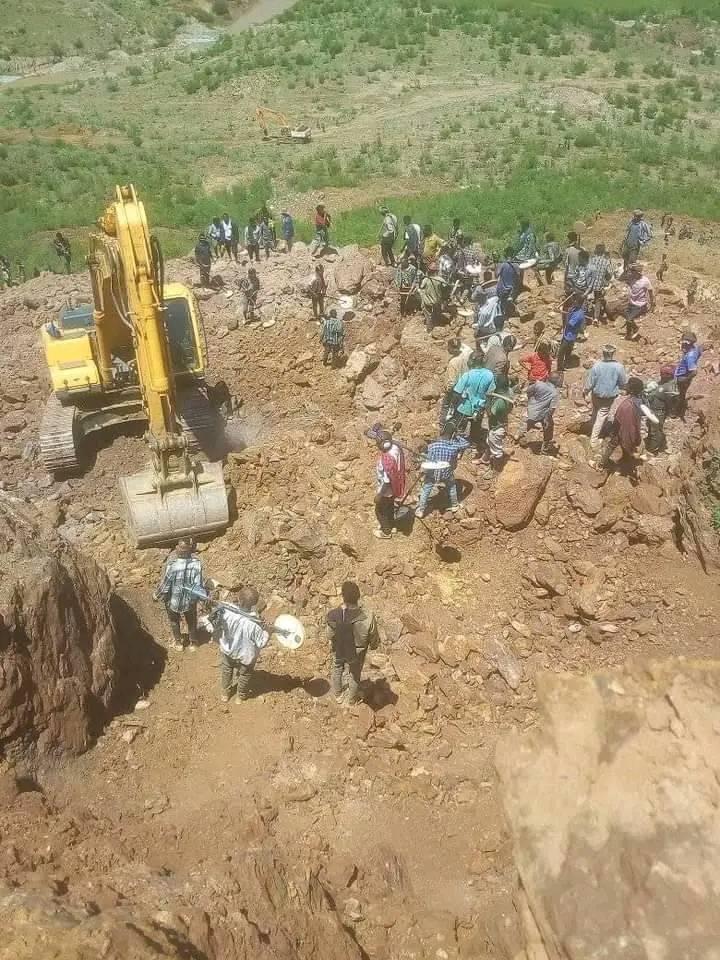
When an excavator appeared at Tsion’s doorstep in the Tigray region of Ethiopia, the 37-year-old mother immediately understood why it came. Accompanying the machine was a group of foreigners, escorted by armed TDF members.

“They told me they needed the land for mining,” she said. “I refused, and they imprisoned me.” After a week of detention, Tsion was released. But upon returning home, she was devastated by what she saw.

The land was almost gone. They had excavated it and transported all the soil elsewhere. Within a week, they had dug day and night. They did it because my land had gold. They took the soil, washed it in another location, and extracted the gold.


Tsion

Tsion has never been the same since. Beyond losing her ancestral farmland and any gold it held, she has also suffered mentally and emotionally. Her experience reflects a broader tragedy unfolding across Tigray.

Land grabs and clashes are frequent at illegal mining sites across Tigray, where several dangerous confrontations have erupted over gold-rich areas.

These often break out when local residents resist attempts by Tigray TDF generals to seize land and hand it over to foreign mining operators. Disputes over gold profit-sharing are also a frequent trigger.

A particularly deadly clash occurred in August 2024 in Rahwa village. The area, known for its substantial gold reserves, has been heavily militarized and densely populated by illegal miners since the end of the conflict. Witnesses report that more than twenty people were killed in a violent altercation between local laborers and foreign operators. The conflict reportedly began when the locals demanded a share of the gold proceeds.

Media suppression has become another concerning trend linked to the illegal gold trade. In March 2025, this reporting team was detained and interrogated while reporting on the illicit gold market in Tigray. The team was forced to delete camera footage before being released. 

In a separate incident in December 2024, unidentified assailants kidnapped three journalists from Tigray Television who were investigating illegal mining in the region. Their abducgtors released the reporters hours later.

A joint field survey conducted by several opposition political parties in Tigray also reveals widespread reprisals and killings of opposition party members and local activists who reported illegal mining activities.

Health Crisis & Environmental Collapse

The use of mercury and cyanide in illegal gold mining in Tigray has wrought environmental damage and serious health problems for residents. They include acute poisoning, respiratory diseases, cancers, and irreversible health damage, disproportionately impacting vulnerable populations such as children, pregnant women, and the elderly.

In an open letter addressed to Tedros Adhanom, Director General of the World Health Organization (WHO), Tadele Mengistu, who was serving as head of the Transport & Communication Bureau of Tigray, urgently highlighted the unregulated use of toxic chemicals in mining operations across Tigray and called for immediate WHO intervention.

Toxic contamination from illegal mining is rendering farmlands barren.


Tadele Mengistu - Head of the Transport & Communication Bureau of Tigray

“The unregulated use of toxic chemicals, including cyanide, mercury, and arsenic, in mining operations is causing widespread environmental and public health disasters,” Mengistu wrote in December 2024.

He warned that the contamination of rivers, agricultural lands, and ecosystems is threatening vital water sources, such as the Tekeze River, and rendering farmlands barren.

Mengistu also called for an international investigation into those responsible for the destruction, including the federal government and “foreign entities.”

In 2024, the Tigray administration issued an order to suspend all mining activities following reports of the use of hazardous chemicals, such as mercury and cyanide. However, this directive was not enforced.

According to the Addis Standard, a local media outlet, protests by residents of Asgede district against the use of harmful chemicals earlier this year resulted in the arrest of more than 20 residents by local security forces.

If left unchecked, large areas of Tigray could become uninhabitable, displacing populations and causing irreversible damage to biodiversity. The contamination risks erasing Tigray's cultural and environmental heritage, leaving a toxic legacy that could persist for generations


Tadele Mengistu

The side effects of mercury exposure have long been established by the scientific and international community. Extended exposure can cause mercury poisoning and lead to kidney damage. It can impair hearing, vision, and balance.

“We are already seeing the effects. There have been instances of cattle and goats dying, and children suffering from skin ailments in affected areas,” said Desta Hailu, an environmental geologist and lecturer at Mekelle University. 

“If a parent is exposed to these chemicals, their children may suffer severe birth defects,” he added.

 “These companies and individuals must be penalized, and those penalties should fund rehabilitation and compensation efforts. Above all, they should be banned from continuing operations.”

However, because this rampant illegal gold mining is being run by government officials and security forces, we are unable to deliver justice to the people.


Judge in Shire town

A judge in Shire town, who asked to remain anonymous for fear of repercussions, said his courtroom is seeing more and more cases arising from environmental hazards caused by illegal mining operators.

The cases involve “farmers, landowners, and residents whose livestock have died, whose soil has been degraded, and whose children’s skin has been affected” and who are suing the operators of the mining sites, the judge said. 

Discrepancies in Export Figures Trace Ethiopia’s Smuggled Gold to the U.A.E.

Multiple studies have identified the United Arab Emirates (U.A.E.) as a major destination for Africa’s smuggled gold. In 2019, a Reuters investigation found that billions of dollars’ worth of gold was being smuggled out of Africa every year through the U.A.E., which served a gateway to markets in Europe, the United States and beyond.

A more recent report by  SWISSAID, an NGO, found that between 2012 and 2022, some 2,569 metric tonnes of undeclared gold from Africa—then worth a staggering $115 billion—ended up in the U.A.E. 

Under current gold prices, the same amount of gold would be worth $278 billion.

These gaps are not incidental; rather, they reflect a broader pattern, in which the U.A.E. functions as more than just a passive recipient of illicit gold from illegal gold sellers and traders. This role is also consistent with a wider strategic stance attributed to the U.A.E.: attracting billions in trade, cultivating deep regional influence, and leveraging that power to secure vital resources. 

Ethiopia’s official ties with the U.A.E. also reflect this dynamic. Since taking office in 2018, Prime Minister Abiy Ahmed has relied heavily on Gulf capital to support his ambitious development agenda. Just months into his term, Dubai pledged $3 billion in aid and investment to back his economic and political reforms and to ease Ethiopia’s foreign currency shortages.

The U.A.E has financed numerous high-profile projects in Ethiopia, including the Unity Park in Addis Ababa and a stadium currently under construction, with a reported investment of $57 million.

Several investigative reports have also uncovered the U.A.E.’s involvement in the Tigray War, alleging that it provided substantial military support to the Ethiopian government. This support reportedly included air bridges, weapons, drone supplies, and training for the Ethiopian Republican Guard.

While support has been arriving from Dubai, Ethiopia’s gold has been flowing in the opposite direction toward the U.A.E.

The United Nations Commodity Trade Statistics Database (UN Comtrade), detailed imports and exports statistics reported by countries, shows that the majority of Ethiopia’s official gold exports in recent years have been destined for Dubai. 

But this trade data also shows more than official exports. A comparison of gold exports reported by Ethiopia with gold imports declared by the U.A.E. reveals significant discrepancies.

Between 2021 and 2023, the National Bank of Ethiopia officially reported gold exports valued at $1.148 billion. However, Dubai reported importing $1.6397 billion worth of gold from Ethiopia during the same period, indicating an unaccounted $490 million in gold exports in 3 years. 

Experts believe that Dubai’s import figures vastly undercount Ethiopian gold. 

Marc Ummel, Head of the Raw Materials Unit at SWISSAID and co-author of SWISSAID’s study on undeclared African gold flow, notes that assessing gold smuggling from Ethiopia requires examining the export figures of neighboring countries. “Ethiopia is a landlocked country. Some of the gold smuggled from Ethiopia typically exits through Eritrea and Somalia before reaching U.A.E.,” he explained.

“In 2023, the U.A.E. declared it imported 5 tonnes of gold from Somalia. While Somalia does have some small-scale mining, the volume of exports is suspiciously high.

“Looking at the region as a whole, it seems clear that a substantial amount of gold entering the UAE from East Africa is routed through neighboring countries to obscure its Ethiopian origins,” Ummel said.

In 2023 alone, the U.A.E. reported importing 37.9 tonnes of gold from Ethiopia, Kenya, Somalia, Sudan and Eritrea, valued at $2.28 billion.

Tigray’s Uncertain Future

Amid internal divisions within Tigray’s leadership, TPLF, the region’s military, has emerged as the dominant political force. A high-ranking TDF general has now been appointed as the new interim president of the Tigray region, replacing Getachew. 

Tensions are once again mounting between the federal government and Tigray’s regional authorities. High-stakes rhetoric has returned, threatening the fragile post-Tigray war transition.

A familiar source of friction, illegal gold mining, has also re-emerged as a key point of contention, with major public announcements implicating military generals in illicit mining activities. In mid-May 2025, foreign nationals were barred from entering Tigray. 

As the situation escalates, many fear the region could once again descend into conflict, prolonging the suffering of the people of Tigray.

Reporting for this story was funded by Transparency International. A version of this story is being co-published with The Continent.

Gold and Guns: How Military Rule, Foreign Deals, and a Looming Crisis Plunder Post-War Tigray

Gold and Guns: How Military Rule, Foreign Deals, and a Looming Crisis Plunder Post-War Tigray

by Kaleab Girma and Ashenafi Endale

Kelali is a former soldier turned gold miner, one of thousands navigating life after war in Tigray. A combatant with the Tigray Defense Forces, Kelali fought in the bloody conflict against the federal government. Like many others, his return to civilian life offered no structure, and no resources.

The war destroyed Tigray and our old way of life,” Kelali said. “After the war, there was nothing we could do. And there was nothing the military leadership could offer us in return for our sacrifice or for our future."


Kelali, ex-combatant

Kelali, who asked to be identified by his first name for his security, is a father in his early thirties, also responsible for caring for his mother. Like Kelali, his younger brother also served in the war.

In the last few years, large amounts of gold have been smuggled from Ethiopia’s Tigray region, with an estimated valued of over $2 billion for the 2024/25 fiscal year alone. This figure could rebuild schools, fund hospitals, and revitalize the war-torn region. Instead, it lines the pockets of a few powerful generals and foreign actors.

Today, deadly clashes are occurring over these precious resources. Illegal mining has ravaged mountains in Tigray, with miners pouring massive quantities of mercury into rivers, threatening both the environment and public health.

Backed by foreign partners and enabled by weak oversight, the system persists—rooted in the war’s legacy and propped up by flows of gold to markets in the United Arab Emirates and elsewhere.  

The Tigray War, which broke out in November 2020, marked one of the deadliest conflicts in recent African history. It pitted Ethiopia’s federal government under Prime Minister Abiy Ahmed against the Tigray People’s Liberation Front (TPLF), a once-dominant political force.

Between 2020 and 2022, the conflict devastated Tigray and surrounding regions. An estimated 600,000 people lost their lives, and more than 3 million were displaced. The war also drew in external actors, notably the Eritrean military, which fought alongside federal forces. All sides were accused of gross human rights abuses, including mass killings, widespread sexual violence, and the deliberate destruction of infrastructure.

On November 2, 2022, the federal government and the TPLF signed a peace agreement in Pretoria, South Africa. While large-scale fighting ceased, substantive progress on the full agreement has been limited. Much of Tigray remains in ruins. Political instability continues to cast a long shadow.

In the absence of other economic opportunities, regional authorities allowed ex-fighters of the Tigray Defense Force (TDF) to form mining cooperatives, typically bands of 25 people, and allocated plots of land to mine gold either manually or with basic equipment.

We mine the gold using traditional manual methods. Then we sell it at local markets.


Kelali

The town of Shire in northwestern Tigray, epicenter of Tigray’s black-market gold trade, serves as a collection and distribution point, with artisanal mining concentrated within a 100 kilometer radius.

At Shire’s bustling black-market gold hub, located just off the main road leading toward Hayelom Square, small scale miners openly sell their gold to buyers.

The market gets busy around 3 p.m., as buyers and sellers call their sources to check gold prices on world markets. Transactions occur openly and are settled through cash or checks, with larger buyers often purchasing on credit and paying the miners after smuggling the gold abroad.

In mid-March, a gram of gold went for around $106, roughy 25 percent higher than the government-set price. Black market exchange rates and foreign gold prices, particularly those in Dubai dictate the prices.

In Ethiopia, individuals or entities with the proper licenses can buy gold. But only the National Bank of Ethiopia may export gold under the law.

A 2024 report by Khermed Law Firm, a Tigrayan firm that investigated illegal mining, estimated that over 100,000 traditional artisanal gold miners are operating in the region.

But Kelali explains these small-scale mining operations are just a tip of the iceberg. “Top TDF generals have seized control of the most gold-rich areas,” he said. They employ armed ex-combatants to protect their holdings.

“The involvement of civilian and military leaders in illegal mining and looting is a major factor contributing to this crisis,” the Khermed report found.

Military control of major gold sites in Rahwa, Hintsats, Meli, and Mato Bula bar access to outsiders. Guards use reflective signals and fire warning shots to deter intruders, allowing in only select personnel, such as generals, trusted TDF members, partners, and intermediaries. International NGOs must receive high-level approval to access the area, with visits typically limited to humanitarian aid deliveries, said Tedros Kahsay, an ex-TDF combatant currently heading security for an  NGO active in Tigray, with clearance to enter these regions.

“The narrative that the generals gave the gold land for TDF is just a coverup. The administration is using this as an excuse, claiming all the gold land is given to TDF,” Tedros said. 

In practice, “the top gold-bearing land is being operated by the generals,” he said, adding that foot soldiers received the least promising areas to mine.

Riches at Stake

Before the outbreak of war, Tigray was among the largest suppliers of gold to the National Bank of Ethiopia. The region held the most licenses to mine gold in Ethiopia, with over 90 licenses registered, according to the Ministry of Mines.

The extent of illegal mining has surpassed the regional government’s capacity to manage or contain it.


Fisaha Miresa - Director of the Tigray Mining Bureau

Now, illegal and unlicensed groups control mining sites across Tigray, said Fisaha Miresa, a Director of the Tigray Mining Bureau, “yet they dominate the sites through armed force, particularly targeting gold extraction.”

“They possess heavy machinery, including excavators, and operate the gold mining sites around the clock,” he said

Many here blame the prevailing lawlessness in Tigray on internal divisions among members of the Tigray People’s Liberation Front (TPLF). Though the Pretoria Agreement put an end to the war, it has also exposed deep rifts within the TPLF itself, as it faced existential questions about its role in the conflict and its ability to lead in its aftermath. 

At the heart of the division is a clash of factions, one led by Debretsion Gebremichael and the other by Getachew Reda. This collapse of governance structures in Tigray, compounded by the militarization of key mining sites, has created a vacuum of legitimacy in Tigray.

The contest for control over these lucrative gold resources had heightened tensions between the factions. Getachew has accused his opposition of complicity in illegal gold mining and smuggling operations, allegedly in collaboration with senior generals from the TDF. In June 2024, he said that while gold worth roughly $300 million was supplied to the central bank in one quarter, three to four times that amount was being smuggled out of Tigray every quarter. 

In the past ten months alone, Ethiopia officially exported $2 billion worth of gold, a significant portion of which—12,210 kilograms—came from the Tigray region. Based on these figures, the gold smuggled from Tigray is estimated to average between 36,600 and 48,800 kilograms a year.

These estimates are corroborated by other well-placed sources who assess that between 30,000 and 50,000 kilograms of gold are smuggled out of Tigray annually.

Tigray’s estimated illicit gold market size is also comparable to nationwide figures. A recent study commissioned by the Embassy of India in Addis Ababa found that Ethiopia loses nearly two-thirds of its total gold production to informal and illegal channels.

In terms of market value, the smuggled gold is estimated to be worth $2 billion to $3.49 billion a year. This estimate reflects figures and market conditions comparable to those under which Ethiopia’s official gold exports were made during the same period. Notably, this figure is on par with Ethiopia’s total gold export revenue during the same period ($2 billion) and dwarfs Tigray’s entire annual regional budget, which stands at just $100 million.

Among those allegedly implicated is Brigadier General Migbey Haile, a senior military official in the region’s army accused of overstepping his military mandate and participating in gold embezzlement operations in northern Tigray. In March 2025, the Ethiopian National Defense Force publicly accused General Migbey of “smuggling Tigrayan gold through Eritrea for personal enrichment,” among other charges. Migbey has categorically denied all allegations.

Foreign Involvement, Expanding Illicit Networks

Tigrayan fighters are not the only players involved in the region’s illicit mining operations, underscoring a broader and deeply entrenched crisis. Refugees, internally displaced persons, and local youth are also actively participating in the illegal gold trade.

Moreover, industry insiders, regional officials, and Tigrayan activists say that foreign actors may have become complicit in illegal mining. After the war, the Tigray administration barred several licensed mining companies from accessing gold sites, and in a letter sent to the Ministry of Mines (MoM) two years ago, it formally requested the revocation of 27 mining licenses, including those for gold exploration and extraction.

While the official reason cited was the companies’ failure to commence operations, the reality on the ground tells a more complex story. By the time of their expulsion, Tigrayan generals and their ex-TDF combatants had already taken control of many of the sites previously held by these companies.

According to well-placed sources in the mining sector at both regional and national levels, when legal access to the mining areas was denied, some companies pivoted to informal arrangements, collaborating directly with military generals, ex-combatants, and local landowners to maintain a stake in gold extraction. 

Foreign involvement in illicit gold mining is not new in Ethiopia. In 2023, the Ethiopian Security and Intelligence Joint Task Force detained more than 90 foreign nationals, including nine companies, and their local accomplices in Gambella and Benishangul-Gumuz regions for allegedly engaging in illegal mineral exploitation.

A similar pattern is unfolding in Tigray, where foreign actors have leveraged the post-conflict vacuum to further embed themselves in the region’s illegal mining networks.

According to Tigrayan officials and other sources, foreign companies, intermediaries, and money launderers are working with local military officials, ex-combatants, and corrupt bureaucrats. Foreign nationals are involved in mining, gold smuggling, and payment facilitation, they said. 

Tigrayan officials have named Canadian, Chinese, Indian, and Middle Eastern nationals as key players in the illicit gold trade. The foreign actors, they say, often operate in the background, providing exploration technologies, mining equipment, and financial backing, while partnering with local generals who control access to the land and labor.

In addition, with gold prices climbing to historic highs over the past two years, so, too, has the incentive for illegal mining.

Global Mining Companies & Tigray

Canada is a global leader in the mining industry, with Canadian gold mining companies  active in the Tigray region prior to the outbreak of war.  As of 2013, over 50 percent of the world’s publicly listed exploration and mining companies were headquartered in Canada. Notably, Ethiopia’s national mining cadaster system was funded by the Canadian government.

Even with a devastating war still raging and despite a public backlash against foreign mining operations, Canadian companies were in contact with the Ethiopian government, pushing to secure licenses and rights for their projects in the region.

One such company is East Africa Metals (EAM) Inc. According to The Globe and Mail, the company stated in a 2021 letter to the Ethiopian government that it had discovered gold reserves worth an estimated $3 billion in Tigray and was “prepared to initiate its exploration and construction programs.”

EAM has repeatedly expressed its readiness to resume operations in the region. In July 2024, the company announced that its development partner had initiated the procurement process for heavy equipment needed for the construction of the Adyabo Project’s Mato Bula and Da Tambuk mines, both in Tigray.

In January 2025, East Africa Metals completed a private placement to raise funds for operations in Tigray and Tanzania, which it said reflects “confidence in the company’s African assets.”

Despite these developments, company officials state that operations in Tigray have not yet resumed.

Our company holds mining licenses for the Da Tambuk and Mato Bula sites. However, we have been unable to access them for the past several years. While the federal government is supportive, the regional administration has not cooperated.


Teketsel Tsige - general manager of Tigray Resources Incorporated (TRI), a subsidiary of East Africa Metals (EAM).

“Our company holds mining licenses for the Da Tambuk and Mato Bula sites. However, we have been unable to access them for the past several years. While the federal government is supportive, the regional administration has not cooperated,” said Teketsel Tsige, general manager of Tigray Resources Incorporated (TRI), a subsidiary of East Africa Metals (EAM).

Satellite imagery shows that mining operations have been ongoing at the Da Tambuk and Mato Bula mines, with significant terrain changes and excavation evident between 2020 and 2024.

The company states that these operations are not done by EAM.

Addressing allegations that foreign companies are operating illegally in Tigray, Teketsel responded, “I’ve heard reports that foreigners are involved in illegal mining in the region. However, I believe they are acting as individuals, not as representatives of any company.”

“We are a legitimate business,” Teketsel said. “We carried out our exploration activities legally and invested millions. For us, there is no path but the legal one. We are waiting for the right time to resume our lawful operations.”

Another Canadian mining company pursuing gold in Tigray is Sun Peak Metals. In early 2024, Sun Peak’s stock surged to its highest level in nearly three years after the company announced its readiness to resume exploration activities on its Shire Project in Ethiopia.

According to the company, the Shire Project comprises six exploration licenses and spans some 559 square miles (1,450 square kilometers) within the highly prospective Arabian-Nubian Shield. Moreover, in June 2024, Sun Peak announced that an initial drill program on the Shire Project in Ethiopia is complete, and results of the survey are pending.

In an emailed statement, Sun Peak stated that while all its exploration licenses are “current and in good standing,” the company has stopped operations. Yordanos added that Sun Peak has retained all its staff and remains hopeful that mining will resume once the region’s political situation stabilizes.

Reporting for this story was funded by Transparency International. A version of this story is being co-published with The Continent.