The battle for bodies in Lithuania has grown violent. Here, a hearse that was blown up.” credit=”klaipeda.diena.lt
KLAIPEDA, LITHUANIA–Viktoras Stulovas had been in a medically induced coma for three days following vascular surgery when his worried son, Ramunas, received a phone call he will never forget.
“A woman who introduced herself as a staffer of a local funeral home extended her condolences to me for the death of my dad and, with great sympathy, offered to handle all necessary funeral arrangements,” Ramunas Stulovas told 100Reporters.
Stulovas recoiled in shock. “You have the wrong number – my father is alive!” he sputtered.
In truth, his 72-year-old father had indeed passed away. The first to hear the tragic news, however, was not the man’s own family, but a funeral home looking for business.
“Someone from a funeral home called the family first?” said Raimundas Pocius of Lithuania’s Funeral Services Association. “That’s not the most extreme thing in this business.”
Far from it.
Former Interior Minister Romasis Vaitekunas recalled an episode when a hearse traveling from Lithuania to Latvia was stopped by funeral home workers who removed the body, dressed it in cheaper clothes and laid it in a low-budget coffin. Relatives reported the case to investigators. “But,” Vaitekunas said, “how many similar or more callous cases have never been brought to light?”
The competition within Lithuania’s funeral industry is so intense that it has boiled over into threats, corruption, vandalism, arson and murder. It is a business known worldwide for turning large profits with relatively low levels of investment, expertise and staff.
“Death is a big money-maker,” Vaitekunas said. “It has always been so.”
Social commentator Tomas Viluckas 100Reporters agreed, but added that Lithuania presents a special case. “Death has been commercialized in all of Western Europe. But what makes things worse in Lithuania is that we still haven’t developed strong business ethics,” Viluckas said. “Therefore we see funeral homes waging war against each other.”
Burning rivalry
One high-profile skirmish was recently played out in here in Klaipėda, a historic city along the Baltic coast.
In October 2013, funeral home owner Liudas Statkus was arrested and charged with torching a $60,000 Mercedes Benz hearse owned by business partner-turned-rival Valdas Ceponis. Ceponis said this was his fourth vehicle destroyed by fire in recent years. He said he had long suspected Statkus, who has since been released from custody and now awaits trial.
Meanwhile, prosecutors have also charged Statkus with operating an illegal morgue in a garage among the blocks of apartments in northern Klaipėda. There, according to police records, he disemboweled cadavers, flushed remains down the toilet and dressed bodies in preparation for burial. The local cadaver registry shows that until the police investigation began, all corpses from a certain medical examiner were sent to Statkus’s funeral home, according to a witness in the case.
Federal investigators are also looking into Statkus’s other activities. In an alleged scheme involving a local medical examiner and former Statkus colleague, the remains of poor or unknown persons were given to Statkus for preparation. Pretending to be relatives of the deceased, the medical examiner or his accomplices would collect government benefits of around US $500 per body, police records show. The medical examiner was arrested and later freed pending further investigation.
A resident of the nearby town of Skuodas told 100Reporters that the medical examiner is known for requesting extra payments in exchange for expedited services – including to handle the body of her brother, who had died in an automobile accident. “He rubbed his fingers mischievously,” said Vilma Pranckuniene, “signaling that we should grease the palm.”
“Fresh commodities”
In a business known for unusual individuals and tactics, such payments are business as usual. Some funeral homes pay medical staff and the police 700 litas (US $270) for tips on the whereabouts of new corpses – known as “fresh commodities.” They then call the relatives or dispatch their representatives to sell their services while the vulnerable families are still in shock.
“Statistically there’s a shortage of cadavers,” said Pocius of the Funeral Services Association. “That has triggered this sick competition.”
A former Klaipėda County police officer told 100Reporters that as a rookie, he was approached by a senior officer who asked him if he wanted some “legal” perks to pad his salary. When he became curious, the older officer explained he could make US $120 – equivalent to a week’s salary – each time he leaked information about a new corpse to a funeral home on a secret list of preferred contacts.
“I was not particularly keen, but I ultimately gave in,” said the former officer, who would only be identified by his first name, Algirdas.
The officer said that on several occasions he was handed more than US $100 at the end of his shift, adding that in Kaunas, the situation is “even crazier.” Still, despite his initial misgivings, Algirdas said, “I don’t think I did something illegitimate. A funeral home would have been called in anyway.”
A funeral home owner in Kaunas, Lithuania’s second-largest city, says many doctors in local reanimation wards and hospices work hand-in-hand with funeral homes that pay for information on recently deceased patients. There is even a type of internal regulation within this black market.
“Doctors get really upset if a junior medical staffer breaks the unwritten rule: informing a relative of the death or its imminence,” Egidijus Rolandas Grybas told 100Reporters. “This is strictly the job of a few doctors who always have business cards of selected funeral homes handy.”
Shady undertakings
Corruption in the funeral business is hardly limited to Lithuania.
In October 2013 police in Italy charged 34 people – including morticians, doctors and funeral home owners – for their role in a bribe-for-kickback scheme. Five morticians in the town of Pesaro each took in more than US $10,000 a month from the operation.
In the US, an army officer was charged in 2005 with demanding bribes to send the bodies of fallen soldiers to a funeral home near Seattle. And in Chicago in the 1980s, five funeral directors and 30 police officers faced bribery charges in an investigation that targeted dozens of suspects.
In South Africa, chaplains were reportedly caught accepting bribes from funeral homes in 2011.
Similar cases have been reported in other countries, but undertakers in Lithuania have been particularly active. Last month, a former boxer was sentenced to 18 years in prison for the 2011 murder of a prominent Vilnius attorney who was planning to buy a stake in a funeral home and potentially expose the owner’s questionable business practices. Though the owner was cleared of conspiracy charges related to the killing, he was sentenced to seven years for other crimes.
Former Interior Minister Vaitekunas told 100Reporters that Lithuania’s funeral business has always been “extremely” competitive and that despite the recent string of violent crimes, the situation actually is not getting worse. Bribery and “gruesome forms of competition,” he asserted, were not limited to the funeral industry.
Opinions vary as how to well regulators are dealing with the problems.
Darius Petrosius, a member of Lithuania’s Parliament who also operates a funeral home in Taurage, contends that oversight of the industry is adequate. In Taurage, for instance, Petrosius said local authorities swiftly shut down “shady undertakers” that began operating in the city.
Pocius of the Funeral Services Association is less optimistic. He said he believes the industry can be reined in, but only with combined, sustained efforts by police, public health watchdogs, lawmakers and the public.
“Unfortunately there’s a big mess in funeral sector,” he said, “and I don’t see it being cleaned up anytime soon.”
Also appearing in the 10 August 2013 edition of the The Baltic Times
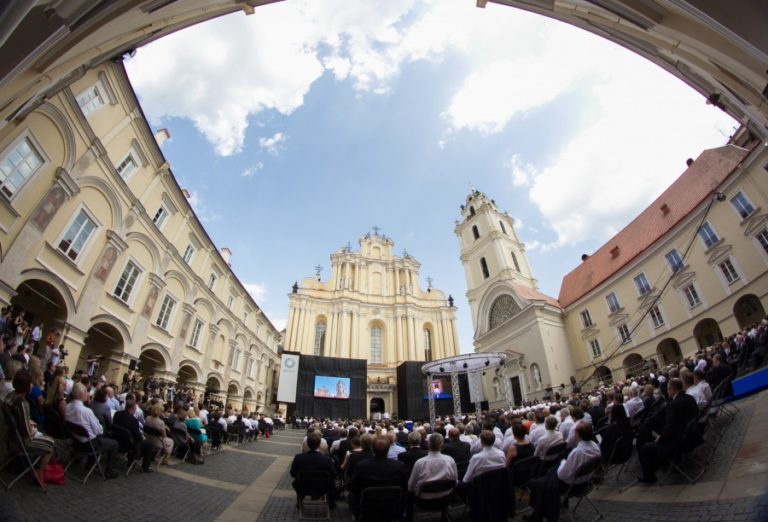
The opening ceremony of Lithuania’s European Union presidency, July 5, 2013.” credit=”Lithuanian Government Photo
VILNIUS, Lithuania–A month into its presidency of the Council of the European Union, Lithuania has been awash in public tenders for everything from branded ballpoint pens to providing logistics for thousands of expected guests. However, two-thirds of these procurement contracts were unannounced tenders or single-bidder contracts, funneled to a select group of well-connected companies, according to an analysis by 100Reporters.
The number of unannounced tenders and single-bidder contracts is expected to rise, as the ruling Social Democratic coalition moves to speed up the awarding of contracts surrounding the EU Council presidency by streamlining procurement rules.
Public tenders awarded without bidding or reserved for a single company can be a sign that connections, not public interest, are at play in the awarding of government contracts. Lawmakers and anti-corruption watchdogs fear that the EU presidency will be a Trojan horse for looming large-scale corruption that may endure in Lithuania long after its stint as president ends. The risk is aggravated by lax oversight of funds budgeted for the rotating council presidency.
With a considerable part of some $85 million in EU-presidency related spending still to be awarded, “the battle for the money will only intensify,” said Agne Bilotaite, a lawmaker and member of the parliament’s Anti-Corruption Commission.
In addition to the spate of unannounced tenders, transparency advocates say there have been other red flags. Litexpo, a company that had won a major catering contract suddenly gave it up. The contract then went to a firm with close ties to government officials. And the government has concentrated all EU-related events in the capital, shutting out second-tier cities like Kaunas in central Lithuania.
Much is at stake for Lithuania, the first Baltic State to have been granted the right of EU presidency. Its leadership will increase Lithuania’s visibility on the continent and boost national pride and, importantly, the economy, pumping over $85 million into local business, with 13.1 percent unemployment and one of the highest rates of emigration in the EU. (http://123.emn.lt/en/general-trends/lithuania-in-the-eu-context)
Lithuania’s six-month commitment for the 28-member state European Union – the biggest confederation with the second- largest economy in the world in 2012–will serve as a unique opportunity to draw the EU’s attention to the small Baltic country’s most important issues: energy security, relations with its neighbors to the East, control of the EU’s outer borders, cooperation in the larger Baltic Sea region and cyber-security.
But transparency advocates say its turn at the presidency risks throwing Lithuania back to the early 1990s, when rampant corruption gripped the state.
According to an analysis by 100Reporters, of some 46 public contracts for work connected to Lithuania’s presidency of the EU, 20 of them, or 43 percent, were handed to companies without open competition, through unannounced tenders. In comparison, of all 13,258 national public tenders in Lithuania during the same period, 2,317, or a little bit less than 17 percent, were unannounced.
Another 10 contracts for work tied to Lithuania’s EU presidency, or 22 percent, were let through simplified bidding procedures, raising the risk of corruption. These simplified tenders, while publicly announced, sidestep normal requirements for considering a minimum of two competing bids. In comparison, 3,538, or 27 percent, of tenders unrelated to the presidency were awarded through these simplified rules during the same period.
Naglis Puteikis, a Conservative member of parliament, said he was not surprised by the findings. “It’s common knowledge that no-bid tenders, or limited ones, increase steeply the possibility of corruption and getting kickbacks,” Puteikis said. “But who cares when, after greasing the right person’s palm, you get a luscious contract?”
Valentinas Mazuronis, minister of Environment, said the spate of unannounced and single-bidder contracts was not a sign of corruption, but of the need for speed.
“I don’t care as much about the form of the tenders as about having a successful presidency of the Council of the European Unio,” Mazuronis said. “Why doesn’t anyone contemplate what would have happened if, with the dozens of tenders to be organized in a short time, we’d have got backlogged, perhaps putting the presidency in jeopardy?”
Mazuronis had proposed streamlining the bidding process, and said he still supported limiting competition for public tenders. “The simpler procedures will make the whole process easier and more effective,” Mazuronis said. “And, I am sure, transparency won’t suffer.”
If corruption does contaminate contract awards, the EU is unlikely to find out on its own. The EU exercises virtually no oversight of national funds spent on the rotating presidency. Rather, member states that hold the presidency are expected to use national institutions to exercise oversight.
Bilotaite said a general lack of independent oversight by the EU on projects it sponsors in Lithuania leads to a disregard for overspending at the national level. “C’mon, it is European money,” she quoted fellow lawmakers as saying. “Don’t worry too much about it.”
Contract Surrendered
Darijus Aleknavicius, the former director of Litexpo, recalled the company’s painstaking work to win a major catering contract for events in Lithuania during the country’s presidency of the EU Council. After winning the $1.6 million contract, however, the company mysteriously gave it up, saying that its kitchen facilities were not up to the task.
In stepped the tender’s runner-up, JSC Taurakalnis, a company with ties to influential Social Democrats in the government and parliament. Taurakalnis already handles the government’s catering needs for employees.
“It might be just a mere coincidence, but still it raises some questions,” said Sergejus Muravjovas, director of the national affiliate of Transparency International.
Bilotaite, of the Anticorruption Commission, has launched a parliamentary investigation of the procurement.
“The argument of improper or missing kitchen facilities cannot be taken seriously. At this point, it isn’t clear what made Litexpo relinquish the lucrative contract for a rival with ties to the ruling Social Democrat Party,” Bilotaite noted.
She says a new tender should have been posted after Litexpo withdrew.
Litexpo, a company that had initially won a $1.6 million catering contract for the EU presidency, gave it up. The contract was then taken over by a company with close ties to the ruling party.” credit=”Lithuanian Government Photo
“It simply relinquished the right for the runner-up. The Public Procurement Law has obviously been violated, but it seems to me it had been pre-arranged in case the initial tender turned up another winner,” said the Lithuanian lawmaker. “This is a clear example of corruption.”
She has sought to place the case on the agenda of the Anticorruption Commission, but in vain.
“I cannot think of any other so urgent question in terms of corruption as this one. But I failed to get it into the agenda as the chairman of the commission, representing the ruling coalition, refuses to do it, citing triviality of the issue,” Bilotaite said. “I just cannot believe it.”
The chairman, Vitalijus Gailius, could not be reached for comment.
Contacted for the story, Aleknavicius refused to discuss the tender. Earlier, he had suggested that he quit the company after facing “major political pressure” to create a new deputy director post at Litexpo—a common scheme in Lithuania, and elsewhere, used to give the ruling party a hand in the company’s management and a share of its contracts and spoils.
Aloyzas Tarvydas, who succeeded Aleknavicius as director of Litexpo, is a seasoned Social Democrat with close ties to a number of top Social Democrats in the government and Lithuanian parliament.
Irena Cereskiene, whose Taurakalnis took over the catering contract from Litexpo, also has long-standing ties with top officials of the Social Democratic Party.
“When I was at the helm of Litexpo, we’d done everything that we could for the tender, to win it and to fulfill the contract,” Aleknavicius said. “It sounds incredible that with the huge investment done, an argument of improper or missing kitchen facilities was raised to explain ceding the contract.”
Public Procurement Service director Zydrunas Plytnikas has refused calls to start his own investigation of the contract. Some suggest the results of such an investigation—should they find improprieties in the procurement service–could cost Plytnikas his job.
Cities Shut Out
Unlike previous EU Presidency hosts, Lithuania has given the coveted presidency only to its capital, Vilnius. Before the start of presidency the city had still been an enormous construction site. Large hoardings in and around the Old Town hid the ear-drilling clatter and roar of jackhammers. Commuters scurried, some cursing, through clouds of billowing dust.
The last time Vilnius saw public works projects on such a vast scale was “in the Soviet era, before a visit of the Soviet Union Communist Party’s General Secretary,” said Mantas Varaska, a member of the Lithuanian Parliament. “But will freshening up the Old Town conceal the grim picture of pothole-ridden streets, cracked pavements and rust-gnawed streetlight posts just a few kilometers away?” he asked.
Officials in other cities complain they have been shut out. “We’ll have only little crumbs of it,” said Andrius Kupcinskas, mayor of Kaunas, Lithuania’s second-largest city.
Expectations in Kaunas, however, had run high.
“Just a year ago, invited to the Ministry of Foreign Affairs for a hearing on the preparation for the mission, we heard assurances that Kaunas qualifies for hosting all D –level events that involve events organized by chambers of commerce and trade, universities and non-governmental organizations. In just a year, it’s all turned around,” the mayor complained.
In letters, the Foreign Ministry and Brussels gave city officials a single explanation: Kaunas’ infrastructure was inadequate. The mayor expressed shock, noting that Kaunas had already hosted a number of European-wide events, including like the European Youth Track and Field Championship and qualification games of the 2011 European Men Basketball Championship.
“I couldn’t believe it,” Kupcinskas said “It’s not a matter of insufficient infrastructure.
“Vilnius lobbyists and authorities had planned on taking away the EU presidency from us long before,” the mayor fumed. “When it comes to events like the EU Presidency, things should not be done this way.”
In Ireland, which has held the presidency over the last six months, guests mostly used public transport and reserved eco-friendly vehicles only for minister-level events. In Vilnius, 160 BMW cars—the dominant brand in the Lithuanian parliament’s luxury fleet–will provide transportation service.
Vytautas Sileikis, director general of Kaunas’ Industry and Trade Chamber (KITC), said the city was sidelined because of “few lobbying efforts and a reluctance to grease palms.,” He declined to elaborate.
As a member of the Enterprise Europe Network (EEN), a European body at the European Commission (EC) created to help small businesses through the European Union, “we were quite confident that Kaunas will be granted right to host the EEN’s three-day annual conference,” Sileikis said. “That would have pocketed the city $2 million USD. But it did not happen.”
And there have been numerous hints not to apply as the events had been already slated for Vilnius, according to Foreign Ministry sources who spoke on condition of anonymity.
But impartiality in sharing the rest of the presidency pie may be just one piece of a large picture, said Pranas Zeimys, a Lithuanian legislator. He is particularly concerned, he said, by a bill Social Democrats are pushing to streamline EU-related tenders.
“We’ll have a slew of no-bid contracts,” said Zeimys. “They would ostensibly relieve pressure on the EU Council Presidency but the presidency cannot be a sacred cow when it comes to accountability and corruption.”
Puteikis, the member of parliament, is stunned by a sudden 60 percent hike in the government budget for travel abroad during the EU Presidency year, to $35 million from $22.7 million.
“Alarmingly, public tenders are not required for the services,” the legislator said. “That is the creek where corruption will spawn.”
Bilotaite is convinced the extent of corruption will surface only after Lithuania’s stint at the presidency ends and the damage is done.
“That how in Lithuania usually is,” she said. “We tend to review things after they are over. Not in the pipeline or through the process.” The practice, she said, “very much undermines corruption prevention.”
Vilnius, Lithuania–Edita Bagdoniene furrows her brow as her 3-year-old son, Mykolas, splashes mischievously in puddles outside. Mykolas is absorbed in his game, but his mother is distracted with worry.
She wants to enroll him in preschool, where his games would have more structure, and he would learn to play with other children. But by her calculations, Mykolas would not get to see the inside of a preschool before his 10th birthday, barring payment of a hefty bribe.
And that is simply out of the family’s reach.
Preschools and kindergartens in Vilnius have long waiting lists for enrollment, and the only way for parents to secure a place for their children is through a cash-stuffed envelope.
“My brother’s friend’s family brought an envelope with nearly $200 inside to pay a preschool director to enroll their child,” said Bagdoniene. “Luckily, the director accepted the money even though the envelope usually has to be thicker.” She adds that a typical blatas, a Soviet-era word that has come to mean “bribe,” is usually about $400.
Since 2006, the European Commission has marked early childhood education as a top priority, and aims to give preschool access to 95% of children over 4 years old by 2020. But standing in the way in Lithuania and a number of other countries is an informal system of bribery to secure the coveted preschool slots. Among Lithuania’s four largest cities, fewer than 10 percent of children under three attend preschool, according to the report of the Vilnius-based European Institute for Gender Equality. Those numbers place the country among the European Union’s nine worst for preschool attendance.
The benefits of early childhood education are hardly in dispute. A longterm study of 20,000 pre-school children in France in the 1990s indicated that the longer children attended preschool, the greater their chance of success in later grades. Only 10% of preschoolers who attended for three years later repeated a grade. More than 30% of those who did not attend were held back.
Some 2,500 children are on waiting lists for just 490 slots available at public preschools in Lituania’s capital, and families with more than three children or single-parent households are favored in the enrollment system.
Some 450 children in the city attend private preschools, but tuition bills of up to $365 per month put that option out of reach for most families. The Bagdonai family’s monthly income consists of Bagdoniene’s $250 in maternity benefits and her husband’s $600 salary as a translator.
“Most families bribe local preschool heads to have their children admitted,” said Arunas Bagdonai, 42, her husband.
The Bagdonai family had considered forking over a bribe, but instead pinned their hopes on a new electronic preschool admission system introduced this fall, in an effort to clamp down on the practice. However, rather than rooting out the demand for bribes, the electronic system appears to have added new layers of confusion.
By Bagdoniene’s count, Mykolas will have to wait seven or more years for a chance to attend preschool.
“Here is my calculation,” she said. “I put him on the enrollment list in the Seskine preschool when he was just born in the beginning of 2010. He was 128th on the list. That has inched up only 30 places over nearly three years. So at this pace, my son would be called to preschool when he reaches ten.” Bagdoniene said. “That is insane.”
Gintare Lavinaite, 24, the mother of a year-and-a-half-old son, is also frustrated by the lack of progress and the shortcomings of the city’s electronic enrollment system.
“I hurried to the municipality to sign up my child, but I was told the e-list would be reset on January 1st, 2013, and only sign-ups after that date would count,” Lavinaite said.
When the Bagdonai family tried to sign up their children online, they found mistakes.
The website told them there were vacancies in the preschool, so they tried to enroll Mykolas and his six-month-old brother, Gabrielus. The municipality never contacted them. Frustrated, the parents called the city administration, only to learn that the website had scuttled their application due to a shortage of available spots, Bagdoniene said.
“A lot of mothers complain that the public e-enrollment system is flawed — you see one set of numbers on it, but then hear quite another when you call the preschools.”
When she contacted the schools about vacancies she saw listed on the Web site, administrators called her “naïve” for trusting the online information.
“The new system is not working. I am pretty sure bribes will find their way to the municipality’s IT specialists in charge of enrollment. Maybe the blatas will just become much bigger to pay for the system to be hacked,” she said.
But the director of the Education, Culture and Sports Department for the city, Gintaras Petronis, dismissed the criticism of electronic enrollment, saying he is confident the system will make school registration more flexible and organized.
“The e-system will sort through the existing waiting lists, discarding redundant registrations,” he said. “It has already found 600 duplicates. Besides, repealing some priority-enrollment benefits for socially-supported families will also help,” he said.
Fuelling frustrations, parents say preschool enrollment in Vilnius was a cinch just four or five years ago.
“There were plenty of vacancies for kids in the establishments. No parent had to think of a waiting list. The Conservatives are the ones to blame for this,” said Viktoras Malinauskas, a 34-year-old father of two.
When the ruling Conservative party, the Homeland Union – Lithuanian Christian Democrats (HU-LCD), came to power in 2008, they boosted maternity benefits as part of an effort to counter flagging birth rates due to massive emigration. Nearly half a million Lithuanians left the country from 2008 to 2011, according the EU statistics agency Eurostat. The party’s family-friendly platform won them votes, but schools were ill-prepared to handle the ensuing baby boom when the toddlers reached school age.
The policy has come under fire, with dozens of women accused of misusing the maternity leave benefits. Some mothers were charged with colluding with their employers to report inflated salaries to the govenrnment in order to gain bigger benefit payouts. The program was overhauled and trimmed due to concerns about fraud and its strain on the budget.
Meanwhile, corruption has emerged in answer to the competition for scarce services.
Rasa Grigaliuniene, deputy director of the Vilnius’ Zirmuneliai preschool, says many parents have offered bribes to help their kids get in the classroom.
“I recall when someone flung an envelope toward me and starting running toward the door. I had to chase the bribe-giver all the way to the parking lot and tuck the envelope forcibly into his pocket. Some crazed person even threatened to blow us up if we did not find a place for his child right away. We did not relent,” Grigaliuniene said.
Tatjana Gilevic, head of the Daigelis preschool in Vilnius, said the new system was plagued with errors.
The system did succeed in eliminating duplications, she said, but discrepancies between admission lists of the schools and municipal authorities persist. Gilevic does not alert the municipality when she comes across such errors. Swamped with work as they are, she doubts they would trouble over such details.
“Every system, even the most sophisticated electronic ones, can be cheated or hacked,” said Gilevic. “But only the future will show whether corruption can be rooted out.”
Aleksas Bruzas, chairman of Lithuania’s Education Employee Trade Union regards the new approach with caution.
“Corruption has been flourishing there, so it’s too early and too optimistic to expect that it will be rooted out any time soon,” Bruzas said. “Even with the e-thing. I reckon it’s only a matter of time before we all start hearing about attempts to hack the system.
Nevertheless, he says, it would be harder to track down and bribe the computer specialists in charge of enrollment than to pay a preschool administrator for the favor.
Meanwhile, the Bagdonai family is trying to remain upbeat despite the setbacks. “I will wait for the New Year and see what happpens then. But my gut feeling is the preschool corruption will not give up easy,” Bagdoniene said.
Time may eventually ease the burden on prechools. With the maternity benefits slashed significantly, national unemployment at 14 percent, and a large scale emigration underway, the short baby boom is set to recede — and with it the competition for preschool slots.
Linas Jegelevicius is the editor of the Palangos Tiltas, a newspaper in Western Lithuania resort town of Palanga, and a correspondent for the English-language Baltic Times.
This website uses cookies to improve your experience. We'll assume you're ok with this, but you can opt-out if you wish.AcceptRead More
Privacy & Cookies Policy
Privacy Overview
This website uses cookies to improve your experience while you navigate through the website. Out of these, the cookies that are categorized as necessary are stored on your browser as they are essential for the working of basic functionalities of the website. We also use third-party cookies that help us analyze and understand how you use this website. These cookies will be stored in your browser only with your consent. You also have the option to opt-out of these cookies. But opting out of some of these cookies may affect your browsing experience.
Necessary cookies are absolutely essential for the website to function properly. This category only includes cookies that ensures basic functionalities and security features of the website. These cookies do not store any personal information.
Any cookies that may not be particularly necessary for the website to function and is used specifically to collect user personal data via analytics, ads, other embedded contents are termed as non-necessary cookies. It is mandatory to procure user consent prior to running these cookies on your website.