Africa’s Hidden Victims: Pandemic Prompted Surge in Police Brutality

Africa’s Hidden Victims

Pandemic Prompted Surge in Police Brutality

By Sally Hayden, Maurice Oniang’o, Linus Unah and Patrick Egwu

Coronavirus-inspired graffiti in Nairobi. Photo by Maurice Oniang'o.

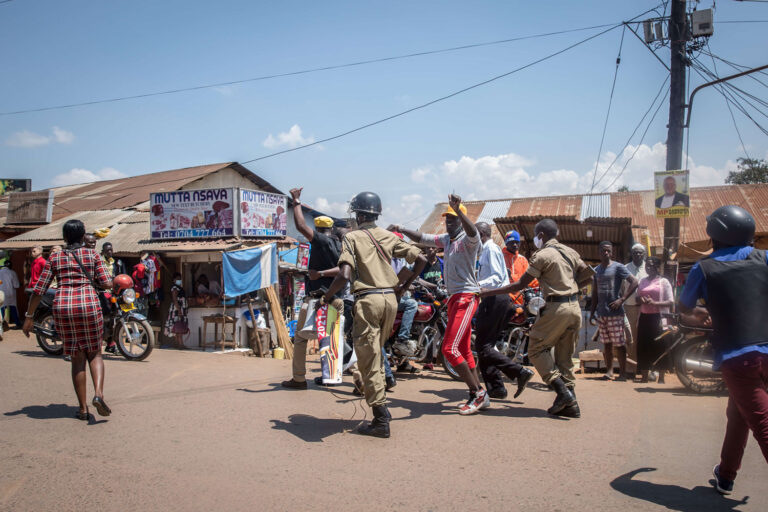
In Nairobi, a teenage boy standing on his balcony became Kenya’s first victim of police brutality in enforcing coronavirus restrictions. In Lagos, Nigeria, police shot and killed a young gas station attendant who came to the aid of a customer the officers were harassing. In Uganda, police used the threat of throwing people into overcrowded prisons, which were potential Covid-19 hotspots, to extort money.

The coronavirus pandemic, slowly beginning to lift as vaccines become available, laid bare how normal violence by security forces has become in parts of Africa. Reports from four countries–South Africa, Nigeria, Kenya and Uganda–found deeply-rooted problems of corruption and brutality flourished amid the pandemic. The tighter the restrictions, the greater the opportunities grew for extortion or brutality. Many, if not most, of the resulting deaths will never be counted.

The problem starts from training, whereby police recruits are brutalized in the name of being trained. So when they graduate, they extend the same brutality they received during training to members of the public.

“The problem starts from training, whereby police recruits are brutalized in the name of being trained,” said George Musamali, a security and safety consultant who served in the Kenya police for more than ten years. “So when they graduate, they extend the same brutality they received during training to members of the public.”

Amid a flurry of predictions about how badly Africa could be affected by the pandemic, governments imposed lockdown measures on an unprecedented scale, with little warning. Across a continent where hundreds of millions of people live hand-to-mouth, citizens in countries with strict restrictions couldn’t afford to abide by them, which stoked confrontations. This heavy-handed policing in enforcing the coronavirus restrictions has led to deaths and devastated many families.

However, Musamali notes that police brutality is not a new phenomenon in most African states, but stems from a culture of impunity that dates back to the colonial period. “In Kenya, we created the police service in 1900, and the reason behind that was that the colonial government wanted the police to protect the lives and property of the white settlers,” he said.

“The training was focused on that, whereby the police were pitted against the locals, and they were there to protect the settlers. ” he added.

Law enforcement officials dispute the charge that their training has not equipped them to deal with such a pandemic.

“We are socially trained to enforce laws and regulations,” said Charles Owino, the outgoing spokesman of Kenya’s National Police. He says that the rise in police brutality has nothing to do with the training or the police as an institution, but represented isolated incidents. “We are more than 120,000, but you may find one, two, or three making mistakes. These mistakes don’t arise from poor training but from several issues, and one is the inherent behavior of the individual,” he said. He added that some individuals might have been bullies even before joining the police service.  

In most countries in the continent, the police training curriculum is based on dealing with lawlessness, civil unrest, and disobedience. However, the pandemic presents a different challenge to police officers as they enforce rules and restrictions to protect the public from a disease.

The pandemic exposed and exacerbated existing issues around trust and accountability of the security forces. A lot of these negative behaviours have been condensed into a short timeframe. And then it's happening on a scale that hasn't been seen before.

“The pandemic exposed and exacerbated existing issues around trust and accountability of the security forces,” said Cindy Chungong, the Africa programs director at International Alert, a nonprofit that works to break cycles of violence. “A lot of these negative behaviors have been condensed into a short timeframe. And then it’s happening on a scale that hasn’t been seen before.”

Restrictions on transport and gatherings coupled with the wide geographic spread of the abuses have hampered human rights organizations charged with documenting how many people have been injured or killed by security forces during this period.

According to human rights organizations and the police oversight on extrajudicial killings, 2020 was the deadliest year for police brutality reports in Kenya. By mid-April 2020, a month into the pandemic, Kenya had recorded only 12 confirmed COVID-19 deaths, but police had already killed 18 people while enforcing lockdown restrictions, according to the National Human  Rights Commission.

The Independent Policing Oversight Authority received 95 complaints of police brutality in the first three months after the curfew was imposed. In March of this year, Missing Voices, a Kenyan civic group, tallied 157 police killings related to the pandemic across 2020. Another report prepared by a consortium of Human Rights organizations reports 2020 as one of the worst years regarding police brutality and extrajudicial killings in Kenya.

“In case a person lost their life it is regrettable,” said the police spokesperson. “We do not support any officer acting out of the law and for that reason we take stringent action against them. Where it borders criminality, we have the officer charged accordingly.” He added that the officers are relieved off their duty before being taken to court. Despite the tough talk, only two police officers in Kenya faced prosecution for alleged brutality during the pandemic.

Anne Okutoyi-Muchimuti, the Director of Research, Advocacy and Outreach at the Commission on Human Rights, said police mistreatment of people living in informal settlements “continuously go unreported. 

“We must take a step back and reflect as a nation on ways in which we can stop this violence” she said.

The First Shot

In Kenya, the killing began with 13-year-old Yassin Moyo, who was standing on a balcony in Kiamaiko neighborhood of Nairobi, on March 13. Yassin was struck in the stomach by a stray police bullet.

“I know my child is in paradise,” said Yassin’s father, Hussein Moyo Molte. “But the officer really wronged me. He was a child. I was hoping that he’ll be the one to bury me, not the other way round.”

A police officer accused of shooting Yassin Moyo was charged with the murder and he pleaded not guilty.  He was granted a one million shillings cash bail. The case is currently ongoing. With time, the grief of Yassin’s family has deepened. “The laughter and happiness that was always here is no more,” his father said.

“They were about 20 of them on the lorry, but the ones who were beating me were about six and when I pleaded with them, they told me that it is only God who forgives,” he said. After the beating, the officers tried to take Owide’s motorbike, but he managed to escape. He ran to his brother’s place, which was closer than his home. He lost consciousness at the door and woke up in Kenyatta National Hospital, where he received treatment for head injuries. After two months of recovery, he emerged deeply in debt. No police officer was charged with his assault.

Ibrahim Aliyu shows where his younger brother, Musa Aliyu, was shot in April 2020 when the police clashed with traders at the Sabon Garri-Trikania market in Kaduna state in northwestern Nigeria while trying to enforce lockdowns and killed at least six people, including Musa. Photo by Linus Unah.

A mural in honor of Yassin Moyo a 13-year-old boy who was standing on their 3rd floor balcony watching the police enforcing the curfew in the streets below when a police shot him on the stomach. He died the same night. The mural was painted on the playground where Yassin used to play. Photo by Maurice Oniang'o.

Killed for a Nickel

Police in several countries turned on citizens who came to the aid of others upon witnessing abuse. In Ol Lessos, Nandi, in western Kenya, police shot a disabled shoe cobbler, Lazaro Tirop, in the head in June. Tirop had tried to intervene when a police officer arrested a motorcycle taxi driver for not wearing a mask. The officer asked for a 50 shilling bribe (5 cents). Later that day, when villagers went to the police station to protest, two more victims were shot dead in unclear circumstances.

Tirop left behind a wife and four children. His wife, Eunice Cheptoo, wanted justice and compensation so that Chebwai’s children could continue with school. “He was our breadwinner and now that is gone. I am appealing to the government to support me and my children,” she said.

In the aftermath, all police officers serving at Ol Lessos police station were transferred to other parts of the country. In July, Police Constable Sammy Onyango was charged with murdering Lazaro Tirop and the case is ongoing.

Eunice Chepto Tirop, the widow of Lazurus Tirop. Tirop, a cobbler, was shot dead by a policeman after he intervened when the officer was extorting money from a motorcycle taxi rider. The taxi driver was not wearing a face mask and the policeman wanted a 5-cent bribe. Photo by Maurice Oniang'o.

Similarly, in southeastern Nigeria, police killed a gas station attendant, Chibuisi Okameme, who rushed to the aid of a customer the police began beating at the pump in the city of Aba. Nigerian police did not respond to a request for comment.

Months later, Okameme’s death remained fresh and painful to his manager at the gas station.

“[They were] beating him mercilessly,” recalled Ndubuisi Nwabeke, Okameme’s manager. The attendant recognized the customer who police were beating and, moved by compassion, begged the police to let the man go. In response, the officer in charge shot Okameme, who was only 26. He died two hours later.

A co-worker, Veronica Uche, burst into tears when she started talking about his death. “He was very playful and didn’t look for trouble,” said Uche, 26. “He was too good; anybody that has worked here will tell you the same thing about him.”

The officer involved in the killing wrote an apology letter to the gas station, and authorities said he was dismissed, but Okameme’s friends and family are demanding justice and seeking compensation for their loss.

His widowed mother, Alaoma Chikezie, worried that she wouldn’t survive the heartbreak. “He was a good son to me,” she said, crying. “He called me every day to ask me how I am doing. As the good child that he is, he had started molding blocks that he would have used to build a house for me.”

Okameme was buried on March 26, just two weeks into the pandemic.

Police officers standing guard in Nairobi after dispersing protests against police brutality in Nairobi. Photo by Maurice Oniang'o.

The institution is not strong and it does not have the technical resources to ensure that police officers face disciplinary actions. Out of the reports we documented and sent to the commission during the pandemic, we have received feedback in only a few cases.

The CLEEN Foundation, a local nonprofit working to promote  public safety, security, and access to justice, deployed over 700 observers to Nigeria’s 36 states to monitor and document human rights violations as the coronavirus pandemic spread.

Ruth Eguono Olofin, the organization’s program manager, said, “Justice has not been served in the bulk of the cases we presented” to several government agencies, including the National Human Rights Commission and the Police Service Commission, which disciplines erring officers. The Police Service Commission, she added, is grappling with a backlog of cases. 

“The institution is not strong and it does not have the technical resources to ensure that police officers face disciplinary actions,” she said. “Out of the reports we documented and sent to the commission during the pandemic, we have received feedback in only a few cases.”

BK9B7342

Police stand over a man who has broken a coronavirus-related curfew in Gulu, northern Uganda. Photo by Sally Hayden.

In Uganda, police violence represents one kind of brutality, and indeed, more than a dozen Ugandans said in interviews that police had beaten and robbed them for violating curfews that began in March 2020.

However, police have also exploited the public’s fear of arrest and incarceration to demand bribes. The country’s overcrowded jails and prisons were potential hotspots for Covid-19, and if bribes were not paid to the arresting officer, the price of freedom went up.

The same month the lockdown began, local media reported that three prisoners were shot dead trying to escape a prison in Arua, southwest Uganda, where they feared  contracting coronavirus in the prison’s cramped conditions. Over the next five months, the number of prisoners in Uganda  surged 10 percent to 65,000, with the facilities crammed with more than three times their intended capacity.

We would like the Ministry of Health to tell us if they're totally incompetent, or they're totally defeated, in detecting (the) COVID-19 pandemic. Maybe they do not know what they're supposed to do. Because you cannot let more than 150 people get infected.

In Amuru prison, in northern Uganda,  153 inmates and the warden tested positive for COVID-19 in August, prompting authorities to shut down the prison and transfer inmates to Gulu, a city 30 miles (55km) away. Days afterwards, Gilbert Olanya, the MP for the Kilak South constituency, in Amuru district, said he wasn’t sure how it could have taken so long to detect the cases.

A month later, more than 200 inmates escaped a prison in Karamoja, an impoverished northeastern region in Uganda. Two more escapees were killed as security guards pursued them.

Opportunity for Extortion

The risk of getting COVID-19 in prison presented an opportunity for corrupt police officers, and left many Ugandans with a stark, potentially fatal choice if they are caught outside after hours: pay a bribe or get a jail term.

Richard Onencan, a 25-year-old shopkeeper in Gulu and father of a four-year-old girl, said he was caught by a policeman half an hour after curfew last May. Onencan had been with his sick sister in hospital, returning to close up his kiosk for the night.

Onencan said the policeman and four soldiers brought him to a vehicle nearby and told him to pay 50,000 Ugandan shillings ($13.52), the total takings he might earn in a day at the kiosk, not including the cost of purchasing the sugar, sweets and toilet paper he sold. “I said no, I can’t pay that… I’ve not yet explained why I am out at this time,” he recalled telling them. “You take me where you want to take me.”

He was brought to the police station and told to write a statement, then put in a small cell with around 30 other people, the majority of whom had also been accused of violating coronavirus restrictions. “The space was not enough so I stood up until morning.”

He felt at huge risk of contracting coronavirus. “We have not any social distance… you cough near your friend. There is not any option to avoid (them). We were not having masks,” Onencan recalled.

Residents of Sabon Garri-Trikania community in Kaduna state in northwestern Nigeria gather to prepare bodies of those who died after police officers enforcing lockdown killed at least six people in April 2020. Photo by Linus Unah.

The detainees would sit and stand in shifts, getting a maximum of 30 minutes on the floor to rest. Outside, his friends and relatives pooled savings to pay 150,000 Ugandan shillings ($40.54) to the police to find out where his file was being held, and another 250,000 Ugandan shillings ($67.61) to someone in the office of Gulu’s attorney general to get him released. Once out of jail, Onencan needed to pay that money back.

The shopkeeper said he was told if his family had refused to pay, he would have served at least six months in prison, and risked being charged with attempted murder. He was never given a charge sheet, or a receipt for the payments his friends and family made. By the time he left the police cell, he had lost so much weight that his belt wouldn’t hold up his trousers anymore.

He said he needs to keep working to survive, and to support his young daughter and his sister who is ill. He’s started to farm, and is planting vegetables, instead of selling goods at the kiosk. “Before COVID-19 started I was working (a) good business, but when COVID-19 began the business has gone down.”

Police officers standing guard in Nairobi after dispersing protests against police brutality in Nairobi. Photo by Maurice Oniang'o.

Calls for reform

“Abusive policing isn’t just an African problem. But it is pervasive across so many African countries that, you know, that question is appropriate,” said Mausi Segun, the Human Rights Watch Africa director, speaking from Abuja. She said there is a “foundational failure of the institutions to be fit for purpose”, and African police forces have long treated citizens like “subjects.” 

“You can’t build on a faulty foundation,” Segun said.

She observed that low-income people tend to suffer violence disproportionately, no matter where they are in the world.

“If you look at the trajectory of police excesses: the excessive use of force, the use of lethal weapons to contain civil demonstrations – most of the time peaceful – they are usually utilised predominantly in low-income communities,” Segun said. “The economic status and the social status of the victims play a huge part in the way that they are treated by police.”

Amid the pandemic, Segun acknowledged that accurate counts of brutality are hard to nail down. At the same, she said, it was crucial to document specific cases to represent the wider problem, and to restore dignity and humanity to the victims of police violence, even in death.

Chungong, at International Alert, said the coronavirus pandemic has highlighted the need for a move towards community-centered policing that addresses the root causes of crime and insecurity, rather than using the police as a “repressive force” who are “protecting the interests of a particular group.”

Security officers resort to brutality and extortion must face sanctions,  with institutional  mechanisms for meaningful oversight, she added. That means reforming recruitment practices, training, workplace culture, and remuneration, Segun said. “Otherwise, what we have is a system that permits and actively encourages impunity.”

Get the right people in the service, and then look into their welfare, train them properly, equip them properly and you will see that they will change the way the police operate

Musamali, the Kenyan security consultant, agreed that, perpetrators of police brutality need to be brought to book. The executive should not only train police on how to handle the public but also address the welfare of cadets and officers.

“Get the right people in the service, and then look into their welfare, train them properly, equip them properly and you will see that they will change the way the police operate, ” he said.

Top photo: A mural in the Mathare slum in Nairobi, which has seen heavy-handed policing in the wake of Covid-19 restrictions. Photo by Maurice Oniang’o. 


Africa’s Hidden Victims was produced and co-published in collaboration with Journalists for Transparency, a project of Transparency International, and is being co-published with Africa.com.

How Did One of North Africa’s Biggest Accused Smugglers Escape Prison?

by Sally Hayden
This story is being co-published with Vice.

Evidence suggests corruption and police complicity led to the escape of a notorious smuggler accused of transporting, extorting, and imprisoning thousands of migrants.

ADDIS ABABA, ETHIOPIA - One afternoon in February 2020, 24-year-old Fuad Bedru spotted someone he knew in Ethiopia’s capital.

Outside of an electronics shop, in Bedru’s own neighbourhood in Addis Ababa, Kidane Zekarias Habtemariam, one of the most notorious human smugglers operating in Libya over the past decade, stood tall. Habtemariam, a sturdy, bald Eritrean man, is accused of extreme violence towards thousands of African refugees and migrants he kept locked up for months or years in warehouses in Libya, after his associates convinced them to try and reach Europe. Those who ended up under his control were convinced by false promises of a fast journey to a continent where human rights were respected, and they could easily get jobs, find stability, and live a happy life. Instead, they were tortured and blackmailed.

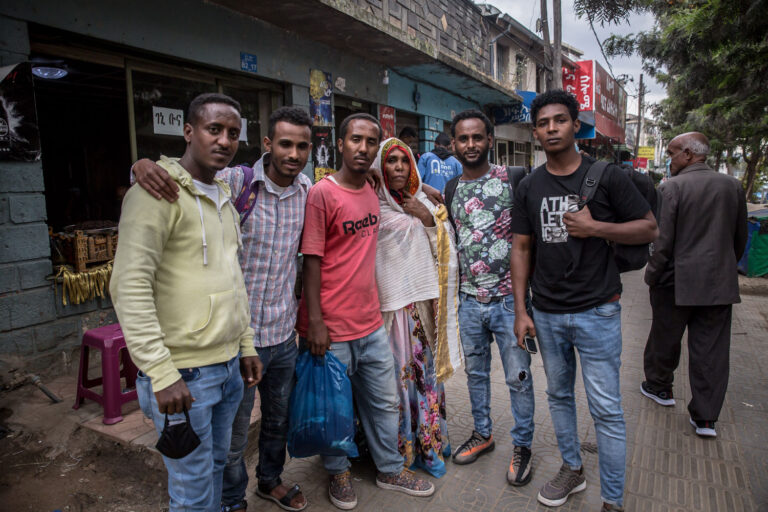
Bedru, who spent three months held captive by Habtemariam in 2018, couldn’t believe his luck. He ran to a nearby policeman and asked him to arrest Habtemariam immediately. According to Bedru and the policeman he approached, Habtemariam tried to bribe them both, pulling $500 from his pocket and promising riches beyond that. Bedru doesn’t have a steady job and he is still struggling to pay back more than $10,000 that his family deposited in ransoms while he was in Libya, including nearly $6,000 demanded by Habtemariam himself. Still, he turned down the offer. “The moral side, the human side of me couldn’t do that,” he told me in October, sitting close to where the arrest took place. “He is a criminal.” But now, Bedru’s attempt to get justice for himself and thousands of other victims is in peril; after just a year in prison, Habtemariam escaped last week.

A victim shows a scar from his time with smugglers in Libya, following a hearing in the smugglers' trials. Photo by Sally Hayden.

Pilgrims walk to church in the Amhara region of Ethiopia. Some come to pray in monasteries, asking that their children will reach Europe or be otherwise saved from smugglers in Libya. Photo by Sally Hayden.
Witnesses Frezgi Ataklti, Salih Mohamed, and Mohamed's mother pictured outside Addis Ababa federal court after they gave evidence against the smuggler Tewelde Goitom - nicknamed "Welid". Photo by Sally Hayden

Ethiopian authorities did not treat Habtemariam as a high-risk defendant, while European diplomats, international human rights organizations and UN agencies, who repeatedly talk about the need to tackle smuggling, failed to monitor the case. A legal trial was ongoing, though proceedings had slowed down as Habtemariam delayed presenting a defense, while some evidence appeared to go missing.

According to multiple sources in Ethiopia’s attorney general’s office, Habtemariam went to the bathroom in a corner of the Addis Ababa federal court complex ahead of the most recent trial hearing last Thursday. He changed out of his orange prison uniform, into a set of new clothes that had been left there, and simply walked out. The police officers charged with guarding him are now under arrest, suspected of facilitating Habtemariam’s escape in return for bribes. “A drama has played out and he has walked away,” said Temesgen Lapiso, Addis Ababa attorney general director for organized and cross-border crime. “He had been attempting to bribe police officers since day one of his arrest … [They] have no understanding of the gravity of his crime and how important his imprisonment is.”
Tewelde Goitom, another notorious Eritrean smuggler, was arrested in Ethiopia in March 2020 and went on trial concurrently with Habtemariam; now, after the latter’s escape, experts are concerned about accountability for Goitom.

The escape is also hugely embarrassing for Ethiopia, where witnesses had worried about the scale of corruption and how it might stymie the road to justice. When Habtemariam escaped, none of the people who testified against him were informed or offered protection. Habtemariam’s getaway has underlined the feeling among victims that, while EU politicians continue to spout anti-smuggling rhetoric as a justification for fortifying borders and shutting out refugees, little is being done by either European or African governments to ensure victims can rebuild their lives or get justice.

Tewelde Goitom - nicknamed “Welid”. Photo via Facebook.

He had been attempting to bribe police officers since day one of his arrest … [They] have no understanding of the gravity of his crime and how important his imprisonment is.

For more than two years, I have been reporting on what happens to African refugees who get trapped in Libya while trying to reach Europe.

In hushed tones, dozens have spoken about Bani Walid, a town known as the “Ghost City” because of the number of people who disappear or die there. This is an epicentre of a 21st century slave trade, where humans are bought and sold as their families are forced to beg or crowd-fund ransoms online to save their lives.

The most powerful smugglers in Bani Walid lived like kings, so well-known they went by a single name. They included Habtemariam—“Kidane”—and Goitom—nicknamed “Welid.”
The men, who have been called “two of Europe’s most-wanted traffickers,” both had warehouses in the same compound, sharing guards and other resources. Victims have estimated that they extorted, held captive, and transported tens of thousands of refugees and migrants between them, from 2014 to 2018. One victim remembered Goitom boasting about moving 15,000 people across the sea to Europe in 2015 alone, when the so-called “European migrant crisis” was at a height.

In late 2020, I attended seven hearings, watching as armed guards led the two men separately into a third-floor room in Addis Ababa’s federal court. They came handcuffed, moving between obvious discomfort and bravado. Waiting for them were victims and their families. There were no international observers present. Often, the only people there who were not directly involved in the trial were a translator and myself.

One by one, nervous witnesses sat in front of a three-judge panel. They described being promised quick passage to Europe and driven across the Sahara Desert, crossing the Libyan border before it became clear they were in for something else. Locked up with hundreds of others, they were forced to call relatives as they were beaten, or left without water, food and medical care, while the amount of money demanded got higher and higher. Some witnesses tried to avoid turning and looking at the accused men when prosecutors requested they identify them—the memories were just too painful.

Kidane Zekarias Habtemariam. Photo via Facebook.

Witnesses in the street outside Addis Ababa’s federal court, following a hearing in the smugglers’ trials. Photo by Sally Hayden.

Victims said the smugglers had no concern for the lives of others. They watched fellow detainees weaken and die from sickness, without medical care. One accused Goitom of purposefully sending Somalis out to sea on stormy days, when their boats were in danger of capsizing, and telling other captives they “weren’t people.” Some survivors said both smugglers forced teams of weak captives to play football against each other. They would shoot at those who missed shots, and the winning man would choose a woman to rape from the other’s detainees.

Goitom was particularly infamous for sexual abuse. Multiple victims in different countries told 100Reporters they personally know women who had babies as a result of rape by him. People held in his warehouse said he would pick out any girls or women he wanted: some married; others very young. He allegedly videotaped the assaults, threatening to post them online if the woman spoke out. Relatedly, no female victim has come forward to give evidence, prosecutors say.

“How could we take money after watching [Goitom] rape countless women?” asked Frezgi Ataklti, 24, a witness who alleges he was also offered money not to testify. Still, he is constantly afraid now, both that there will be retribution against witnesses and that Goitom, too, will escape.

The number of people giving evidence was unexpectedly low and remote testifying was not allowed, which meant that Habtemariam could only be charged on eight counts related to people smuggling and trafficking, and Goitom on five. Their victims, many of whom are fellow Eritreans and Somalis fleeing wars and dictatorships, are still searching for a safe place to live. Some have reached Europe or Tunisia, while others, in the process of being resettled to safer countries by the UN, are temporarily in Rwanda and Niger. Some victims struggle on in Libya, meaning they can’t take part in the trials.

Fuad Bedru, 24, the victim who spotted human smuggler Kidane Zekarias Habtemariam in the street in Addis Ababa last February and encouraged police to arrest him. Photo by Sally Hayden.

How could we take money after watching [Goitom] rape countless women?

Ethiopian prosecutors said they were working with Interpol to try and recover money the smugglers stashed away, which could then be given back to victims, but find these returns unlikely. Ransoms were deposited in many countries, from the United Arab Emirates and Israel, to the UK and Sudan. Funds were moved on to Canada, Sweden, and others, through a network of the smugglers’ relatives and associates, prosecutors say. Few assets were found in Ethiopia. Even if compensation does happen, it is unclear if the witnesses against Habtemariam can benefit from it, given there was no verdict in his trial.

“Everything has its own time,” said one 22-year-old victim, who called the men “savages” and said he could barely believe the arrests had happened. “Personally I wouldn’t have cared if they only smuggled. That’s why we went to Libya,” he said, asking not to be named because he still hasn’t reached a secure location. “They raped virgin women. They beat people to death. They ransomed enormous amounts of money from each of us and in doing so they used all tools of torture … They starved people and many died as a result.”

They raped virgin women. They beat people to death. They ransomed enormous amounts of money from each of us and in doing so they used all tools of torture … They starved people and many died as a result.

Similar stories have been told by victims across the world, many of whom don’t know each other.

Yet prosecutors, before Habtemariam’s escape, estimated the smugglers would get less than 10 years in prison out of a maximum possible 25-year sentence, because of sentencing guidelines and the lack of evidence.

The only formal extradition request came from the Netherlands, Lapiso said. Informally, Italy also asked about the possibility, but Lapiso said it wouldn’t happen, even after a prison sentence was over. “We have the evidence, we can handle them and we are handling it right now,” he said in October. “There is no sound reason to hand them over to another country.”

Italy, according to the prosecutors, reportedly refused to share information it gathered about the two smugglers because of a policy of not allowing cooperation in situations where Ethiopia could theoretically inflict the death penalty. (This is the same reason Italy sheltered two accused war criminals in their Addis Ababa embassy for nearly 30 years.) “They told us they have [a lot of] evidence concerning these guys,” Lapiso said. The death penalty is extremely unlikely anyway, he added, because it can’t be inflicted if there is a single mitigating circumstance.

After the trials began, Lapiso said there had been no communication or follow up by any of the embassies, who did not respond to my requests for comment. He was also not aware of any communication from the International Criminal Court, which has previously shown interest in prosecuting smugglers operating in Libya. In 2017, prosecutor Fatou Bensouda told the UN Security Council she had received “credible accounts that Libya has become a marketplace for the trafficking of human beings.”

“We must act to curb these worrying trends,” she said. (The ICC did not respond to multiple requests for comment, though one person with knowledge of their investigation said it was important to remember it is a court of last resort and has no jurisdiction if a crime is being prosecuted domestically.)

A victim shows a scar from his time with smugglers in Libya, following a hearing in the smugglers' trials. Photo by Sally Hayden.

Pilgrims listen to preachers in the Amhara region of Ethiopia. Some come to pray in monasteries, asking that their children will reach Europe or be otherwise saved from smugglers in Libya. Photo by Sally Hayden.

People walk in the street outside Addis Ababa's federal court. Photo by Sally Hayden.

Anti-smuggling rhetoric has been the stated impetus for many of the European Union’s anti-refugee policies in recent years. In 2017, the EU began to provide training, equipment and other support to the Libyan Coast Guard, so it could intercept and turn back refugee boats on the Mediterranean Sea. The EU has allocated more than $100 million for such operations, despite evidence of ties between the Libyan Coast Guard’s loose collection of officials and smuggling networks. The EU recently signed another $121 million worth of deals to fly drones across the Mediterranean, which can spot boats and direct the Coast Guard right to them.


Between 2017 and 2020, more than 55,000 men, women and children were caught and returned to Libya. This had a direct impact on the smuggling trade there and removed most chances of escape. Smugglers began to extort refugees already under their control for more and more money—torturing them, selling them between each other, and eventually abandoning them, sometimes without even bothering to put them in boats. For refugees and migrants who have become caught up in this violent trap, Habtemariam’s escape is just another symbol that international efforts are focused at stopping European arrivals at any cost, rather than helping refugees find safety.

A victim shows a scar from his time with smugglers in Libya, following a hearing in the smugglers' trials. Photo by Sally Hayden.

Smuggling prosecutions are notoriously imperfect and often political, with European security forces regularly accused of pursuing innocent people.

In one high-profile case, farmworker Medhanie Tesfamariam Berhe spent three years locked up in Italy after he was extradited from Sudan in 2016 on charges of human smuggling. But it was a mistake: Berhe was confused for Medhanie Yehdego Mered, a man accused of overseeing the travel of 13,000 people to Europe. Even after journalists exposed the truth, Italian prosecutors doubled down, insisting they had the right person; Berhe was only released in 2019.

100Reporters confirmed with dozens of people that the prisoners on trial in the Ethiopian court were Habtemariam and Goitom, but there were other irregularities. Habtemariam’s age was listed as 51, but victims, including one who went to school with Habtemariam in Eritrea, say he is in his early 40s. One of the phones Habtemariam had on him when he was caught went missing, and was not listed on an evidence sheet. “It’s really corruption,” said the victim, who is now in Sweden. “They are playing a big game.”

Goitom is being charged under what victims say is a fake name: Amanuel Yirga Damte. When asked about it, prosecutors said it was the name he gave police when he was arrested.

In Ethiopia there is a proverb: ‘Genzeb kale bezemay menged ale’. This means ‘If there is money, there is a way through the sky.'

Independent legal researchers who read the charge sheets, of which 100Reporters also has copies, described them as confusing and poorly drafted. And there seemed to be clear omissions: For example, Bedru, the young man whose quick thinking secured Habtemariam’s arrest, wasn’t called to court or included in the cases.

In the lead-up to the trial, witnesses were pressured not to participate. Some described receiving phone calls from people offering them rewards, along with suggestions that they keep their testimony deliberately vague. Ahead of one hearing, witnesses were approached outside the courtroom by men carrying cash; they said Goitom, who was present, in handcuffs, directly urged them to take it. That same day, three of Goitom’s contacts were forced to leave the federal court by police. (The accused men, through their lawyers, as well as the lawyers themselves, declined to be interviewed prior to Habtemariam’s escape.)

A lawyer, Desta Mesfin, and a well-known musician, Tarekegn Mulu, allegedly connected to the smugglers, are also facing charges for their roles in attempted bribery. “They are trying what they can,” Lapiso said in October. “In Ethiopia there is a proverb: ‘Genzeb kale bezemay menged ale’. This means ‘If there is money, there is a way through the sky,’” a victim said.

For now, Goitom remains in prison. “Seeing him again in this condition made me happy, even if I never made it to Europe,” Salih Mohamed, a 32-year-old father of three, told 100Reporters shortly after he testified against his former smuggler. He had a scar on his head that he said was caused by beatings in Goitom’s warehouse. ”He used to haunt me in my dreams,” Mohamed said, but being involved in the trial made him feel enthusiastic about life again.

Still, Mohamed would have preferred if the cases were prosecuted outside the country. “He has money,” Mohamed told me. “If he manages to get out of prison even after 10 or 20 years, he will not have mercy on us. He won’t let us live.”

In an interview days after Habtemariam’s escape, Lapiso, the Addis Ababa attorney general director for organized and cross-border crime, said they have had no success in trying to find the smuggler. Still, he was defiant, arguing that Ethiopia shouldn’t be judged by their failure to manage this case. “Prisoners have escaped from all kinds of countries, even highly civilized nations. This incident occurred due to a failure or mistake made by a few individuals, it is not a fair analogy to question the nation’s capacity.” He said he hoped the prison and its officers would “stay alert” so Goitom didn’t get away, too.

Yestihareg Tefera, mother of Daniel Tilahun, and his brother, Temesgen, sit in their home in Cherkos, Addis Ababa, with a photo of the teenager who died in Libya. Photo by Sally Hayden.

Daniel Tilahun’s mother, Yestihareg Tefera, has sat quietly in court over the past few months, looking at Habtemariam, the man she believes is responsible for her son’s death. She testified herself, hoping to see justice done.

Thousands of people from Cherkos, their impoverished neighborhood in Addis Ababa, have made the journey west, through Sudan to Libya, with the goal of crossing the Mediterranean Sea to Europe. This area even birthed some of the Ethiopian Christians who were publicly beheaded by ISIS in Libya in 2015, but that didn’t deter locals from traveling. While smuggling networks have representatives all along the route, from Addis Ababa to Khartoum, it is inside Libya that the most ruthless smugglers work—the ones who hold thousands of refugees and migrants in warehouses.

Tefera first knew something was amiss when Tilahun, a quiet 18-year-old who kept to himself, lost interest in his business. He had been installing TV satellites with his older brother, saving up to start his own electronics shop. He began to watch National Geographic like he was studying it, trying to learn about other countries and how to survive in them. As his earnings from work grew, Tefera said, he was targeted by a local woman, someone Tefera called a “hustler” and “spiritualist,” who worked with smugglers and looked for young men with a little money and big dreams.

The deal changed from crossing the sea to buying your life

In a framed photograph of Tilahun in Tefera’s home, he is smiling, wearing a white t-shirt with his hands in his pockets and a backpack over one shoulder. “Daniel was just a kid,” said Temesgen, about his brother.

Tilahun had saved over $2,000 before he set out for his trip. He only told his family he was leaving on the day he said goodbye on May 6, 2017. “It takes a strong heart to attempt that journey,” his mother said, on the verge of tears.

After a dangerous drive through the desert, and an initial payment much higher than expected, Tilahun ended up under the control of Habtemariam, where he was told to pay another $5,500—money his family would have to find. “The deal changed from crossing the sea to buying your life,” Temesgen remembered. After he left, the family never saw Tilahun alive again.

The teenager stayed under the control of smugglers for years, even after Habtemariam reportedly left Libya for the last time. He communicated with his family via WhatsApp and Facebook, or sent messages through fellow captives. In an audio message, Tilahun told his sister that his friends had finally been released. “Please do your absolute best to make the deposit in a week, even in two days if possible,” he said. “They beat me up every single day, they punish us with food and a lot of other things, I don’t think I can take it anymore … The situation I am in right now is between life and death.”

I want the whole [smuggling] chain from top to bottom torn apart. Every level held responsible.

In October 2018, his family made a final payment of almost $5,000, with money raised through public radio appeals, contributions from neighbors and friends, and begging in a city market. They were promised Tilahun would cross the sea shortly afterwards, but nothing changed. Tilahun’s last messages to his sister, sent through a messaging app on July 30, 2019, read “Don’t worry about my absence, just pray for me.”

Eventually, word reached his family that Tilahun had died, but the information was garbled and they still don’t know how it happened. It could have been the result of drowning at sea or years of abuse and torture in the Libyan warehouse. Temesgen said the details don’t really matter, as “it won’t bring him back.”

“We dearly hope that with God’s help, justice will be served,” his mother added. Before his escape, she prayed Habtemariam would be convicted and given a lengthy sentence.

The family risked a lot to give evidence in the smuggling trials, but they initially said it was worth it. Temesgen was hoping for consequences. “I want the whole [smuggling] chain from top to bottom torn apart,” he said. “Every level held responsible.”

Additional reporting by Lule Estifanos and Kaleab Girma.

Sally’s reporting in Ethiopia was funded by Journalists for Transparency, a project of Transparency International. This report is being co-published with VICE World News.

UN Refugee Agency Reopens Corruption Investigation

By Sally Hayden

The United Nations is investigating allegations of corruption among employees at a Ugandan refugee camp following a 100Reporters investigation, but victims say they face retaliation for testifying and that the UN is not protecting them.

In a story published in partnership with NBC News and Journalists for Transparency, refugees at the Nakivale settlement in southwest Uganda said employees and contractors working for the UN Refugee Agency, the UNHCR, as well as local police and employees of the Ugandan government’s Office of the Prime Minister and police, were demanding bribes for everything from access to essential services, including medical referrals, to resettlement in Europe or the U.S.

The reporting came as part of a broader investigation this spring, in which dozens of refugees in East Africa accused UNHCR staff and contractors of exploiting refugees and whitewashing corruption charges.

Refugees interviewed said they felt they had nowhere to turn when they witnessed corruption, as they had to rely on the UNHCR, whose mandate is to protect them, for food, medicine and safety.

A UNHCR spokesperson denied the allegations of wrongdoing at the time the stories were published. But staff are now carrying out interviews with refugee witnesses at the Nakivale refugee settlement and elsewhere.

In an email in October, UNHCR spokesperson Cecile Pouilly confirmed the agency’s Geneva-based Inspector General’s Office had reopened the corruption investigation at the Nakivale camp following publication of the series. She described the step as a matter of policy rather than judgment, saying an earlier investigation of corruption in refugee resettlement had deemed similar allegations to be “unsubstantiated.”

While UN investigators so far have interviewed some 25 witnesses, Pouilly said, “the information provided to the IGO seems, however, to be based on hearsay rather than concrete evidence. The investigative work is ongoing and continues in order to leave no stones unturned.”

The UNHCR brought the witnesses to Entebbe, some 200 miles from Nakivale, where a UN investigator interviewed them.

Once there, several said they felt they were being intimidated, while others said the interviews were conducted respectfully but they have had no help dealing with security threats since then.

One Congolese refugee, a source for the original news report, said the investigator asked mainly about how he had gotten in touch with a journalist and about the questions posed in the course of reporting the story. He was not asked to detail instances of corruption he had witnessed, the witness said. He reported leaving the interview with the sense that investigators were seeking ways to prove him wrong, or minimize the corruption he had exposed.

“[I]t was like an intimidation, not an investigation,” the man said. “Now we have the feeling we are sacrificed. We don’t know who has to protect us. We don’t know where to run from here.”

In a November email, Pouilly said, “While we understand that being interviewed by an investigator can be stressful for some refugees, we can safely say that the tone of these interviews was not intimidating, which was by the way confirmed by some of the refugees you also talked to. All interviews were led by professional and highly experienced investigators, and recorded, following strict guidelines we have in place.”

Pouilly did not comment further when asked about alleged retaliation against refugees.

Nine refugees said they faced retaliation after their interviews, and that pleas for protection have gone unanswered. They also all said they were warned not to speak to reporters again.

Refugees described retaliation they have suffered, including being attacked, harassed and ostracized by other refugees and UN staff and contractors.

Two witnesses said people connected with UNHCR warned they could have their refugee status canceled, while one refugee said he was threatened with deportation by a staff member working for the Ugandan government. Another said he was called in by Ugandan government staff in the settlement and made to repeat his testimony in front of the UNHCR staff member he had accused of asking for bribes. Several said their family members have also been threatened, and now sleep separately from them because of the risk of attacks.

“I’m living in hiding,” said one refugee witness, adding that he sleeps away from home, and had been abandoned by his family. “They are fearing to be killed,” he said.

Another said the UNHCR staff at the Nakivale camp had not changed, despite the airing of allegations against them. “The people we denounced are still the same people working now.”

Many refugees described a cycle of testifying and subsequent retaliation since they first decided to report corruption in Nakivale to UNHCR in 2016, two years before they first spoke to a reporter.

“We are seen as troublemakers,” said one witness, who, like others, asked not to be named for fear of being targeted further. “If we didn’t report until now we’d be OK. Others who kept quiet are fine. We will keep reporting until there is a solution.”

Another refugee said, “We’re in a situation now where we can’t shut up and say there is nothing. If we’re denouncing it, that can make things better for all refugees.”

A third said he has been asked for more bribes since the UN investigation was relaunched, and exploitation and abuse of power by aid workers in the settlement is ongoing.

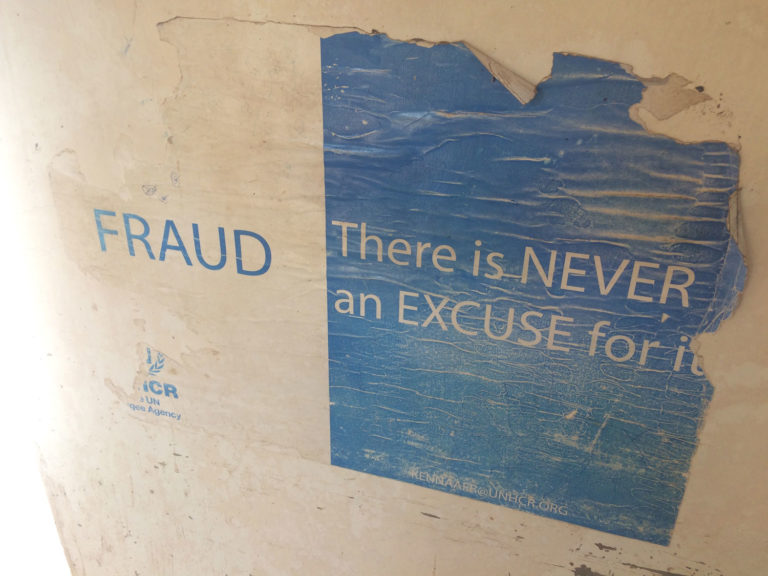
UNHCR asks refugees to report corruption, using posters and advocacy campaigns displaying phone numbers and email addresses they can contact. Refugees accuse UNHCR of encouraging them to come forward without proper systems to combat corruption or regard for the consequences refugees face for speaking out.

One witness showed this reporter a WhatsApp message from one of the IGO investigators, in which the investigator said local UNHCR protection staff and the police are the ones responsible for the refugee’s safety, despite both being implicated by his testimony.

“When we saw that message we thought we were dying,” said the witness. “Because when there is someone of his position telling you something like that, you realise you are nothing and there is nowhere you can run.”

The message echoed a similar email from the IGO to another witness in 2017, seen by this reporter, which said, “With respect to the security issues you have raised, kindly use the existing refugee protection referral channels within Nakivale Settlement, for example, the police, UNHCR and partners to find a workable solution.”

Refugees predict that Washington’s recent announcement of massive cutbacks in the numbers of refugees the U.S. will accept for resettlement will also discourage witnesses of corruption from coming forward, given the shrinking likelihood they will find safe haven. In September, the Trump administration set a cap of 18,000 refugees who can be resettled to the U.S. in 2020, the lowest number in four decades.

Witnesses said investigators from UNHCR’s Office of the Inspector General had stopped responding to their messages.

“If I’m still alive today it’s only because God is with me,” said one man.

In an email to this reporter in July, a UNHCR IGO spokesperson said the agency had “taken a number of measures to strengthen the protection of several refugees despite the challenging environment we face on the ground.”

“We are strongly committed to investigate any possible misconduct among our staff despite all difficulties we are facing in our endeavor to gather the tangible evidence needed.“

Refugee witnesses said this email was inaccurate. “They told you they are aware but from that time nothing has been done. They say ‘measures,’ but we have not seen anything in the field. They didn’t call me, they didn’t send any message. We are staying alone, isolated.”

There are more than 1.3 million refugees in Uganda, according to UNHCR figures, the majority of whom have fled countries with wars or dictatorships including South Sudan, Democratic Republic of the Congo, Burundi, and others in the region. In May, UNHCR and the Ugandan government appealed for donations of $927million to fund their refugee operations.


This report was produced in a collaboration between 100ReportersNBC News, and Journalists for Transparency, an initiative hosted by the International Anti-Corruption Conference Series and Transparency International.

Asylum for Sale

2

03

By Sally Hayden

Part 1     Part 2     Part 3

NAKIVALE, Uganda — Mamadou remembers the harsh lights.

He had been captured by the security forces in his home country and taken to a room in a police station he described as a "container," then moved to a prison.

O

Once there, men in uniforms beat him, before tying and squeezing his genitals and raping him, he said. He believes some were police, and some military intelligence.

“I have been tortured physically, psychologically, and gang-raped.”

Years later, Mamadou has found uncertain refuge in the Nakivale refugee settlement, a sprawling green expanse in southwest Uganda.

His experiences left him emotionally fragile, and he suffers from high blood pressure. “I am not really strong,” he said.

Though he has begun to move from “victim to survivor of sexual violence,” Mamadou also said he quickly realized the refugee settlement he moved to was far from the safe haven he had imagined.

Instead, he says, he soon became the victim of another type of abuse rampant in refugee camps: corruption.

Mamadou, whose name has been changed and country of origin left out because of security fears, was among almost 20 people in the Nakivale refugee settlement interviewed for this investigation who said refugees are exploited by officials demanding bribes for everything from:

collecting food rations

5,000

Ugandan shillings, or $1.30
medical referrals

$5-$13

police referrals

$5-$80

depending on the incident

M

Most expensive, they said, is resettlement to another country, usually in the West, through the United Nations refugee agency, UNHCR. It can cost 1 million to 3.5 million Ugandan shillings ($268-$938) for a person, $5,000 for a family — money that refugees believe is shared among certain UNHCR staff and brokers, who may be aid workers for other organizations or members of the refugee community.

What happened to Mamadou and other sexual assault survivors in the Nakivale camp shows how the most vulnerable migrants can be exploited and preyed upon again in refugee camps, afraid to speak out for fear of losing access to services, with nowhere left to turn.

Through drawings and coded phrases, other men who had survived sexual violence also started sharing their stories of brutality, torture and humiliation that forced them to flee their homes and come to this sprawling, but isolated, Ugandan refugee camp of more than 100,000 people.

A widely used tactic

It is not clear how many male refugees worldwide have been victims of sexual violence, though experts say the numbers are certainly high.

Women gather to sit and chat in Nakivale refugee settlement, southwest Uganda. More than 100,000 refugees live there, according to the Ugandan government. Photo by Sally Hayden.

S

Stigma and a lack of support often stop men from reporting what they have been through. A recent report by the Women’s Refugee Commission listed sexual violence as a reason males leave their home countries to try and reach Europe, and found it was also “commonplace” against boys and men along smuggling routes in North Africa.

“For those men who are fleeing conflicts and who have also been detained in connection with those conflicts, we see a high prevalence,” said Karen Naimer, the director of the Program on Sexual Violence in Conflict Zones for the U.S.-based non-profit Physicians for Human Rights, which documents rights abuses around the world.

Sexual violence is a form of torture meant to humiliate, as well as to destroy individuals and communities, she said. “In the context of detention, it’s certainly a tactic that’s used widely with respect to men…This is a tool that’s used really widely around the world.”

Naimer said if a victim doesn’t get proper support the trauma can last a lifetime, causing depression and affecting sexual health.

There are enormous impacts that men experience after having endured sexual violence. It can impact their ability to sleep," she said, "their ability to have meaningful relationships.

Karen Naimer
Director of the Program on Sexual Violence in Conflict Zones for Physicians for Human Rights


In Nakivale, Mamadou did find a kind of healing. It took him a long time to begin to speak about the sexual violence he had been through, but when he did, he found he was not alone.

In 2013, Mamadou banded with other survivors of sexual violence to form Men of Peace. The organization’s name symbolized the future they were hoping for. It brought together more than four dozen refugees who had escaped war, brutal abuse and torture in the Democratic Republic of Congo, Burundi, Rwanda and other countries in the region.

Though most of the group’s members did not identify as gay, the organization also formed against the backdrop of Uganda’s infamous anti-homosexuality bill, then being debated in Parliament. Police and government officials did not understand the difference between gay people and male sexual violence survivors, several Men of Peace members said, and they were badly stigmatized because of it.

"Still now, there is a confusion between you and the gay community," said Mamadou, adding people don't realize that men can be rape victims, too.

A church pictured in Nakivale refugee settlement, southwest Uganda. More than 100,000 refugees live there, according to the Ugandan government. Photo by Sally Hayden.

What happened to females is already known everywhere, but we are trying to break the silence.

Mamadou

The men gathered to support one another in dealing with recurring trauma and discrimination in their communities, which was exacerbated by the debate inside the country. Some were taunted and called girls’ names; others said neighbors ostracized them completely.

Together, they planned to campaign for counseling, legal protection and medical care. First, members say they asked government employees in the Office of the Prime Minister, which works with refugees, for help in finding an office. Several said they were asked to pay a bribe of 1 million Ugandan shillings ($268) in exchange, which they couldn’t afford. When asked about corruption in the camp during an interview in October, the office’s assistant commander, Bruno Asiim, denied it is a problem. Asiim didn’t respond to further requests for comment.

Men of Peace members then say they approached the U.N. refugee agency for support. They say the agency’s protection officer, Henry Bataringaya, was assigned to help them.

According to seven people aware of events at the time, Bataringaya quickly began demanding money, which he claimed would help the group’s members to win resettlement. The men were clearly vulnerable and had a good chance of being accepted — with his support, they quoted Bataringaya as saying.

Bataringaya denies these claims.

Men drink beer and spirits in a bar in Nakivale refugee settlement, southwest Uganda. More than 100,000 refugees live in Nakivale, according to the Ugandan government. Photo by Sally Hayden.

A

All the members of Men of Peace interviewed for this investigation, who spoke on condition of anonymity out of fear of retaliation, said they have experienced corruption repeatedly in Nakivale. One said he had to pay 100,000 Ugandan shillings ($27) to the hospital for a document acknowledging he had been tortured, and $81 for a police report after he was attacked in the settlement. Another said he had to pay government employees $81 to begin receiving food rations.

For poor refugees desperate to escape a life of subsistence and exploitation, resettlement is seen as a holy grail, though an expensive one. Described as a “life-changing experience” by the UNHCR, resettlement is an opportunity to start a new life in another country, usually in the West, that only around 1 percent of the world’s refugees ever benefit from.

Those chosen should be those most in need, said Kay Bellor, the vice president for programs at the Lutheran Immigration and Refugee Service, one of nine organizations that helps refugees coming to the U.S. She said there’s not one specific characteristic or experience that makes people vulnerable: those who qualify could be single mothers or sexual violence survivors, or from a range of other backgrounds. Before the Trump administration began drastically reducing the country’s intake, Bellor said the U.S. had a long history of taking in vulnerable refugees.

Refugees who resettle, Bellor said, “enjoy permanent protection from forced return to the country where they were persecuted.”

“Their children are safe and they are able to go to school,” she said. “They are able to rebuild shattered lives.”

Most cases are referred to U.S. authorities by the UNHCR before they go through a separate screening process.

“If UNHCR determines that they’re a refugee and determines that they need resettlement, then we might get that case,” Bellor said.

For refugees in the five countries examined in this investigation, though — Kenya, Uganda, Ethiopia, Libya and Yemen — resettlement can be tainted by corruption.

Schoolchildren pictured in Kakuma refugee camp, northwest Kenya. Photo by Sally Hayden.

I

Interviewees described certain local UNHCR staff as eager to exploit people desperate for a new start, away from countries where they still fear danger, instability and a crushing lack of opportunity. This follows similar claims by refugees in Sudan last year.

In on-the ground interviews in Nakivale, 13 refugees said they had been asked for money or paid money to UNHCR staff, brokers, government officials or staff from UNHCR-associated aid agencies.

One survivor described bribes demanded during resettlement as an integral part of the economy for local aid workers.

That's the market for corruption. That's the food here.

Member of Men of Peace

And other needs suffer, they say. While pressuring the group to hand over bribes, Bataringaya failed to assist them with separate, more modest, aims, according to multiple Men of Peace members who asked not to be named for fear of reprisals. Initially, they said, he asked for 2 million Ugandan shillings ($536) from each member for resettlement, eventually lowering the figure to 1 million ($268). As sexual violence survivors, he said, they had a good chance of being accepted by another country because their situation was so precarious in Uganda.

“We are very poor and couldn’t get that money,” one Congolese victim remembered.

Reached through his UNHCR email, and then on the phone, Bataringaya says he was questioned about these allegations before, but his name was cleared last year by the UNHCR’s internal investigative body, the Inspector General’s Office (IGO). He wouldn’t give more information, directing me to speak to the IGO directly for more information. “The IGO knows my situation,” he said.

Click here to read the NBC News and J4T versions of this story.

The IGO declined to comment.

A woman walks along a road in Nakivale refugee settlement, southwest Uganda. More than 100,000 refugees from countries including Burundi, the Democratic Republic of Congo, Eritrea and South Sudan live there, according to the Ugandan government. Photo by Sally Hayden

L

Like other refugees interviewed for this series, the sexual violence survivors in Nakivale reported the corruption they came up against to the UNHCR, but said they only suffered more afterward. The UNHCR’s Inspector General’s Office lacks the independence, local knowledge and desire to properly investigate, according to former and current UNHCR staff and two former U.N. investigators. Dozens of refugees across five countries, interviewed as part of this investigation, say the IGO has tended to clear allegedly corrupt officials rather than supporting refugees who are victims of them.

UNHCR spokesperson Cecile Pouilly denied this, saying, “Every report or allegation of fraud, corruption or retaliation against refugees by UNHCR personnel or those working for our partners is thoroughly assessed and, if substantiated, results in disciplinary sanctions, including summary dismissal from the organization.”

Pouilly said. "Some 49 percent of these were substantiated, compared to 35 percent in 2015. We believe this increased substantiation rate reflects UNHCR's efforts to professionalize and strengthen its investigative function."
2017 Investigations

35%

2018 Investigations

49%

P

Pouilly also said that sexual violence “is an issue of major concern to UNHCR and unfortunately a terrible reality for many refugees, both male and female survivors.”

“UNHCR regularly refers survivors of sexual violence to resettlement, and this is one of the elements that are taken into account when assessing the vulnerability of individual refugees,” she said. “However we also work hard, and in close cooperation with partners, to ensure that a range of services are made available, including medical and psychological support, and other appropriate responses, to survivors wherever they are.”

In 2015, members of Men of Peace say they took a chance, trekking to the UNHCR office in the town of Mbarara, some 40 kilometers (25 miles) away, to report the shakedowns, so Bataringaya wouldn’t spot them. They said that rather than acting on their complaints, UNHCR officials referred them back to Nakivale. Next, the men say they complained to Pietro Fossati, UNHCR’s head of resettlement in Nakivale at the time. All that happened, according to seven testimonies, is that Bataringaya was pulled from working with Men of Peace, though he remains a UNHCR staff member. Afterward, they say his colleague Peter Ssenteza made a telephone call to a member of the group, demanding, “Why do you want to get resettlement for free?”

When asked about claims against Bataringaya, UNHCR spokesperson Cecile Pouilly said the agency can’t comment on individual staff members.

Ssenteza denies making any such call, and said any refugee can complain at any time to the IGO if they have a problem. “Fraud couldn’t go undetected for even one day,” he said, adding that refugees try to break down staff who are strict about rules by making allegations against them. Ssenteza said staff should have a right to take legal action against any refugee who defames him. He wouldn’t confirm whether the IGO has ever investigated him.

In 2016, an investigation was carried out in Nakivale, following complaints from other refugees. A team of IGO investigators from UNHCR headquarters in Geneva visited in November that year. They were headed by Coralie Colson, whose LinkedIn profile says she’s been employed as a senior investigations specialist by UNHCR since 2013.

Shortly before the scheduled interview, Men of Peace members said one of them received a call from a local UNHCR staff member, who knew about the upcoming IGO interviews, even though the investigation was supposed to be confidential. This made them apprehensive.

The group sent a representative to speak to Colson on behalf of them all, disclosing what they had been through fully for the first time. Colson promised she would help, but nothing happened, they say. One year later, witnesses were told by email that the investigation was being closed with no further action.

Now if we write to the Geneva office they don't reply.

Member of Men of Peace

When contacted for comment, Colson forwarded my email to Henrik Malmquist, the head of the IGO’s investigation service.

Malmquist said the description of how complaints by the Men of Peace had been handled “makes me very concerned,” and asked that information be shared with him confidentially “without compromising your sources.”

Said Malmquist, “We are all professional investigators with solid backgrounds from law enforcement, military, or other international organizations and are well placed to handle the most sensitive information.”

A sign outside UNHCR's office in Nakivale refugee settlement, southwest Uganda, tells refugees to report anyone who's asking for bribes for resettlement. Photo by Sally Hayden

D

Despite Malmquist’s saying the IGO was completely independent, he also referred the query to Adrian Edwards, a UNHCR global spokesperson, who responded, saying the IGO team who visited Nakivale had found “suspected interference with witnesses, including possible coaching of them,” which “meant the allegations could not be substantiated and the case had to be closed.”

Meanwhile, the Men of Peace say they feel more at risk than ever, afraid to speak out and equally afraid of staying quiet and suffering.

“Since then, there are problems — I don’t sleep at home, I change places all the time,” a Congolese refugee said, as another explained he never takes the same route home for fear of being attacked by other refugees who resent them for speaking out. He believes the UNHCR would not step in to help the men if something did happen.

Maybe UNHCR just wants us to die so the problem is over. Only God is protecting us.

Congolese refugee

This report was produced in a collaboration between 100ReportersNBC News, and Journalists for Transparency, an initiative hosted by the International Anti-Corruption Conference Series and Transparency International.

Continue Reading

Refugees say some U.N. workers demand bribes for resettlement

Part 2

Whistleblowers

U.N. refugee agency does not protect us or address corruption

Male refugees victimized by sexual violence say officials wanted bribes to help

Whistleblowers: U.N. Refugee Agency Does Not Protect Us or Address Corruption

1

02

By Sally Hayden

Part 1     Part 2     Part 3

Whistleblowers face reprisals for speaking up, while corruption persists

NAKIVALE, Uganda — Gratien Zimy Ntezimisi lives in a shelter as sturdy as a small castle. He says there’s a good reason he lives behind cement walls and an iron door with a heavy lock.

They try and force the door to see is there a way for them to enter, fight and maybe kill me,” he said. “When they fail they vandalize the compound, my trees, my vegetables.

On some nights, he says, unseen figures attack his home. They throw stones that clatter on his metal roof and push and ram his door.

“They try and force the door to see is there a way for them to enter, fight and maybe kill me,” he said. “When they fail, they vandalize the compound, my trees, my vegetables.”

Even in daylight, the 41-year-old from the Democratic Republic of the Congo feels like a pariah. He says his neighbors in this 71-square-mile refugee camp near the Tanzanian border are reluctant to help him report problems to the police, or even to greet him.

“I am surrounded by neighbors, but when such things happen to my home not one of my neighbors have come to me to say they saw something.”

Ntezimisi says the trouble started three years ago, when he reported corruption involving staff members of the U.N’s refugee agency, UNHCR, to the agency directly.

He had been working as an interpreter for an organization contracted by the U.S. government, sitting in on interviews with refugees who were about to be resettled in the States — a job that made him well known in the settlement. Refugees began to approach him, confiding similar stories, about UNHCR staff members and suspected brokers asking them to pay to start a new life in the West.

“You keep on hearing the same story from different people on a regular basis,” he said in Kampala, Uganda’s capital, in July 2018, in the first of many interviews. Ntezimisi had traveled nearly 190 miles overnight to meet this reporter because he said he was desperate to publicize what was happening.

As part of his interpreting job, Ntezimisi had been trained in tackling fraud and corruption. All over Nakivale, as in many other refugee camps around the world, anti-corruption posters are ubiquitous, informing refugees that services are free and wrongdoing should be reported to UNHCR. So Ntezimisi decided to do just that.

Boys play basketball in Nakivale refugee settlement, southwest Uganda. Photo by Sally Hayden

It should be noticed that the people mentioned in this current fraud report is just the tip of the iceberg...

On May 31, 2016, Ntezimisi travelled to UNHCR’s headquarters in Kampala with a report he had taken two months to compile, full of specific information about instances when refugees were asked for money. It named the offenders, the victims and the amounts, all carefully typed. The report implicated UNHCR staff, the police, other aid organizations and government employees.

“It should be noticed that the people mentioned in this current fraud report is just the tip of the iceberg,” he wrote in the document. “The problem is so massive that a poor refugee without any resources could hardly pretend to be able to uncover the whole scam network in its entirety.”

Posters and promises aside, Ntezimisi was unprepared for what happened next. While UNHCR instituted a formal investigation, the interpreter says he saw nothing change, and instead became the target of ongoing retaliation for speaking up.

His experience was hardly unusual. In a seven-month investigation across five countries with significant refugee populations, more than 50 refugees, current and former UNHCR staff members and former U.N. investigators accused UNHCR of failing to adequately address corruption allegations, failing to protect refugee whistleblowers, and “whitewashing” investigations so as not to lose support from donors. This follows similar claims by refugees in Sudan last year.

Refugee whistleblowers in Kenya, Uganda and Yemen accuse UNHCR of encouraging them to report allegations, but then failing to properly protect them when they do. (Only refugees who explicitly agreed to be named are identified; all others are kept anonymous because of the risk to their safety.)

Retaliation allegedly suffered by refugees who speak out has included physical violence, withholding of food rations, changes in their refugee status, being blocked from receiving UNHCR assistance, death threats and arrest.

Refugees interviewed in Kenya, Yemen, and Uganda accuse UNHCR staff of calling the police on them after they protested against corruption, resulting at times in arrest or assault. Refugees in Uganda reported spending days in a police cell, while Sudanese refugees in Libya accused UNHCR staff of assaulting them after they tried to protest corruption in Tripoli late last year.

Though the UNHCR can and does launch fraud investigations through its internal Inspector General’s Office (IGO), victims, staff, former U.N. investigators, and lawyers say that the IGO lacks the mandate to protect refugee witnesses.

Former UNHCR and U.N. investigators, as well as others with experience of U.N. processes, also argue that diplomatic immunity allows U.N. staff to exploit refugees without fear of punishment. “There has been a bit of movement but it’s moving the deck chairs on the Titanic. You’ll never get accountability with them policing themselves,” said Edward Flaherty, a Geneva-based lawyer who’s worked on U.N.-related cases for two decades

The UN fiddles around the edges, they issue new policies, (but) the immunity and impunity remains. The lack of accountability remains… It’s amazing that this stuff is still being revealed because the UN crushes whistleblowers.

Edward Flaherty​

In an emailed response to written questions, UNHCR said immunities are given “in the interest of the organization, not for the personal benefit of staff.”

“UNHCR cooperates in the administration of justice. Where a matter has been referred to national authorities for criminal accountability, waivers of immunity are facilitated through United Nations Headquarters in New York,” said UNHCR spokesperson Cecile Pouilly.

A boy poses on a bicycle in Nakivale refugee settlement, southwest Uganda. More than 100,000 refugees live there, according to the Ugandan government. Photo by Sally Hayden

In the past, UNHCR has pointed at its lack of witness protection. “Lessons learned from key investigations,” as listed in a March 2018 overview of the IGO’s work, included that “the support that UNHCR can provide to witnesses who face security risks when they are involved in investigations is limited” and “the primary responsibility for witness protection lies with the host State.”

Speaking in an interview at the United Nations General Assembly last September, UNHCR Deputy High Commissioner Kelly Clements said, “We’re a humanitarian agency. We’re not a law enforcement agency. … So there are limits to what we can do. … We often will rely on national authorities or local law enforcement authorities to help us.”

Pouilly said the agency recognizes it has a responsibility to protect those who come forward and cooperate with investigations. “While bearing in mind the primary responsibility of the host state in ensuring the physical security of refugees within its territory, UNHCR has devoted significant attention to strengthening measures to protect witnesses and persons of concern who cooperate with an IGO investigation, and these efforts are continuing.”

“Taking into account good practice in international and national investigation, the IGO takes steps to mitigate risks to witnesses during the investigation phase, including in the conduct of interviews, the anonymization of testimony and redaction of investigative findings and report,” Pouilly said, adding that the IGO can request additional help for witnesses on a case-by-case basis, including organizing a security assessment, providing counseling, financial and legal support, and relocating refugees either within the country they’re in, or resettling them to another country.”

It should be noticed that the people mentioned in this current fraud report is just the tip of the iceberg...

'Maintain a low profile'

In two-and-a-half years of communication between Ntezimisi and UNHCR reviewed by 100Reporters, his pleas grew more and more desperate, as he transformed from moral whistleblower to hunted victim: refused food rations, intimidated by police and locked for days in a cell after he says UNHCR called security on him.

“Every time I’m in Nakivale I get threats, so I go to Kampala or Mbarara and report to UNHCR,” he said, referring to a local town. “They always take me back with the police.”

He added, “Reporting is basically a way for me to say I’m suffering. If I keep quiet, no one will know that I’m undergoing such mistreatment.”

In one November 2017 incident documented through emails, UNHCR asked Ntezimisi to visit Ugandan police for what they called a “discussion” about his safety. Instead, he says he was met by nine police officers, who first told him to finger the police involved in corruption, and then threatened him, accusing him of damaging the name of the police force and government.

On Nov. 24, 2017, Ntezimisi wrote to a UNHCR field officer, Henok Ochalla, telling him what happened and asking, “Is it logic[al] for me to rely on the Office of the Prime Minister and police for my physical protection?”

"Worse than all these is the UNHCR position, which is thinking that I am forging all these complaints of insecurity [to get] resettlement."

Gratien Ntezimisi

Responding, Ochalla said he was “totally convinced” the meeting should have been about how to protect Ntezimisi, and said he would seek clarification, while advising Ntezimisi to “maintain [a] low profile.” However, Ntezimisi says he still never received any direct protection.

Earlier in 2017, says Ntezimisi, his name disappeared from the list of refugees allowed to receive food rations in his area. Ugandan officials then reissued Ntezimisi’s food ration card, he says, but it was a card he could only use in a remote village, meaning he could not collect his monthly allocation of food.

He wrote again to UNHCR’s Nakivale office in August 2018, saying he had gone 16 months without food aid “as punishment for reporting the fraud.” In response, UNHCR staff member Ghulam Nabi Seddiqi wrote, “I am sorry that the challenge could not be addressed. I will once again talk to concerned actors for advocacy purposes.”

“I have become a beggar to find a meal,” Ntezimisi messaged this reporter, sick with typhoid and going days without food. “That’s how I live, asking friends [for charity] for two years now.”

Asked about Ntezimisi’s case, UNHCR spokesperson Adrian Edwards said help was offered and refused. However, Ntezimisi says the only offer was to move him to another Ugandan refugee settlement, where he would still be at risk, because accused UNHCR employees move between settlements regularly.

Last June, Ntezimisi traveled back to the UNHCR Kampala office with five other witnesses of corruption to request protection again, but says the agency offered none. The refugees ended up sitting in front of a UNHCR vehicle in protest, refusing to move until someone helped them. In response, Ntezimisi and other participants say UNHCR called the police, who hauled them away.

“We spent three days, three nights in the police station here in Kampala,” Ntezimisi said. His account was confirmed by another refugee who was with him.

“We requested them to temporarily find a solution,” said Ntezimisi. “Rent a house here, identify who within our group (is) at the most high-risk level, put (us) in the house while (we) are waiting for a durable solution, either resettlement or other means.”

“They said no,” Ntezimisi said. Instead, “They started to intimidate us.”

Back when he first reported corruption, Ntezimisi says he had faith that something might come of his complaints. In November 2016, he testified to representatives from the UNHCR Inspector General’s Office, who came from Geneva to look into allegations, telling them both of exploitation he had heard about and of the pressure he had been put under since disclosing it.

On Dec. 12, 2017, Ntezimisi received an email from Coralie Colson of the IGO, who had also interviewed other refugees in Nakivale.

“As promised, I am getting back to you with respect to the allegations you have made against UNHCR staff,” she wrote. “The Inspector General’s Office has now concluded its investigation and has decided to close the case. This email hereby informs you of the IGO’s decision.”

He was given no explanation.

I think the reason Geneva concluded that nothing wrong was found is that the more the UNHCR name is clean, the more they will get funding and the benefit they get from that

Ntezimisi

He was upset, he said, but not surprised.

Questions emailed to Colson were responded to by Adrian Edwards, a UNHCR global spokesperson. Edwards said the probe was dropped because of “suspected interference with witnesses including possible coaching of them.” He did not confirm who may have interfered with the investigation, though he said Ntezimisi was the “main complainant.”

When asked about this, other refugees who gave evidence during the investigation said they didn’t even know Ntezimisi, but interference did happen after a local UNHCR staff member was given details of Colson’s interviews and called refugees to intimidate them in advance.

Locals in Kakuma, northwest Kenya, collect water with jerrycans. Photo by Sally Hayden.

Figures had been exaggerated by at least 300,000

The success story that wasn't

At the same time Ntezimisi made his initial report about corruption, UNHCR was enthusiastically promoting Uganda as one of the best places in the world to be a refugee. Spokespeople praised the country as a “model example,” citing Kampala’s policy of giving refugees a plot of land and rights that included freedom of movement. Media coverage in major outlets like the Guardian, BBC, The New York Times and Der Spiegel in 2014 to 2018 lauded Uganda as a rare positive refugee story.

Alongside the publicity came pushes for more funding from donor countries. In 2017, Uganda and UNHCR jointly announced they were looking for $8 billion to provide for South Sudanese refugees who were fleeing the civil war at home.

Ntezimisi and a dozen other refugees in Nakivale said they felt vindicated in February 2018 when corruption in Ugandan refugee camps at long last made headlines. In October 2018, the Ugandan government admitted refugee figures had been exaggerated by at least 300,000, while the U.N.’s Office of Internal Oversight Services (OIOS) ruled in a damning audit in November that UNHCR in Uganda critically mismanaged donor funds in multiple cases.

Over the past year, Ntezimisi says, UNHCR staff members in Nakivale have stopped denying corruption exists. Instead, they have begun to accuse him of “taking advantage” of the fraud to get resettlement.

A man walks along a path in Dadaab refugee camp, eastern Kenya. Photo by Sally Hayden.

They are like a dictator government. The first punishment is denying services… they will torture (you) mentally.

No protection

Like most refugee camps, Nakivale is extremely remote. To reach it from Kampala takes six hours on a cramped bus, followed by nearly an hour in a taxi over bumpy, muddy roads. Many refugees never leave this isolated expanse of countryside. They live on the bare minimum. Some have waited 10 or 20 years to see if peace might come to their homelands, and they are desperate to escape.

Ntezimisi’s plight has served as a warning to others tempted to complain openly of corruption.

“It’s not the first time we spoke about this. We get repressed. Our files get blocked,” warned another Congolese refugee there. “The UN does not have any protection mechanism for whistleblowers. We’ll tell you things, but we have no guarantee.”

Among UNHCR staff, dissatisfaction about the lack of progress in tackling corruption is not uncommon. Staff say the IGO is both too far removed from the reality on the ground and not adequately independent to carry out its function.

A current UNHCR resettlement staff member, who spoke on condition of anonymity, described instead subtly trying to investigate other colleagues’ work, despite a lack of authority to do so. The staff member said suspicions surround certain employees, but only the Geneva-based IGO has the authority to investigate them. Local management, with better knowledge of the specific circumstances, tends to brush aside allegations, the staffer said.

Much of the problem, the staffer said, stems from a disconnect between international employees and the refugees they are ostensibly there to serve. Complaints may not be believed or even heard. “There’s definitely a culture of not wanting to be seen talking to a refugee, and in a way not treating a refugee as a person. You don’t want to be seen to be overly friendly to a refugee.”

Keeping one’s distance could be judged as fair, an effort to avoid favoritism, “but there’s a negative,” the staffer said. “You’re not seeing them as humans or taking them at face value.”

Still, the staff member wanted to remain anonymous. “I have a grand plan of fixing the problem from the inside out, however idealistic and unrealistic that is. Resettlement is a lifesaver for very few, so it really upsets me when the process is corrupted.”

According to U.N. figures, the Inspector General’s Office concluded 144 investigations in 2018, of which 49 percent were substantiated. From 2017 to 2018, an IGO report said, 897 complaints were received relating to misconduct, of which nearly half involved some kind of fraud.

“In 2018, additional investigators were recruited and some stationed in Nairobi, Pretoria and Bangkok enabling them to be deployed rapidly and to have a better understanding of local contexts and issues,” the U.N.’s Pouilly said.

In total, 10 staff members were dismissed on grounds of corruption from 2017 to 2018, she added. However, critics say without systemic overhaul, a few dismissals do little to change a culture of exploitation.

“It fits a pattern and is what I’d describe as commensurate with the culture of the U.N. in general,” said Peter Gallo, another former U.N. investigator, speaking about drawn-out investigations with limited conclusions.

Said Gallo, “The U.N. will always be happy with a result that has a lot of activity and ends with no result.”

“There’s definitely a culture of not wanting to be seen talking to a refugee and in a way not treating a refugee as a person. You don’t want to be seen to be overly friendly to a refugee.”

A former UNHCR staff member, who quit after participating in an IGO investigation that came to nothing said that was the U.N.’s “typical strategy of covering up, containing damage.”

“It is really a headache for me when people pay less attention to human lives and care more about polished reports for donors and PR propaganda,” the ex-staff member said. “Bunch of liars.”

UNHCR guidance for employees emphasizes the importance of maintaining the image of an honorable organization. In a “brand book” released in April 2016, UNHCR said all staff communications with the media, partner organizations, governments and refugees should convey “the attributes that audiences universally say are most likely to make them want to support a humanitarian organization,” including “can be trusted.”

When asked whether UNHCR is whitewashing wrongdoing by staff to protect its public image, UNHCR spokesperson Pouilly responded: “We wish to stress that eradicating any misconduct from our organization is a key priority for UNHCR and we have extensively communicated on these issues, both internally and externally.

“As you know, our programs are only partially funded, which has a real impact on the lives of millions of refugees around the globe. Without additional financial support, we will not be in a position to offer to refugees the protection and assistance they desperately need.”

Kalobeyei Integrated Settlement in northwest Kenya is one of the places where refugees have complained of corruption. Photo by Sally Hayden.

Death threats

In 2016, an IGO investigation was launched in Kakuma refugee camp, northwest Kenya, as a result of what refugees described as a rare anti-corruption campaign by a senior international UNHCR staff member, Inge De Langhe. More than 20 refugees interviewed there last October for this report said corruption had been a problem as long as they could remember.

Within months, though, De Langhe was forced to leave the camp as a result of death threats, according to seven refugees who knew her, as well as former UNHCR contractors and staff members. “She was chased like a wild animal,” said one Congolese refugee with knowledge of events. UNHCR Kakuma camp head, Tayyar Sukru Cansizoglu, told this reporter he hadn’t heard of this, and believed De Langhe left when she reached the end of her contract.

Four UNHCR staff members in Kakuma were eventually referred to the Kenyan police, with at least one being arrested and two resigning. Refugees and former staff said the referral and resignations wouldn’t have happened without De Langhe’s persistence.

However, after De Langhe returned to UNHCR headquarters in Geneva, five refugees told me the incident had proved how alone they are: They felt both abandoned and retaliated against, while two reported being contacted by other UNHCR protection staff and warned not to communicate with any foreigners again.

“You used to communicate with the white people. You used to communicate with Inge, now your case has gone to Geneva with her,” one refugee said he was told by UNHCR staff member George Micheni, who was also accused by another refugee of asking for a $1,000 bribe and has since moved to work for UNHCR in Egypt.

When contacted on their UNHCR email addresses, both De Langhe and Micheni said they couldn’t comment, instead referring questions to UNHCR media spokespeople, who said they can’t disclose details about specific staff members.

Another refugee alleged Kenyan UNHCR staff began paying refugees to give false information to visiting investigators, claiming he was offered money, too, but turned it down.

Two refugee witnesses were eventually moved to Nairobi for their protection, and disappeared from communication, but the fallout was much greater than that.

“Geneva [has] no power here,” a UNHCR contractor and refugee in his 20s said. “Things are worse now.”

For those left in the camp, the feeling of danger is very real. In several cases, witnesses said refugees were killed by police or members of the local community, seemingly without repercussions – though there is no proof these killings were linked to corruption.

The wife of one of those killed asked this reporter to make UNHCR aware that she needed protection. Despite UNHCR staff saying they would contact her, at the time of publication, five months later, the woman says she’s still heard nothing.

Geneva have no power here. Things are worse now.

'There is a cancer'

Five hundred miles away, in Nakivale, Ntezimisi is full of advice on how corruption could be curtailed, but becoming more despondent by the day. He suggests limiting the power of local employees, who may be under pressure from their families to find extra income. Increased transparency as to how the resettlement process works would also help, he said.

"You're not going to blame the doctor because he told you you have a cancer..."

“Many people are kept in darkness. They don’t know what to expect, who expects what,” he said, adding that UNHCR “keeps it a secret, and people exploit that secrecy.”

Ntezimisi says donors should conduct their own investigations and speak to refugees directly to monitor what’s going on. “They keep pumping in money to the system which is corrupt, and the people are suffering without their knowledge. It doesn’t make sense.”

Ntezimisi also wants to reach out to other refugees in similar situations, maybe through a YouTube channel. He says he would like to offer help to anyone trying to change UNHCR’s systems, but thinks reform is unlikely in the short term, particularly if the messenger is the one who is punished.

“Unfortunately, I discovered that there is a cancer,” Ntezimisi said. “You’re not going to blame the doctor because he told you you have a cancer.

“That cancer needs to be treated.”

This report was produced in a collaboration between 100ReportersNBC News, and Journalists for Transparency, an initiative hosted by the International Anti-Corruption Conference Series and Transparency International.

Continue Reading

Refugees say some U.N. workers demand bribes for resettlement

Part 2

Whistleblowers

U.N. refugee agency does not protect us or address corruption

Male refugees victimized by sexual violence say officials wanted bribes to help