Asylum for Sale

01

By Sally Hayden

Part 1     Part 2     Part 3

In some of the world's most desperate places, UN caseworkers are demanding bribes from refugees.

Fraud and corruption are endemic, and those who speak out are punished.

Children walk across sandy terrain in Dadaab refugee camp, eastern Kenya. Photo by Sally Hayden.

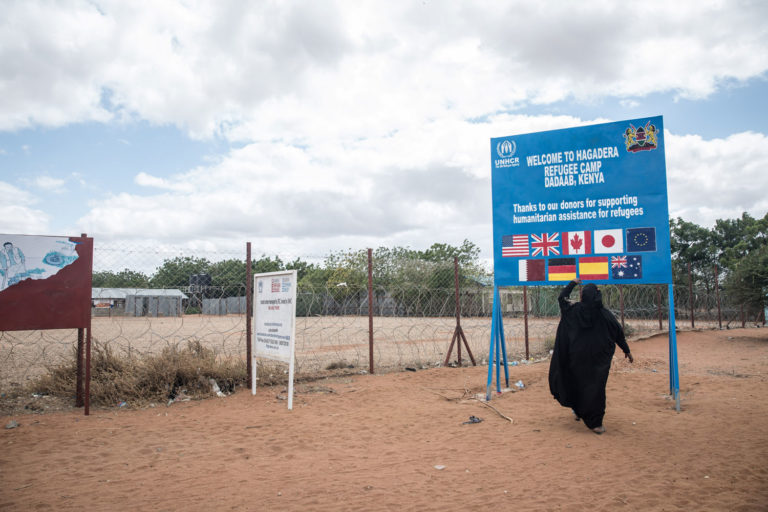
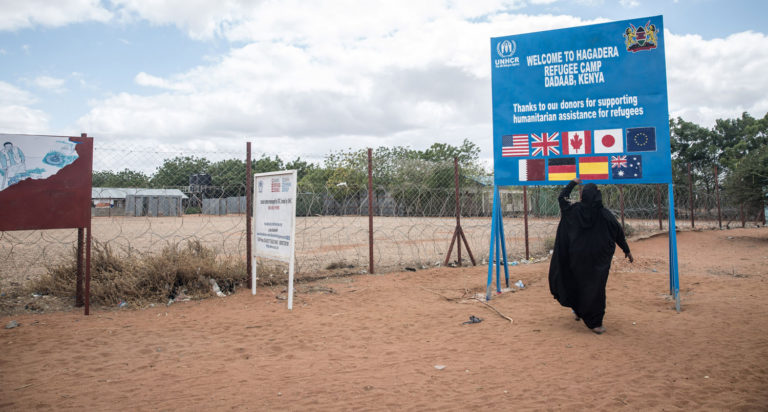
DADAAB, Kenya — Hamdi Abdullahi stands outside the United Nations compound in this dusty, sprawling camp — home to more than 200,000 Somali refugees — and throws stones at its barbed wire fence and heavy gates.

Though the U.N.’s refugee agency, UNHCR, is known everywhere as the chief protector and spokesman for most of the globe’s 25 million refugees, Abdullahi shouts as she hurls the stones, accusing the agency of stealing her children.

She has been protesting outside the compound off and on for years.

The Somali refugee’s four children are now 8,000 miles away in Minnesota, with her former husband and his new wife. She last saw them in 2014. They were among the less than one percent of refugees in the entire world chosen to be resettled in a new country and given a chance to start their lives again.

Abdullahi said that while her family’s need to resettle was genuine, she was left behind because of false information fed to the U.S. government by a UNHCR resettlement officer, David Momanyi, to whom her ex-husband paid a hefty bribe. “I always remember his face,” Abdullahi said.

Their status as vulnerable refugees who’d fled a war zone helped her children, her ex and his new wife get into the United States. But Abdullahi says the bribe left her in the Dadaab refugee camp, where she now throws rocks and curses, only to be chased away by the security guards. 

“I’m like the walking dead,” she said.

Her account is corroborated by a former U.N. contractor, speaking anonymously for fear of retribution, who said he personally collected tens of thousands of dollars from refugees while acting as a middleman for Momanyi — and other UNHCR staffers — over several years. He said Abdullahi’s ex-husband paid almost $20,000 in multiple installments.

In separate interviews, more than a dozen other refugees said Momanyi was known for taking bribes. One described the Kenyan as “the architect of corruption and refugee resettlement problems.”

In an interview at Dadaab, the UNHCR’s staff denied corruption could have played any role in the outcome of Abdullahi’s case. They also looked up her case number and said her files show her husband remains in Kenya, and was never resettled. Two UNHCR Dadaab staff members also denied that Momanyi had ever worked there.

Young men stand in front of a UNHCR field office in Dadaab refugee camp, eastern Kenya. Photo by Sally Hayden.

Momanyi is the architect of corruption and refugee resettlement problems.

Contacted on his UNHCR email address, Momanyi — who now works in another country — referred questions to a UNHCR media spokesperson, who said she could not comment on individual staff members.

Reached by phone, Abdullahi’s husband confirmed he had been resettled in Minnesota, but said any allegations of corruption were “false information.”

“The U.S. government gave me resettlement to come to the United States but that’s it. There’s no bribe. … She was rejected by the United States government. That issue, it’s over… You know (in) America there’s no bribes.”

The allegations of corruption at the UNHCR are not limited to one man or one place. A seven-month investigation across five countries with significant refugee populations has found widespread reports of the UNHCR’s staff members exploiting refugees, while victims and staff members who report wrongdoing say the agency fails to act against corruption, leaving them vulnerable to intimidation and retaliation.

In interviews, more than 50 refugees registered with the UNHCR in Kenya, Uganda, Yemen, Ethiopia and Libya have described corruption and exploitation involving the agency's staff and personnel from other aid agencies, following similar claims by refugees in Sudan last year.

Most of those interviewed for this investigation do not know each other. They are separated by hundreds or even thousands of miles, but their accounts follow starkly similar patterns involving large amounts of money and middlemen — often other members of the refugee community.

Reporting included on-the-ground interviews in the Dadaab and Kakuma refugee camps in Kenya and the Nakivale refugee settlement in southwest Uganda. Refugee sources were not paid for interviews, and most said they wanted to speak out because they have exhausted all other options, including complaining to the UNHCR itself. Only refugees who explicitly agreed to be named are identified; all others are kept anonymous because of the risk to their safety.

Refugees, current and former UNHCR employees, aid workers and two former U.N. investigators say bribery and corruption are common in a variety of services the UNHCR and companion organizations are charged with providing, but report that it is especially unavoidable in resettlement — a precious opportunity for the world’s most vulnerable refugees to restart their lives in safe new countries, usually in the West.

While UNHCR staff have occasionally faced internal punishment for taking bribes, these sources — almost unanimously — accuse the organization of ignoring or “whitewashing” charges so as not to risk losing support from donors. Suspected perpetrators are allowed to resign or move to other locations rather than face investigation, according to dozens of refugees and former and current staff. Temporary suspensions of resettlement — as is currently happening in Sudan following allegations of corruption there in mid-2018 — doubly punish the most vulnerable, they say.

Click here to read NBC News and J4T versions of this story.
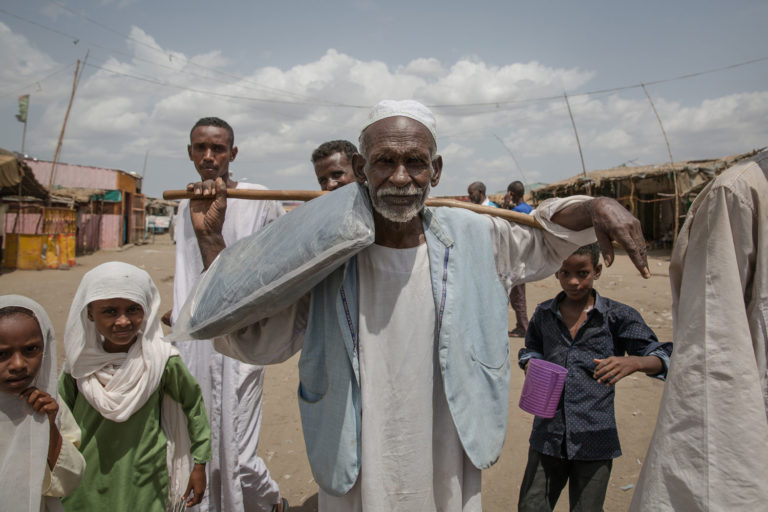
A man walks through a market in Dadaab refugee camp, eastern Kenya. Photo by Sally Hayden.

Three former UNHCR staff members said their employment contracts were unexpectedly terminated after they spoke out about fraud and exploitation or took steps to stop it. Instead, corrupt staffers in positions of power replaced them with others more willing to tolerate bribery or other misconduct, they allege. Alternatively, staff suspected of misconduct may receive good references so they are promoted and moved to other locations, current and former staff said.

You’re punished if you care too much about the rights of refugees. It’s not a place for that.

“All the processes are geared on the trust of the staff member,” a current UNHCR resettlement staff member said, speaking on condition of anonymity for fears of professional repercussions. Resettlement fraud happening somewhere like Dadaab, where there are few processes in place and higher officials aren’t doing appropriate checks, is “the perfect Petri-dish of corruption,” the staff member continued. “You can do it easily.”

Kenyan policemen stand amid burning rubbish in Dadaab refugee camp, eastern Kenya. Photo by Sally Hayden.

We’re 18 years later, and it’s even worse now than ever before

UNHCR spokesperson Cecile Pouilly said the agency strongly denies the allegations of widespread corruption within the organization.

“The overwhelming majority of 16,000 staff and affiliated workforce are deeply committed professionals, many of whom are working in difficult environments, sometimes risking their own safety. But as in other organizations, we are not immune to risk or failures on the parts of individuals,” she said. “This is why we have established a solid safeguarding structure, which has been further strengthened in the last two years, and which we continuously seek to improve.”

In the past, Pouilly said, scammers have posed as UNHCR officials to defraud refugees, using fake identification cards and claiming they can influence the resettlement process. “While it is impossible for UNHCR to root out ground-level impostors, we have taken renewed action to raise awareness among refugees of the process and educate them on how to recognize and report fraudsters, reminding them that all services provided by UNHCR and its partners are free. Guarding against attempts to undermine the integrity of resettlement is always a priority for us.”

[After publication of this report, UNHCR released a public statement saying it “strongly rejects the widespread allegations against its workforce,” and saying they risk “jeopardizing the future of refugees in dire need of resettlement.”]

However, exploitation of refugees by the UNHCR staff is not new. Frank Montil, a former senior UNHCR investigator and narcotics detective, uncovered a refugee extortion racket in Kenya in 2001, in which the agency’s staff may have made millions of dollars by taking bribes at every stage of the resettlement process. “We’re 18 years later, and it’s even worse now than ever before,” he said, after hearing the results of this investigation.

Montil says that while an international investigative team was assembled in 2001 after the accusations emerged, the UNHCR has effectively blocked a similar body being set up since, because of fears of the fallout it could cause. Instead, he noted, the agency relies on its own internal mechanism, which he says isn’t focused on gathering evidence for prosecutions, despite clear allegations of criminality. The UNHCR says they have waived immunity and assisted local authorities in pursuing criminal prosecutions, following the conclusion of their own investigations.

“I’m not surprised, because wherever you’ve got refugee camps you’ve got the potential of this sort of thing going on,” Montil said. “The demand side of resettlement is enormous and the supply side is small. UNHCR refuses to look at the context in which it operates.”

Like several other former U.N. investigators and insiders who spoke to NBC News, Montil compared the UNHCR to the Catholic Church, in how he says it repeatedly tries to avoid admitting or tackling wrongdoing by staff, and will not allow skilled independent investigators to get involved.

“It’s pretty bloody sad,” he concluded.

19.1

million refugees globally

'Give me something' — UNHCR was established after the Second World War, in 1950, with a mandate to protect refugees across the world. Today it is responsible for 19.9 million refugees globally, roughly 2.5 million of whom live in refugee camps, sometimes staying for decades.

More people are forcibly displaced now than at any time in history and in recent years, as migration has grown politically fraught, the agency's role has ballooned. UNHCR regularly represents refugees' interest at the highest levels: spokespeople meet with leaders around the world, advocating for millions of refugees' rights, while pinning their own budgets to refugees' needs.

In the past two decades, UNHCR's requested funding has soared eightfold, standing at $8.5 billion for 2019, up from $965.2 million in 2000.

$8.5

Billion (2019)

$965.2

million (2000)

The agency also has a heavy focus on public relations, and appoints celebrity ambassadors such as actors Angelina Jolie, Ben Stiller, and Cate Blanchett, and authors Khaled Hosseini and Neil Gaiman, to “help to bring our organization to every corner of the world.”

For many of the refugees it cares for, resettlement is the ultimate goal, yet the most elusive. And until they restart their lives in a safe country where they have a chance at getting citizenship, the organization that is charged with protecting them can seem as repressive as the dictatorships some have escaped.

less than

5%

of refugees have
been resettled

Refugees often cannot even get refugee status and qualify for resettlement abroad without UNHCR involvement. And while UNHCR helped resettle 55,000 people in 2018, by the agency's own estimate, that's less than five percent of the refugees needing resettlement worldwide.

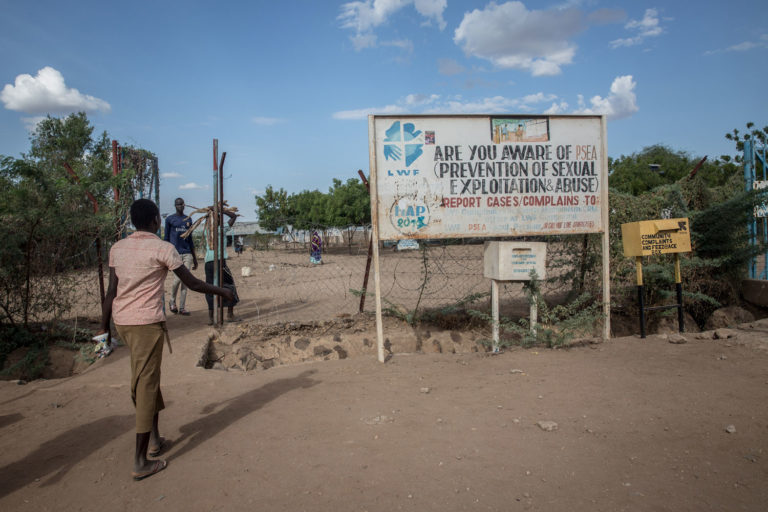
A refugee in Kakuma refugee camp, northwest Kenya, stands in front of a sign informing people that corruption and fraud are forbidden. Photo by Sally Hayden.

In Dadaab, where resettlement is known as “boufis” — or “the urge to move abroad,” resettlement is associated with wealth. “A poor man has no place in resettlement,” said one Somali refugee in his 50s who has been in the camp 16 years. “So many in the diaspora, when I ask them [how they were resettled], they say, ‘It was my money.'”

In Kakuma, northwest Kenya, home to almost 200,000 people from a dozen countries, refugees said it is possible to pay some of a resettlement bribe by signing over ownership of your shelter. “If you don’t have money, you need to hand over your house, if it’s good,” said a South Sudanese refugee, who paid $600 to forward his own case. “If your house is bad and you don’t have the money, you will never go.”

A poor man has no place in resettlement. So many in the diaspora, when I ask them [how they were resettled], they say, ‘It was my money.'

A refugee cycles past a sign pointing to the office of one of UNHCR's implementing partners in Nakivale refugee settlement, southwest Uganda. More than 100,000 refugees are registered as living there, according to the Ugandan government. Photo by Sally Hayden.

In Nakivale settlement, in southwest Uganda, refugees say corruption is everywhere. According to interviews with nearly 20 refugees, officials and authorities demand bribes for everything from medical referrals (20,000-50,000 Ugandan shillings, or $5-$13), to collecting their food rations ($1.30), to police referrals ($5-$80, depending on the incident). While UNHCR is not directly responsible for all of this, refugees accused UN staff of overlooking obvious corruption, to avoid drawing attention to their own behavior.

Refugees said resettlement, the ultimate prize, can cost between 1 million Ugandan shillings and 3.5 million ($268-$938) for a person, $5,000 for a family (or four cows, according to two refugee interviewees, who said the cows are shared between the Ugandan authorities and UNHCR).

In each location, the language of bribery is different. In Dadaab, several refugees alleged, UNHCR staff and other officials seeking bribes will say, “You ought to work hard for your case.”

“Kito kidogo,” Swahili for “something small,” — or “supporting your documents” — is requested in Kakuma. “Can you get some water for me?” one refugee said he was asked, by an official seeking money.

In Nakivale, the demand is often a more blatant, “Give me something.” In other instances, staff have instructed refugees to “speak well,” or asked for “soda,” “airtime” or a “good report” — all code for cash bribes.

“It’s a systematic thing,” said a member of the Somali Bantu minority ethnic group, sitting outside his Dadaab shelter. “You go to the (UNHCR) gate and are turned back multiple times, so you start asking why. Someone tells you who to go to. (That person will) ask: ‘Do you have anything so I can make life easy for you?’

“They hang around outside the UNHCR gates like hawkers,” he said.

Another Bantu, in his late 20s, demonstrated a particular handshake he said is needed to get through the main UNHCR gate in Dadaab. 100 or 200 Kenyan shillings ($1-2) is folded under the thumb, and then slipped to the guards, employees of multinational security firm G4S. “I had to shake hands because I was in need,” the Bantu said of a recent visit.

A woman walks through a busy street in Dadaab refugee camp, eastern Kenya. More than 200,000 refugees live there - mainly Somali. Photo by Sally Hayden.

They hang around outside the UNHCR gates like hawkers

Refugees crowd around a UNHCR field office in Dadaab refugee camp, eastern Kenya. Photo by Sally Hayden.

G4S management denied widespread corruption at Dadaab. “We do not tolerate corruption or abuse and all allegations are thoroughly investigated,” said Iain Thomson, manned security services operations director for G4S Kenya. “We work closely with UNHCR and partners to ensure refugees know how to report any incidents of corruption, including a recent radio interview which was broadcast to the whole camp.”

In each camp or group of refugees, the names of UNHCR employees who will help for a price are passed around friends and neighbors looking for an escape route, they said.

In Nakivale, Uganda, multiple refugees accused UNHCR staff members Henry Bataringaya and Peter Ssenteza of repeatedly demanding bribes and targeting the most vulnerable refugees, including sexual violence survivors. (Ssenteza has since moved from Nakivale to Tanzania, where he continues to work for UNHCR.) Kamushaka Manasee Chalangati, who was employed by UNHCR partner agencies GIZ and the American Refugee Committee, was accused by eight refugees of working as a broker for UNHCR staff and taking hefty sums from many refugees, before disappearing without fulfilling the promises he had made them.

Henry, Peter and Manasee, if you pay them, you can get anything

“Henry, Peter and Manasee, if you pay them, you can get anything,” said a Kenyan now working as a driver back in his home country, who said he moved to Nakivale in 2004, pretended to be Somali to get resettlement to the U.S., and personally paid Ssenteza. “My children were fake. I paid $1,500 in Nakivale to get refugee status and was there from 2004 to 2011. My wife wants me to go back and continue it. My case is still pending.”

A Congolese refugee, also in Nakivale, said he paid nearly $1,000 in total to Manasee, of which, he quoted Manasee as saying, $400 would go to a named UNHCR staff member. The next day, the refugee said he received a call from the named person, and was told to come to UNHCR’s office, “which means he got the money,” the refugee deduced.

Though he got the meeting, his case has again stalled, he said.

As this reporter watched and listened, the refugee phoned a number he said belongs to Manasee, put him on loudspeaker, and asked if he could have his money back. “Do you mean that all the money I paid went for nothing and was wasted just like that?” he asked.

“Don’t worry. I’ll call my guy and they’ll come back to you,” the person on the phone replied. I later contacted the same number. The man who answered confirmed he was Manasee, while other refugees who knew him independently identified the picture on his WhatsApp account as him. Manasee confirmed he had worked in Nakivale, but said he had never taken money from refugees, saying he had never even had the opportunity to. “From my side it’s 100 percent no,” he said.

Contacted through their UNHCR emails, and then by phone, both Ssenteza and Bataringaya directed me to the UNHCR’s internal investigations body, the Inspector General’s Office (IGO).

Bataringaya said he had already previously been investigated and cleared under corruption charges, while Ssenteza wouldn’t confirm whether he had been investigated. He contended that refugees make false allegations, and that UNHCR staff should have the right to sue refugees who accuse workers of wrongdoing.

“All these allegations you see are not new,” Ssenteza said. “You know what refugees do, when they see UNHCR staff that don’t bend towards maybe what they want to be done for them… they can sometimes try to break them down by making allegations.”

He said UNHCR has adequate “checks and balances,” through the IGO, which refugees are encouraged to report wrongdoing to.

“It’s not just a matter of mentioning names, because refugees can come up and mention names of all people in resettlement. So, does that mean you fire the whole unit just because their names are mentioned?”

“A refugee can defame you. Come up with your name, throw it out there and there is no repercussion for that refugee for giving false information… There needs to be accountability for refugees too. I think the staff who is defamed should be able to take up legal action against a refugee.”

Refugee women sell camel milk as a Kenyan soldier walks by in Dadaab refugee camp, eastern Kenya. Photo by Sally Hayden.

'When you ask her why she agreed, she will just cry'

For women, there are other ways to pay.

A single Somali mother in her 20s, who asked to be called Amina, said she was 13 when her mother sent her to find out whether their family was being considered for resettlement. She had already dropped out of school to work, earning a meager sum to support her siblings. At a UNHCR field office in Dadaab, she approached a staff member, whom she identified. I could not contact the man so am not naming him here, though I sent his name to UNHCR spokespeople and confirmed with other former staff members he had worked there. Amina says he beckoned her into his office and locked the door, before giving her two options: either pay $3,500 or have sex with him to “help” her case.

“I told him, ‘I don’t have the money and can’t allow you to use my body. Can you just help me as a refugee?'” she remembered. “He laughed it off and told me, ‘If you can’t do it there are many people in the queue waiting.'” Amina claims the UNHCR staff member then grabbed hold of her neck, before pushing her out of the office.

“It affected me a lot psychologically, and my mom was so heartbroken about UN services she told me to never go back.”

Amina still lives in Dadaab and is too frightened to complain outright. “Fear is a triangular thing. The (refugee) card might be cancelled, then they can use the police to arrest us for being illegal, the police will torture us,” she said, sitting under a tree far from her dwelling, where she worried people might report her for speaking to a journalist. “When we try to convince people to protest in large numbers they just say the reprisal won’t be worth it.”

“Money and sex, they’re always there for people to take advantage of, people who want favors,” said a mother who asked to be called Fatima, and also knew of incidences of this happening.

The former UN contractor who collected bribes for UNHCR staff members in Dadaab said it was an open secret that some UN staff were exploiting refugee women, and sometimes ended up impregnating or marrying them. “He will take advantage, just because he has a big office. Maybe he can do nothing, but he will pretend for her he can do the best.”

Later, “when you ask her why she agreed, she will just cry,” he said.

A woman stands in front of a UNHCR sign at Dadaab refugee camp, Kenya.

Fear is a triangular thing. The (refugee) card might be cancelled, then they can use the police to arrest us for being illegal, the police will torture us

Stolen identities

Many refugees who cannot pay bribes said their personal cases, including detailed interviews and fraught histories establishing a need for resettlement, were stolen by others who can afford to skip the queue to a new life. Some report going to UNHCR after years of interviews and other procedural checks, only to be told they had already resettled, leading them to conclude someone else had gone abroad on their identity.

“UNHCR workers will tell you you’ve already traveled. Sometimes they try to cover it up by giving you a fresh case,” one Somali woman said in Dadaab.

A girl poses inside a shop in Dadaab refugee camp, eastern Kenya. Photo by Sally Hayden.

Urban refugees in (the Kenyan capital,) Nairobi who have money will replace those in Dadaab or Kakuma

Refugees in Kenya, Uganda, Yemen, Ethiopia and Libya said being resettled on someone else’s case, after they’ve done the grunt work and initial interviews, substantially raises the cost of the payment demanded. The former UN contractor and middleman in Dadaab agreed. He said that it costs between 3 million and 7 million Kenyan shillings ($29,250-$68,270) to buy an identity right at the end of the UNHCR process, when cases move over to potential host governments for vetting. “Urban refugees in (the Kenyan capital,) Nairobi who have money will replace those in Dadaab or Kakuma,” he said.

An Eritrean refugee, who spent time in the Ethiopian capital of Addis Ababa, said a close friend did just that, making multiple trips from the city to a rural refugee camp, to interview under another person’s name, before travelling to the U.S. “I confirm (it) and I saw it, but many people are doing (it) like this.” He said his friend paid $14,000 to a broker, which was transferred to a UNHCR staff member after he departed.

UNHCR spokesperson Pouilly said biometric registration is now used in all stable operations where UNHCR operates, including Ethiopia, Kenya, and Uganda, to prevent identity fraud. “Biometric registration makes theft of identity virtually impossible and biometric screening of refugees is done at various stages of the resettlement process, including right before departure,” she said.

Refugees in Kenya and Uganda said they are aware UNHCR has been collecting more biometric data in the past year or so, but while they agreed it is a step towards tackling fraud, they said any such change leads to an increase in other methods of cheating.

A wholesaler in Kakuma refugee camp, northwest Kenya. More than 185,000 refugees from countries including Ethiopia, the Democratic Republic of the Congo, Burundi, Tanzania, and South Sudan live in the camp. Photo by Sally Hayden.

A broken system

Abdullahi was rejected for resettlement by the US government “due to credibility issues and a lack of refugee claim,” according to UNHCR, though the rest of her family, who were in a linked case, were accepted. Afterwards, the illiterate mother says Momanyi pressured her into signing a form, telling her it meant she could leave for the U.S. with her family. She said she was never given a copy and soon after she signed it, her children left without her.

A current UNHCR resettlement staff member, who reviewed the evidence and spoke on condition of anonymity, said Abdullahi’s case could have been tampered with. The document she said she was tricked into signing could have been a “resettlement consent form for non-accompanying parent,” a copy of which the UNHCR would not have been obliged to provide her.

Pietro Fossati, a resettlement officer in Dadaab refugee camp, eastern Kenya, poses outside his office. Photo by Sally Hayden

He’s been running riot for years. The system is broken. Corruption is not being dealt with.

Pietro Fossati, a UNHCR resettlement officer in Dadaab, downplayed the significance of any possible interference in Abdullahi’s case. Whether or not corruption took place, it would not have changed the outcome of Abdullahi’s application for resettlement, he said, because the U.S. government had the final say.

Fossati then said he would make sure Abdullahi is invited in by UNHCR for a counselling session, though, at the time of publication, five months after my interview with him, she says she still hasn’t been contacted.

Both Fossati and Assadullah Nasrullah, an associate external relations officer in Dadaab, denied ever hearing of Momanyi, who departed Dadaab in 2016. Another UNHCR Dadaab staffer, speaking privately, said this is impossible, given that Momanyi overlapped at least two years with Nasrullah.

No review of Momanyi’s work has taken place, they said. And while refugees and former UN contractors in Dadaab say they were made to believe the agency had fired Momanyi for corruption, he is actually still employed in a senior UNHCR role in Shire, Ethiopia, where he continues to deal directly with vulnerable refugees’ cases.

“Fraud, unfortunately, it’s a cancer affecting anybody and you can never be sure that you can eliminate (it),” said Fossati. “What we are doing, UNHCR is already doing, is putting in place measures mitigating the possibility of fraud taking place and having an effective response and measure. The fact that certain staff have been dismissed or sanctioned or so on, it’s a sign the machine is working.”

A refugee walks under a UNHCR awning in Dadaab. Photo by Sally Hayden.

I don’t sleep at night. Here it’s all corruption, there’s no rights for women and children.

Corruption and guilt

In Dadaab, outside of UNHCR’s heavy gates, Hamdi Abdullahi’s nightmare is far from over. She has begun to chew khat, a leafy stimulant, to numb the pain of losing her children. She picks up her cellphone and smiles at photos of them on WhatsApp, her bloodshot eyes briefly gleaming, before she begins to talk about how she doesn’t want to die in a refugee camp.

“I’d rather die in my country than a foreign land.”

While she’s glad her children are living in the U.S., with opportunities they could never have dreamed of in Dadaab, she longs to be with them.

“I don’t sleep at night,” she said. “Here it’s all corruption, there’s no rights for women and children.”

Meanwhile, the former broker who once collected bribes for UNHCR staff, amassing enough to buy himself a nice car, said he can no longer look at the refugees he once coerced into paying. The misery of their lives makes him feel too guilty.

Eventually, he said, he realized many of the refugees who paid were never even resettled, just had their cases moved along a few stages. They began to get angry, and he did too.

“These people they are so hungry. They fled from Somalia, they get a lot of problems, they saw their father die. Everyone wants to get resettlement,” he said. “In this world, nobody will tell you this thing is corruption. Someone will just tell you this is a deal, and a good deal.”

“I don’t even want to remember this story. I don’t want to talk about it… I’m not feeling good to talk about this, I’m feeling bad. You know [former collaborators] will advise you, they will tell you, if you report, you’ll be the one punished, because you were helping him. Even the police are corrupted,” he continued.

“My mother told me, even if it’s true, it’s not good… for me to expose everything,” the former bag man said. “If you’re someone in a glass house, don’t throw stones.”

This report was produced in a collaboration between 100ReportersNBC News, and Journalists for Transparency, an initiative hosted by the International Anti-Corruption Conference Series and Transparency International.

Continue Reading

Refugees say some U.N. workers demand bribes for resettlement

Part 2

Whistleblowers

U.N. refugee agency does not protect us or address corruption

Male refugees victimized by sexual violence say officials wanted bribes to help

Protected: Resettlement

0

This content is password-protected. To view it, please enter the password below.

Protected: Asylum for Sale: Ghost Investigations

0

This content is password-protected. To view it, please enter the password below.

Sudan:

0
[vc_row content_placement="bottom" css=".vc_custom_1516616279137{padding-top: 0px !important;padding-right: 0px !important;padding-bottom: 0px !important;padding-left: 0px !important;background-position: center !important;background-repeat: no-repeat !important;background-size: cover !important;}" el_class="articleblock"][vc_column css=".vc_custom_1516614414727{margin-top: 0px !important;margin-right: 0px !important;margin-bottom: 0px !important;margin-left: 0px !important;padding-top: 0px !important;padding-right: 0px !important;padding-bottom: 0px !important;padding-left: 0px !important;}"][vc_raw_html css=".vc_custom_1516616819732{margin-top: 0px !important;margin-right: 0px !important;margin-bottom: 0px !important;margin-left: 0px !important;padding-top: 0px !important;padding-right: 0px !important;padding-bottom: 0px !important;padding-left: 0px !important;}"]JTNDYSUyMGhyZWYlM0QlMjJodHRwcyUzQSUyRiUyRjEwMHIub3JnJTJGMjAxNyUyRjEyJTJGZWFzdC1nb2VzLXdlc3QlMkYlMjIlM0UlMEElM0NpbWclMjBzcmMlM0QlMjJodHRwcyUzQSUyRiUyRjEwMHIub3JnJTJGbWVkaWElMkYyMDE4JTJGMDElMkYxX1RBUEFDSFVMQS5qcGclMjIlMjBzdHlsZSUzRCUyMndpZHRoJTNBJTIwMTAwJTI1JTNCJTIwbWFyZ2luLWJvdHRvbSUzQSUyMC0zcHglM0IlMjIlM0UlMEElM0NkaXYlMjBjbGFzcyUzRCUyMnNpZGV0aXRsZSUyMiUzRUVhc3QlMjBHb2VzJTIwV2VzdCUzQyUyRmRpdiUzRSUwQSUzQyUyRmElM0U=[/vc_raw_html][/vc_column][/vc_row]
MORE FROM THIS SERIES

By Sally Hayden

Nurah suspected her 13-year-old son was dead when the smuggler who claimed to be holding him hostage refused to put him on the phone. That was three years ago, but that series of events still runs through her mind every day.

Her son had left home, without warning and leaving no good-bye note or clue to his destination. Nurah was already anxious because just a month before, her older son had abandoned Sudan, hell-bent on making it to Libya and then across the Mediterranean Sea to Europe. 

And then the angry man called, demanding a ransom of $2,000. “I said if my son was alive, I wanted to hear his voice, but they didn’t put him on,” she recalls, hunched over in a hot, cramped room in the Sudanese capital Khartoum, her eyes staring firmly at the tiled floor.

The case of Nurah – who requested we withhold her real name for safety reasons – is just one of many in Sudan, where young people are disappearing with startling frequency – encouraged by smugglers to leave for Europe without telling their parents, who they hope will pay the costs later.

A man approaches the fence which surrounds Shagarab camp in eastern Sudan, on July 20, 2017. Despite the fencing, security guards admitted anyone can access the camp. Residents worry Eritrean security will come after them there. (Photo by Sally Hayden)

Most want to go to Europe because it’s seen as the closest safe region, but that dream is becoming increasingly unlikely. Along with vast increases in European Union funding to Libya, Sudan and other countries aimed at stopping the flow of refugees, have come EU training for the Libyan coastguard to crack down on boats leaving from their shores, and new restrictions on nongovernmental search-and-rescue missions run off the Libyan coast.

However, that doesn’t mean desperate people will stay still. Reporting from central and eastern Sudan – a major origin, transit, and destination country – it is clear that many will continue to look for routes into a life with more security and opportunity.

In Kassala, on Sudan’s eastern border, and in Sudan’s capital, smugglers are easy to find. In Khartoum, they are the Eritreans that have cars, one refugee told me. In Kassala and in the refugee camps along the Eritrean border, smugglers come through recommendations – just ask a few people and you’ll get set up with one. 

“Smugglers are very organized, it’s organized crime,” said Ismail Omer Teirab, deputy chairman of the National Committee to Combat Human Trafficking (NCCT). He believes that the gangs are often working with the security forces. “First they bribe policemen. Otherwise, they couldn’t go through the checkpoints.”

An Eritrean teenager sits on his bed in the unaccompanied minors section of Shagarab refugee camp, eastern Sudan, on July 20, 2017. (Photo by Sally Hayden)

For those like Nurah fleeing Eritrea because of forced military service or severe oppression, a journey from Kassala to Khartoum costs $300 to $450 for boys and men, and $750 for women whose families will pay more to ensure their safety.

For those wanting to carry on, the trip to Libya costs between $1,600 and $1,800, while getting the whole way to Europe from Khartoum will come to $4,000 to $5,000, a small fortune even for working refugees, who earn as little as $50 a month.

When a ransom is added, the price may climb much higher. If the deal goes wrong, some even end up paying with their life.

Many of the migrants who brave the voyage end up falling into the hands of militias who are operating a vicious slave trade inside Libya – a country with multiple governments and many tribes.

Refugees and migrants who unsuccessfully attempted the journey to Libya say that smugglers will often sell them on once they draw near the Libyan border. At that point, they no longer know who is in charge of them, and the terms of their “contract” can change. While some are held in detention, suffering malnutrition and often physical or sexual abuse, others are forced to work until their smugglers decide their debt has been paid off.

“Traffickers don’t keep their agreements. They’ll increase or double it and sell them to other traffickers,” said a 27-year-old Eritrean. His friends had set out on the journey, but cannot reach them to find out what happened to them. For him, Europe “is only a hope, a wish.”

The Khatmiyah mosque at the base of the Taka mountains in Kassala, Sudan, on July 19, 2017. The town is close to the Sudanese-Eritrean border which sees many refugees pass through. (Photo by Sally Hayden)

”Go now, ask for money later.”

The Central Mediterranean is currently the deadliest route to Europe. Some 600,000 people have crossed since 2014, while around 12,000 are feared to have died at sea. More than 2,700 are believed to have died so far in 2017.

Migrants and refugees who come through Sudan often originate in Eritrea, where they’re fleeing forced indefinite military service. In Sudan, their movements are limited. They claim they face harassment by the police, and those who manage to get permission to work are often paid very little, and much less than a local would get.

Often those who try to get to Europe are young, the second generation of refugees who came to Sudan, many Eritrean and Ethiopian migrants told me. They see their parents being paid low wages, and suffering discrimination, police brutality and corruption, and decide they don’t want the same life.

Meanwhile, smugglers search out young people and convince them to make the journey without telling their parents.

“Go now, ask for money later,” the smugglers tell them. “That way, no one can stop you.”

“I hid it from my family. I won't tell my parents until I get to Libya,” explained one 24-year-old woman with delicate features in Khartoum. She said her parents had properties in Eritrea they could sell, a sacrifice that would leave them with nothing. If she is caught, though, she knows they will have to pay. “I will be exposed to slavery and sexual violence if they don’t pay.”

A young girl stands in a dormitory in the unaccompanied minors section of Shagarab refugee camp, eastern Sudan, on July 20, 2017. (Photo by Sally Hayden)

Another 24-year-old, a nurse from Eritrea who wants to be a doctor, said she was aware of the dangers. “I know, but there is no more miserable life than this that I am now living,” she said. “I want a chance… a better life.”

Two weeks ago, her 18-year-old sister tried to follow her to Khartoum, but was kidnapped on the Eritrean border. They have been told the ransom is $5,000, an impossible amount, but they worry that if they don’t pay up, the girl will be moved up to the Sinai desert in Egypt. Among Eritreans, there are rumours that there is a trade in organ harvesting in that area, although the UN Special Rapporteur for Eritrea said she has not found enough evidence to prove those claims.

“There are many who tried to go to Libya and they are dead,” said Azgiamin Tesialassi, an Eritrean woman with braided hair, speaking in a dark, stone-walled room in a cheap neighbourhood popular with refugees. “Some are lost in the desert and some at sea. For those who are dead, no one can help.”

As we speak, she keeps repeating the words delalti haisebat – which means human smugglers in her language, Tigrinya. “Our children are being kidnapped by smugglers here.”

Boys sit in their dormitory in the unaccompanied minors section of Shagarab refugee camp in eastern Sudan, on July 20, 2017. (Photo by Sally Hayden)

Stopping the flow?

“If trafficking is business now, how can we make it non-profitable? I haven’t an answer,” Ismail Omer Teirab, NCCT deputy chairman said in an interview in Khartoum’s oldest hotel, the Acropole.

At least 100 people get through the Libyan border a month, Teirab estimates, though the exact statistics are impossible to know, because the area is so vast and impossible to fully monitor.

The NCCT was formed after Sudan brought in the much-lauded 2014 Human Trafficking Act. Teirab, a former teacher from Darfur, said he wants to run campaigns to educate refugees and Sudanese youth about the dangers of trusting their lives to people smugglers. However, he says he has received minimal funding, and hasn’t even been given enough for an office, other staff members, or a photocopier. 

“Every day, young people see videos of Europe on their phones now, how can we combat that?” he asks.

Jeff Crisp, a research fellow at the public affairs think tank Chatham House and the former Head of Policy at UNHCR, said if the Mediterranean becomes impassible, smugglers may begin encouraging people to go in a different direction.

“It’s something a lot of people say: if one route closes, it diverts into another,” Crisp said. “[But] it takes a while between one route closing off and then people taking up a different route.”

During our investigation, we discovered evidence that some migrants from northern and east Africa are finding their way to South America, by routes much more circuitous and arduous. One Somali ended up in Mexico, after flying from Zambia to Brazil with a work visa. Another Somali travelled to Brazil from South Africa. In Colombia, Brazil and Mexico our reporters heard stories of Eritreans who had also passed through on their way to the United States.

Crisp said the current EU reaction towards Libya was motivated by political factors as well as increased visibility of the magnitude of the crossings.

“Panic is the word I would use for the EU response to the whole refugee and migration issue over the last three years,” he said. “It’s really not got its act together and its lurched from one thing to another.”

“I think everyone thinks that there’s an importance in appearing and talking tough,” he added.

Crisp said while it was obvious the EU was hoping people would no longer go on boats if there were no rescues off the coast, “that really depends on how much information they have and what the smugglers and traffickers tell them.”

Tekulu, an Eritrean 24-year-old in Khartoum hoping to make the journey north soon, said smugglers don’t tell refugees the truth about the risks involved with these journeys, or give them adequate information about what the situation on the other side might be. “With the traffickers – no one tells you exactly how people live as refugees and how they arrive. They just tell you things are good.”

Tekulu isn’t willing to shatter those illusions for anyone who might come after him. “Even if I tell them not to come, how can they stay here? It is good for me to keep quiet.”

Eritrean girls chat on a bed in a dormitory in the unaccompanied minors section of Shagarab refugee camp, eastern Sudan, on July 20, 2017. (Photo by Sally Hayden)

A migrant’s tale

It took two months for Helen to regain her memory after the first time she tried to get to Libya, so harrowing was what she witnessed.
The 22-year-old Eritrean had set off in a group of 87 migrants, all eager to move on from the discrimination and exploitation they experienced in Sudan. Now almost a third of them were dead. “All of us lost our minds,” she said. “We couldn’t remember where we had been.”

In a cramped, dark room in the Sudanese capital Khartoum, she sits slumped, her delicate features crumpling as she recounts a merciless odyssey from her home country to the desert in the north. As soon as she finished school, Helen, whose name has been changed for safety reasons, was forcibly recruited to work in Eritrea’s navy, a sentence with no end in sight.

So in 2015, she escaped, making it across the border and into Sudan.

It didn’t take long for her to meet a smuggler – the sort of man who watches closely for new arrivals in Khartoum. She was told a payment of $1,600 would get her to Libya, where she could pay the same again for a boat to Italy.

No one had to provide the money upfront, Helen explained. Once she arrived in Libya the smugglers would contact her parents in Eritrea and make them cough up the funds, a standard practice among migrants travelling from the Horn of Africa and a way smugglers encourage poverty-stricken young people to keep moving. Although she was ashamed to ask, Helen knew her parents had properties they could sell if she needed it.

The first hurdle came right outside Khartoum, where local security forces operate regular checkpoints. Helen says her convoy was stopped by military men – who she believes were Sudanese special forces – dressed in green khaki. She quickly learned they were also “thieves.”

The soldiers went through the group, confiscating their IDs before questioning them in turn. “The men investigated harshly. We were beaten. If you refused you would be beaten more,” says Helen, who showed us scars she still has from the interrogation.

Eventually, they withdrew and the migrants were alone again, just without papers, money and luggage. For Helen, losing her bags also meant the small amount of food she had with her was gone.

Yet they continued, travelling for another four days before reaching a series of high mountains. There was only one road that could lead them through, and again, they came across a check point and were threatened.

“We couldn’t identify them but they came to kidnap us,” she said of the soldiers, who she believes were either Sudanese or Chadian. Three of their vehicles were set alight during the fight and a number of drivers were arrested.

The smuggler she had travelled with managed to get away. The migrants were mostly injured and bloodied, speeding away from the clashes in their remaining vehicle. As they fled, one fell off the back of the truck onto the ground. No one stopped to help. “We don’t know what happened to him,” Helen said, although later she speculated that maybe that fall saved his life.

They drove for a long time before the vehicle broke down.

“We were in a very deserted area and had no way and means to go [anywhere]. We didn’t know which direction to go in. We spent about three days there without water and food. Most people struggled between life and death.”

Helen watched 26 of her companions die before a car stopped beside them and saved her life.

Now she’s back in Khartoum, but without an ID card or refugee status she feels vulnerable to abuse and exploitation.

At the moment, she’s receiving a monthly stipend from the UNHCR of 800 Sudanese Pound ($42), just over half of the cost of her monthly rent.

But despite the horrors of her first journey, Helen says she is ready to leave again. Eventually, she hopes to reach the UK. The first person to tell her parents she’s moved on will likely be a smuggler, phoning from Libya to demand payment.

Eritreans play pool in one of the makeshift pool halls in Shagarab camp in eastern Sudan, on July 20, 2017. (Photo by Sally Hayden)

The man trying to stem the flow, without a car, a photocopier or any staff

Ismail Omer Teirab has worked as the deputy chairman of Sudan’s National Committee to Combat Trafficking for the past two years, under a busy minister who acts as the figurehead.

In discussions about stemming migration from north Africa and the often-criticised EU-funding being funnelled towards countries in the region, his organisation has received a lot of attention. Founded after the Human Trafficking Act of 2014, it is mentioned again and again in discussions around the Khartoum Process, a dialogue between countries along the migration trails from north Africa to Europe. Under this initiative, the EU has given more than 200 million Euros to Sudan with the specific aim of stopping migration.

Better Migration Management (BMM), an EU-commissioned and funded programme backing the Khartoum Process, singled out Sudan’s NCCT as an example of a government-associated authority that the EU could work with. Its “Sudan concept” paper identifies the NCCT as a “window of opportunity” for the EU, and said it aims to empower it.

The organisation has also received vocal backing from the International Organization for Migration (IOM), who in their 2016 appeal asked for $1.3 million, in part to encourage the establishment of the National Coordination Mechanism on Migration which would support the NCCT on developing a National Action Plan.

But our interview with the man in charge of steering the Sudanese committee showed the body is underfunded to the point of being ineffective. In July, we met in my hotel, near the Blue Nile river and the city’s airport, because Teirab has no office. He says he needs five staff members, but that for the moment he’s on his own. He has no car and gratefully accepted an offer of 120 Sudanese Pounds, or $6.31, for the taxi home.

Teirab, a civil servant originally from Darfur who earns a teacher’s salary, speaks passionately about the problems smuggling is causing in Sudanese society. Despite his organisation’s title he thinks it’s important to highlight that according to his research there is no “trafficking” in Sudan – where migrants are exploited or forced into various forms of slavery to pay off the cost of the travel – only “smuggling”, the act of taking money to transport someone from one location to another.

But regarding the latter, he says it’s almost impossible to stop young people in Sudan from dreaming of Europe. They see pictures everyday on their phones, he says, holding up his rather battered looking Chinese-made device.

He believes the best way to combat smuggling would be through campaigns run online, on TVs and in schools, telling young people that “anything you see in phones and TV is false.”

He’d also like photocopiers and a four-wheel drive car so he can go to rural parts of eastern Sudan to meet with Eritrean refugees who have crossed the border, fleeing mandatory military service or oppression.

He complains that aid money on this issue is being disproportionately funneled towards the security forces: “The EU support the policemen and border force but not the NCCT,” he complains, saying that Brussels has already run six police training courses while he still tried to hobble together his action plan single-handedly. The EU did not respond to multiple requests for comment.

The risks for migrants and refugees travelling to Libya and across the Mediterranean to Europe have been well documented. Those who reach Libya can be sold into slavery, or held for ransom in detention facilities. If their families can’t pay it, some migrants are killed.

Children walk to school in Shagarab camp in eastern Sudan, on July 20, 2017. (Photo by Sally Hayden)

For those who can afford to pay their way on towards Europe, the risks are still high. At least 2,776 people have died crossing the Mediterranean from Libya this year, according to the IOM, making it the deadliest migration route in the world. Some of those who travel from Sudan die before they even cross the Libyan border. While in Khartoum, several refugees who made failed attempts to get to Libya told how they witnessed fellow passengers die en route.

In Sudan, discriminatory treatment of refugees also acts as a push factor, Teirab said. In Khartoum, Eritrean female refugees are sometimes sexually abused while working as maids in houses. In eastern Sudan, migrants are captured by tribes and held for ransom or sometimes brought to Egypt, where there are rumours that their organs are trafficked.

Like many Sudanese involved in refugee and migration-issues, Teirab was heavily critical of Europe, saying Sudan could support refugees internally but needs more help. “Sudan is like a pot. Let us keep them here inside Sudan. Sudan can receive more if necessary.” But first, he says, they need some resources.

[vc_row content_placement="bottom" css=".vc_custom_1516616279137{padding-top: 0px !important;padding-right: 0px !important;padding-bottom: 0px !important;padding-left: 0px !important;background-position: center !important;background-repeat: no-repeat !important;background-size: cover !important;}" el_class="articleblock"][vc_column css=".vc_custom_1516614414727{margin-top: 0px !important;margin-right: 0px !important;margin-bottom: 0px !important;margin-left: 0px !important;padding-top: 0px !important;padding-right: 0px !important;padding-bottom: 0px !important;padding-left: 0px !important;}"][vc_raw_html css=".vc_custom_1516616819732{margin-top: 0px !important;margin-right: 0px !important;margin-bottom: 0px !important;margin-left: 0px !important;padding-top: 0px !important;padding-right: 0px !important;padding-bottom: 0px !important;padding-left: 0px !important;}"]JTNDYSUyMGhyZWYlM0QlMjJodHRwcyUzQSUyRiUyRjEwMHIub3JnJTJGMjAxNyUyRjEyJTJGZWFzdC1nb2VzLXdlc3QlMkYlMjIlM0UlMEElM0NpbWclMjBzcmMlM0QlMjJodHRwcyUzQSUyRiUyRjEwMHIub3JnJTJGbWVkaWElMkYyMDE4JTJGMDElMkYxX1RBUEFDSFVMQS5qcGclMjIlMjBzdHlsZSUzRCUyMndpZHRoJTNBJTIwMTAwJTI1JTNCJTIwbWFyZ2luLWJvdHRvbSUzQSUyMC0zcHglM0IlMjIlM0UlMEElM0NkaXYlMjBjbGFzcyUzRCUyMnNpZGV0aXRsZSUyMiUzRUVhc3QlMjBHb2VzJTIwV2VzdCUzQyUyRmRpdiUzRSUwQSUzQyUyRmElM0U=[/vc_raw_html][/vc_column][/vc_row]
MORE FROM THIS SERIES

About This Series

East Goes West was produced in a collaboration between 100Reporters, a Washington, a nonprofit investigative reporting organization that focuses on corruption and civic accountability, and Journalists for Transparency, a project of Transparency International.